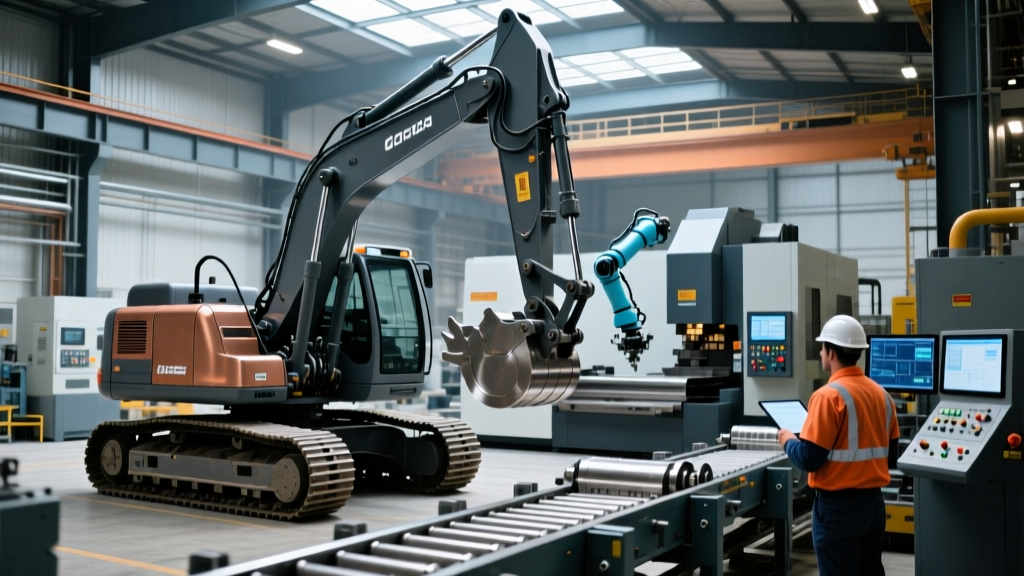
Heavy Equipment Telematics News: 2026 OSHA Compliance Standards
Review the latest heavy equipment telematics news regarding 2026 OSHA compliance, ISO 13849-1 safety standards, and mixed-fleet retrofit strategies.
The 2026 Regulatory Shift: From Telemetry to Active Intervention
For safety directors tracking heavy equipment telematics news, the transition from passive location tracking to active safety intervention is the defining regulatory trend of 2026. Historically, telematics in construction and mining were utilized primarily for asset utilization, fuel burn analysis, and preventive maintenance scheduling. Today, regulatory bodies view telematics as a primary engineering control for hazard mitigation.
The Occupational Safety and Health Administration (OSHA) has officially aligned its enforcement guidelines with modern construction safety management systems, mandating that heavy machinery operating in high-traffic zones possess verifiable, time-stamped digital logs of proximity alerts. This means that if a 30-ton excavator strikes a pedestrian or another vehicle, the absence of a telematics-generated proximity alert log will automatically trigger a 'willful violation' classification, bypassing standard negligence defenses.
ISO 13849-1 and the Performance Level (PL) Mandate
The integration of telematics into safety circuits is now governed by ISO 13849-1:2023 Safety of Machinery. Under the 2026 revisions, telematics units that interface directly with machine braking or hydraulic lockout systems must achieve a minimum Performance Level (PL) of 'd'. This requires dual-channel sensor inputs and diagnostic coverage of at least 90%. Fleet managers can no longer rely on standalone GPS trackers to trigger emergency stops; the telematics gateway must be hardwired into the machine's primary safety relay with redundant CAN bus monitoring.
Telematics Hardware Compliance Matrix
Selecting the right hardware is critical for meeting the new ISO and OSHA benchmarks. Below is a compliance matrix comparing leading OEM and aftermarket telematics units against 2026 safety standards.
| Telematics System | ISO 13849-1 PL Rating | Proximity Sensor Integration | Avg. Hardware Cost | OSHA Data Retention |
|---|---|---|---|---|
| Caterpillar Cat Connect (Vision) | PL d (Native) | Native Radar + Camera Fusion | $0 (Bundled on 2024+ models) | 7 Years (Cloud) |
| John Deere JDLink | PL c (Software) | Third-party via J1939 CAN | $350 / year subscription | 5 Years (Cloud) |
| Trimble Earthworks 3D | PL e (Hardware) | Native LiDAR + Ultrasonic | $4,800 per unit | 10 Years (Local/Cloud) |
| Geotab GO9 (Heavy Duty) | N/A (Aftermarket) | External Bluetooth Ultrasonic | $195 + $35 / month | 3 Years (Cloud) |
Note: Aftermarket units like the Geotab GO9 are excellent for utilization tracking but require secondary safety relays to achieve ISO 13849-1 compliance for active machine braking.
OSHA's 'Digital Guardian' Protocol and Audit Triggers
The most critical development in recent heavy equipment telematics news is OSHA's deployment of the 'Digital Guardian' audit protocol. Inspectors are now equipped with standardized data-request templates that require fleet managers to export specific telematics parameters within 48 hours of a reported incident.
- Parameter 1: Machine ground speed and engine RPM at the exact timestamp of the incident.
- Parameter 2: Proximity sensor trigger logs (specifically looking for suppressed or ignored cab warnings).
- Parameter 3: Operator login credentials (RFID or biometric) to verify authorized operation.
- Parameter 4: Hydraulic pressure telemetry to determine if the implement was under load during a collision.
According to NIOSH Highway Work Zone Safety research, over 60% of backing-up fatalities in construction occur because operators ignore or disable audible cab alarms. The 2026 OSHA mandate strictly prohibits software configurations that allow operators to mute proximity warnings. Telematics systems must now log 'mute' button presses, and three consecutive mutes within a shift must automatically trigger a remote engine derate.
WARNING: Data Privacy vs. Safety LoggingWhen configuring telematics to log operator behavior, fleet managers must navigate complex labor union agreements regarding biometric and behavioral tracking. Ensure your telematics privacy policy explicitly separates 'machine safety telemetry' (which is legally required) from 'operator performance scoring' (which may violate collective bargaining agreements). Always mask operator names in raw data exports provided to third-party insurers.
Step-by-Step Fleet Retrofit Strategy for Q3 2026
For mixed fleets containing legacy iron (manufactured pre-2020), achieving compliance requires a systematic retrofit approach. Attempting to wire modern LiDAR into obsolete J1587 CAN bus architectures will result in voltage drops and ghost faults.
- Audit the CAN Bus Architecture: Identify whether your legacy equipment uses SAE J1939 (standard on most 2008+ diesel engines) or the older J1587/J1708 protocols. J1587 machines require a hardware protocol converter (e.g., Noregon JPRO adapter) before a modern telematics gateway can read engine RPM or hydraulic pressure.
- Install Isolated Safety Relays: Do not wire aftermarket proximity sensors directly into the OEM ECU. Install an isolated safety relay module (such as the Brigade Electronics VBV-770) that intercepts the ignition or hydraulic pilot circuit. This ensures the telematics system can kill the machine without corrupting the OEM warranty or ECU logic.
- Deploy Dual-Input Proximity Sensors: To meet ISO 13849-1 PL 'd', install both ultrasonic sensors (for close-range, 0-15 feet) and 77GHz radar (for mid-range, 15-50 feet). Feed both signals into the telematics gateway.
- Configure Automated OSHA 300 Mapping: Program your telematics dashboard (e.g., Samsara or Geotab) to automatically flag 'near-miss' proximity triggers and format them into a digital equivalent of the OSHA 300 injury and illness log. This pre-packages the data for immediate handover during an audit.
Cost-Benefit Breakdown: OEM vs. Aftermarket Telematics
Retrofitting a 50-unit mixed fleet represents a significant capital expenditure. Here is the financial reality of OEM upgrades versus aftermarket integrations:
OEM Dealer Activations (e.g., Cat Connect, Komatsu KOMTRAX):
Dealers typically charge $1,200 to $2,500 per machine to 'unlock' and activate advanced safety telemetry on older, pre-subscribed models. While expensive, this provides seamless integration with the machine's native braking systems, guaranteeing ISO compliance without custom wiring.
Aftermarket Integration (e.g., Samsara, Geotab + Brigade Sensors):
Hardware costs average $450 per machine (gateway + ultrasonic sensors), plus installation labor ($600 per machine). Total capital outlay is roughly $1,050 per unit. However, integrating these systems to actively brake the machine requires custom fabrication of hydraulic solenoid interceptors, adding $800 per unit in specialized labor. Aftermarket is highly cost-effective for passive logging and GPS tracking, but OEM is vastly superior for active safety intervention.
Frequently Asked Questions (FAQ)
Can a dashcam with AI object detection replace proximity radar for OSHA compliance?
No. While AI dashcams (like those from Lytx or Motive) are excellent for post-incident liability and operator coaching, OSHA's 2026 guidelines require deterministic sensors (radar, ultrasonic, or LiDAR) for active machine intervention. Camera-based systems are susceptible to blinding from sun glare, heavy dust, and fog, making them unsuitable as the primary safety input for hydraulic lockouts.
What is the penalty for telematics data gaps during an OSHA audit?
If a machine is involved in a struck-by incident and the telematics log shows a 'gap' in data transmission during the exact minute of the event, OSHA will classify this as spoliation of evidence or willful negligence. This elevates the violation from a 'Serious' citation (approx. $16,500) to a 'Willful' citation, which carries a maximum penalty of $161,323 per violation in 2026.
Do skid steers and compact track loaders require the same telematics compliance as 30-ton excavators?
OSHA's Subpart O applies to all motorized construction equipment. However, the ISO 13849-1 Performance Level requirement scales with the kinetic energy and mass of the machine. Compact equipment under 10,000 lbs operating in fenced, pedestrian-free zones may only require PL 'c' (basic telematics logging and audible alarms), whereas 30-ton excavators operating near public right-of-ways strictly require PL 'd' or 'e' with active braking capabilities.