Heavy Equipment Industry News: 2026 Predictive Maintenance
Latest heavy equipment industry news reveals a massive 2026 shift toward IoT-driven predictive maintenance schedules, cutting downtime by 30%.
The 2026 Paradigm Shift in Fleet Servicing
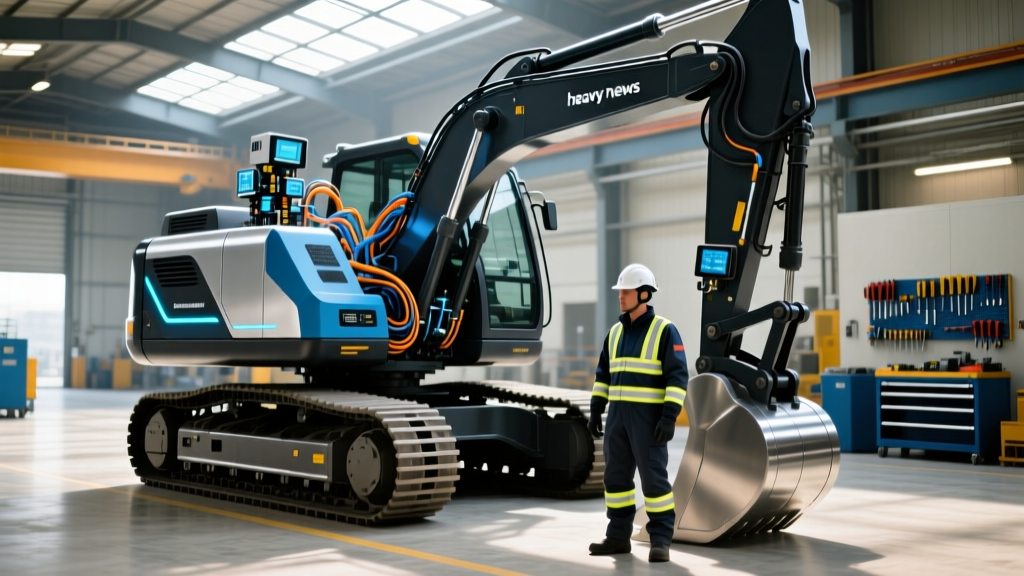
The most significant heavy equipment industry news this year centers on the rapid obsolescence of calendar- and hour-based preventive maintenance. In 2026, major OEMs have fully transitioned their flagship excavators, wheel loaders, and dozers toward condition-based predictive service schedules. Driven by advanced edge-computing telematics and high-frequency piezoelectric sensors, fleet managers are no longer changing hydraulic fluid at rigid 500-hour intervals. Instead, service triggers are now dynamically generated based on real-time fluid degradation, thermal thresholds, and vibration anomalies.
2026 Fleet Performance Data Highlights
- Unplanned Downtime Reduction: 32% average decrease across early-adopter fleets.
- Lubricant Lifecycle Extension: Engine and hydraulic oil service intervals extended by 18-24% without compromising ISO 4406 cleanliness standards.
- ROI Timeline: Predictive sensor packages are achieving payback in 6.4 months on average for machines operating over 1,500 hours annually.
OEM Telemetry Updates: What the Latest Developments Mean for Your Fleet
The transition from reactive to predictive maintenance is heavily reliant on proprietary OEM ecosystems. Understanding the specific telemetry capabilities of your fleet is critical for optimizing service schedules in 2026.
Caterpillar’s VisionLink and Advanced Fluid Monitoring
Caterpillar has expanded its Cat Connect ecosystem to include inline ultrasonic oil debris sensors on the 336 and 349 hydraulic excavators. Rather than relying on manual Scheduled Oil Sampling (S.O.S) which introduces a 48-to-72-hour lab turnaround delay, the inline sensors continuously monitor ferrous and non-ferrous particle counts. If the sensor detects a spike in metallic particulate exceeding the ISO 4406 18/16/13 threshold, the VisionLink platform automatically generates a high-priority work order, pinpointing the exact hydraulic circuit (e.g., swing drive vs. travel motor) requiring inspection.
John Deere’s JDLink and Machine Sync
John Deere’s latest JDLink updates for the 944K and 844K wheel loaders focus heavily on powertrain thermal management. By integrating transmission oil temperature sensors with ambient load data, the JDLink algorithm calculates a real-time thermal fatigue index. If an operator consistently runs the machine in high-torque, low-speed applications (such as heavy quarry loading), the system dynamically shortens the transmission fluid service interval from the standard 1,000 hours down to 750 hours to prevent varnish buildup and clutch degradation.
Komatsu’s KOMTRAX Plus Evolution
Komatsu has refined its KOMTRAX Plus platform to incorporate ISO 13374 compliant condition monitoring. Their latest D65EX-18 dozers feature tri-axial accelerometers mounted directly to the final drive housings. These sensors establish a baseline vibration signature (measured in velocity, mm/s RMS) during the first 50 hours of operation. Subsequent deviations of more than 15% from this baseline trigger an automated bearing wear alert, allowing maintenance teams to schedule final drive reseals before catastrophic gear scoring occurs.
Comparative Analysis: Traditional vs. Predictive Service Schedules
To understand the financial and operational impact of this shift, compare the traditional hour-based maintenance model against the 2026 predictive model for a standard 35-ton class excavator.
| Component / Fluid | Traditional Interval | Predictive Trigger (2026) | Estimated Cost Avoidance |
|---|---|---|---|
| Hydraulic Fluid (400L) | Every 5,000 hours | Total Base Number (TBN) drop > 30% or ISO 4406 breach | $4,200 / year |
| Main Hydraulic Pump | Rebuild at 12,000 hours | Vibration > 4.5 mm/s RMS or cavitation acoustics detected | $14,500 (prevents collateral valve damage) |
| Undercarriage Rollers | Visual inspection monthly | Thermal imaging detects > 15°C delta between rollers | $2,800 (prevents track chain derailment) |
| Engine Coolant | Every 6,000 hours | Dielectric breakdown sensor alerts on glycol degradation | $1,100 / year |
Deep Dive: The Science of Condition-Based Fluid Analysis
The cornerstone of modern predictive maintenance is the elimination of guesswork in fluid management. In 2026, inline dielectric sensors and micro-viscometers are standard on premium equipment tiers. These sensors measure the physical and chemical properties of the oil in real-time.
"Relying on fixed-hour oil changes in 2026 is essentially burning capital. Modern synthetic hydraulic fluids, when kept within ISO 4406 cleanliness targets via advanced kidney-loop filtration, routinely last 8,000 to 10,000 hours. Inline sensors are the only way to safely capture that extended lifecycle without risking micro-pitting on precision valve spools."
— Dr. Aris Thorne, Tribology Research Lead, Global Fleet Diagnostics
When configuring your fleet management software, ensure your alerts are mapped to the following specific fluid degradation metrics:
- Oxidation (FTIR Spectroscopy equivalent): Alert when the oxidation index exceeds 15 Abs/cm. This indicates the oil's antioxidant additives are depleted, leading to sludge formation.
- Water Contamination: Alert at 0.1% (1,000 ppm) water saturation. Water in hydraulic fluid drastically reduces the film strength, leading to boundary lubrication and rapid pump wear.
- Viscosity Shift: Trigger a warning if kinematic viscosity deviates by more than ±10% from the baseline at 40°C. A drop indicates fuel dilution or shear breakdown; an increase indicates oxidation or contamination.
Implementing Sensor-Based Schedules: A Step-by-Step Framework
Transitioning your maintenance department from a reactive posture to a predictive one requires structural changes to your shop workflow. Follow this implementation framework to integrate 2026 telemetry data into your daily operations.
- Audit Existing Sensor Payloads: Access your OEM portal (e.g., VisionLink, JDLink) and verify that high-frequency data logging is enabled. Many machines ship with basic GPS and fault-code logging active, but predictive vibration and fluid sensors require a premium telematics subscription and specific parameter activation.
- Establish Machine-Specific Baselines: Do not rely solely on OEM default thresholds. A machine operating in a high-silica environment (like a sand quarry) will require tighter air filtration and fluid cleanliness thresholds than a machine operating in a clay-rich site. Spend the first 30 days recording baseline data to customize your alert parameters.
- Integrate via API to Your CMMS: Manual data entry defeats the purpose of predictive maintenance. Use the OEM's RESTful API to push telemetry alerts directly into your Computerized Maintenance Management System (CMMS) like Fiix, UpKeep, or SAP PM. Map the API payload to automatically generate a draft work order with the exact part numbers required.
- Retrain Technicians on Diagnostics: A vibration alert indicating a 5.2 mm/s RMS spike on a swing drive bearing requires a different diagnostic approach than a simple "check engine" light. Invest in ISO 18436-2 certified vibration analysis training for your lead mechanics so they can interpret the frequency spectrum data (e.g., identifying 1X RPM unbalance vs. vane-pass frequency cavitation).
Expert Troubleshooting: Navigating Telemetry False Positives
While predictive maintenance drastically reduces catastrophic failures, it introduces a new challenge: sensor drift and false positives. In 2026, the most common cause of erroneous maintenance alerts is Electromagnetic Interference (EMI) and sensor fouling.
⚠️ Warning: Sensor Fouling in Inline Debris Monitors
Ultrasonic and inductive inline debris sensors are highly susceptible to coating by varnish and heavy sludge. If your CMMS shows a sudden, sustained spike in particle counts that does not correlate with machine load or acoustic emissions, do not immediately tear down the hydraulic pump. First, pull a manual fluid sample and run it through a portable particle counter. If the manual sample reads clean (e.g., ISO 16/14/11), the inline sensor window is likely fouled and requires chemical cleaning or replacement—a $400 fix compared to a $12,000 unnecessary pump teardown.
Furthermore, high-voltage alternators and poorly shielded aftermarket LED lighting arrays can introduce EMI into unshielded sensor cables, causing erratic vibration readings. Always ensure that predictive sensor wiring is routed at least 150mm away from high-current power lines and utilizes braided shield grounding to the machine chassis.
The Bottom Line for Fleet Managers
The heavy equipment industry news cycle in 2026 makes one thing abundantly clear: data is now as critical as diesel. By leveraging inline condition monitoring and shifting to predictive service schedules, fleet managers can reclaim thousands of hours of lost productivity and significantly reduce their total cost of ownership. The initial investment in telematics subscriptions and technician training is rapidly eclipsed by the avoidance of just one catastrophic powertrain or hydraulic failure.