How a Heavy Equipment Shipping Calculator Computes Freight Rates
Discover how a heavy equipment shipping calculator computes freight rates using bridge formulas, permit matrices, and trailer specs for accurate 2026 pricing.
The Core Algorithm: Dimensional Weight vs. Gross Vehicle Weight
Standard less-than-truckload (LTL) freight calculators rely heavily on dimensional weight (DIM weight) to price shipments. However, when moving a 90,000 lb Caterpillar 390F excavator or a 150,000 lb Liebherr LTM 1300 crane, dimensional weight becomes irrelevant. A specialized heavy equipment shipping calculator operates on an entirely different algorithmic foundation: Gross Vehicle Weight (GVW), axle load distribution, and the Federal Bridge Formula.
The algorithm's first step is determining whether the equipment's weight and axle spacing comply with federal and state highway limits. According to the Federal Highway Administration (FHWA), the Bridge Formula calculates the maximum allowable weight on any group of axles to prevent structural damage to bridges. The formula is expressed as:
W = 500 [ (LN / N-1) + 12N + 36 ]
Where W is the overall gross weight, L is the distance in feet between the extreme axles, and N is the number of axles. When you input your equipment's weight into a shipping calculator, the software cross-references this formula against available trailer configurations. If a standard 3-axle lowboy trailer violates the bridge formula for your specific load, the algorithm automatically upgrades the equipment requirement to a multi-axle hydraulic modular trailer (such as a 13-axle Goldhofer configuration), which exponentially increases the base rate.
Trailer Selection Logic: Matching Specs to the Load
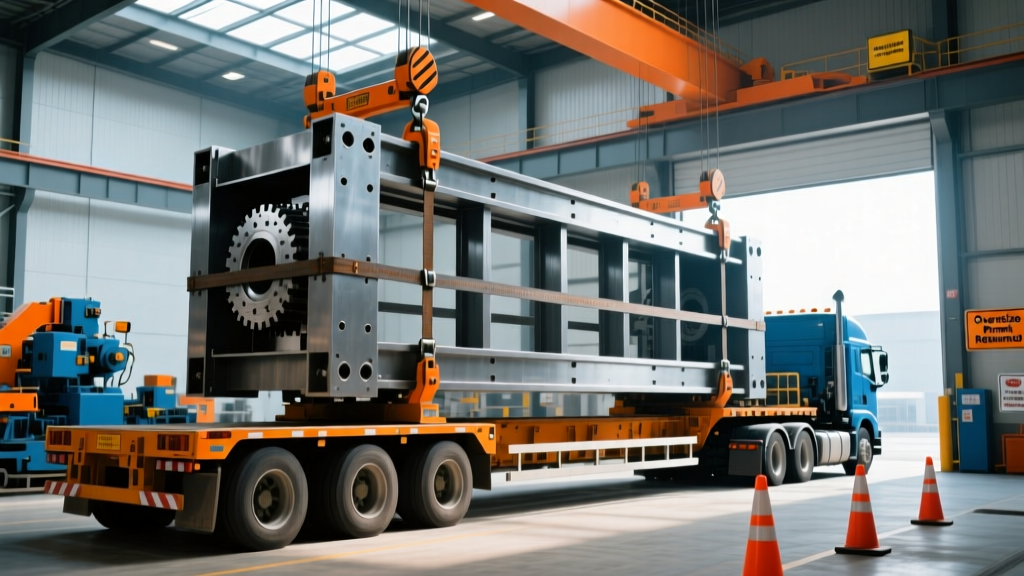
Once the weight and bridge formula constraints are satisfied, the calculator's decision tree selects the most cost-effective trailer type. This is not a random assignment; it is a strict matrix based on deck height, well length, and weight capacity. The algorithm evaluates the equipment's exact dimensions—specifically height and length—to prevent the load from exceeding the legal 13'6" height limit without requiring expensive oversize permits.
| Trailer Type | Max Payload (Standard) | Main Deck Height | Well Length | Optimal Equipment Type |
|---|---|---|---|---|
| Step Deck (Drop Deck) | 48,000 lbs | 38" (Lower) / 60" (Upper) | 43' (Lower) | Wheel loaders, motor graders, standard tractors |
| Standard Lowboy | 80,000 lbs | 24" | 24' - 29' | Mid-size excavators, dozers, compactors |
| RGN (Removable Gooseneck) | 42,000 - 150,000 lbs | 24" | 24' - 29' | Tracked excavators, pavers, heavy crushers |
| Schnabel Trailer | Up to 300,000+ lbs | Custom / Variable | Custom | Wind turbine blades, power transformers, superloads |
If the calculator detects that your equipment's ground clearance is less than 6 inches, it will automatically filter out standard flatbeds and step decks, forcing the selection of an RGN or lowboy to prevent the equipment's undercarriage from high-centering on the trailer's incline ramps.
The Routing Matrix: Permit and Escort Multipliers
The most complex variable in a heavy equipment shipping calculator is the routing matrix. Heavy haul algorithms integrate with state Department of Transportation (DOT) databases and specialized routing software like PC*Miler or ProMiles to map legally permissible roads. When the equipment's dimensions exceed the legal thresholds (Width > 8'6", Height > 13'6", Length > 53', or Weight > 80,000 lbs), the calculator triggers the oversize/overweight (OS/OW) permit module.
Algorithmic Permit Stacking Warning: Calculators do not just add a flat 'permit fee.' They calculate the exact number of state lines crossed and multiply it by specific jurisdictional fees. Furthermore, if the route requires travel through restricted urban corridors, the algorithm adds 'curfew hours' to the transit time, which increases driver per diem and layover costs.Once permits are calculated, the algorithm determines escort requirements based on the FHWA size and weight guidelines and state-specific mandates. For example, a 14-foot wide load might require one pilot car in Texas, but two pilot cars and a state trooper escort in neighboring states. The calculator factors in these 2026 escort rates:
- Standard Pilot Car: $1.75 - $2.25 per mile
- Superload Escort (with height pole/steering): $3.00 - $4.50 per mile
- State Police Escort: $45 - $75 per hour (billed for minimum 4-hour blocks)
- Utility/Bucket Truck (for wire lifting): $125 - $175 per hour
Step-by-Step: Critical Data Points for Algorithmic Accuracy
The accuracy of a heavy equipment shipping calculator is entirely dependent on the precision of the user's input. Entering 'large excavator' will yield a useless estimate. To trigger the correct pricing algorithms, you must input the following exact specifications:
1. Exact Dimensions and Center of Gravity (CG)
Length, width, and height must be measured with attachments in their transport position. More importantly, the Center of Gravity (CG) must be identified. If the CG is heavily biased toward the rear of a machine, the calculator must account for specialized loading procedures to prevent the trailer from tipping backward during the loading phase. According to the FMCSA cargo securement rules, the aggregate working load limit (WLL) of all tie-downs must be at least 50% of the equipment's weight. An off-center CG requires asymmetric chain placement, which increases loading time and labor costs.
2. Working vs. Non-Working Condition
Can the equipment drive onto the trailer under its own power? If the machine is non-operational (e.g., a blown hydraulic pump or seized tracks), the algorithm must add the cost of a heavy-duty winch system, snatch blocks, and potentially a secondary piece of equipment to push or pull the dead load. This typically adds $400 to $800 to the loading/unloading labor fee.
3. Track Width and Ground Pressure
For tracked equipment, the algorithm checks the track width against the trailer's well width. If a dozer with 36-inch wide pads exceeds the 102-inch legal trailer width, the calculator will flag the load for an oversize width permit and add the cost of track-chain protectors to prevent the steel tracks from destroying the trailer's wooden or steel decking.
Limitations of Automated Calculators: When to Trigger a Manual Route Survey
While modern heavy equipment shipping calculators are highly sophisticated, they have hard limitations. Algorithms excel at routing standard oversize loads (up to 120,000 lbs and 12 feet wide). However, they fail to accurately price 'Superloads'—shipments exceeding 200,000 lbs, 16 feet in width, or 18 feet in height.
'Automated routing software can tell you if a road is legally designated for heavy haul, but it cannot tell you if a specific 1950s rural bridge will structurally support a 250,000 lb gross vehicle weight. Superloads always require manual structural engineering surveys.' — Heavy Haul Logistics Director, Specialized Carriers & Rigging Association (SCRA) guidelines.
If your equipment falls into the superload category, the calculator's output should only be used as a baseline. You must initiate a manual route survey, which involves physical inspection of the route by civil engineers. This process includes:
- Bridge Structural Analysis: Hiring engineers to review load ratings for every bridge on the proposed route.
- Utility Coordination: Manually contacting local power companies to schedule wire-lifting crews at specific intersections.
- Obstacle Removal: Budgeting for the temporary removal of toll booths, road signs, or guardrails.
- Turn Radius Sweeps: Using CAD software to simulate the trailer's turning radius at specific highway on-ramps and off-ramps.
Understanding the underlying mechanics of a heavy equipment shipping calculator transforms it from a simple pricing widget into a powerful logistical planning tool. By inputting exact specifications, understanding the bridge formula constraints, and recognizing the threshold where automated routing must give way to manual engineering surveys, fleet managers and project estimators can secure highly accurate, actionable freight budgets for their most critical machinery moves.