USMC Heavy Equipment Operator vs Renewable Energy Careers
Compare the USMC heavy equipment operator path with renewable energy sector careers. Analyze pay, equipment, and transition requirements for 2026.
The Core Divergence: Tactical Earthmoving vs. Utility-Scale Grading
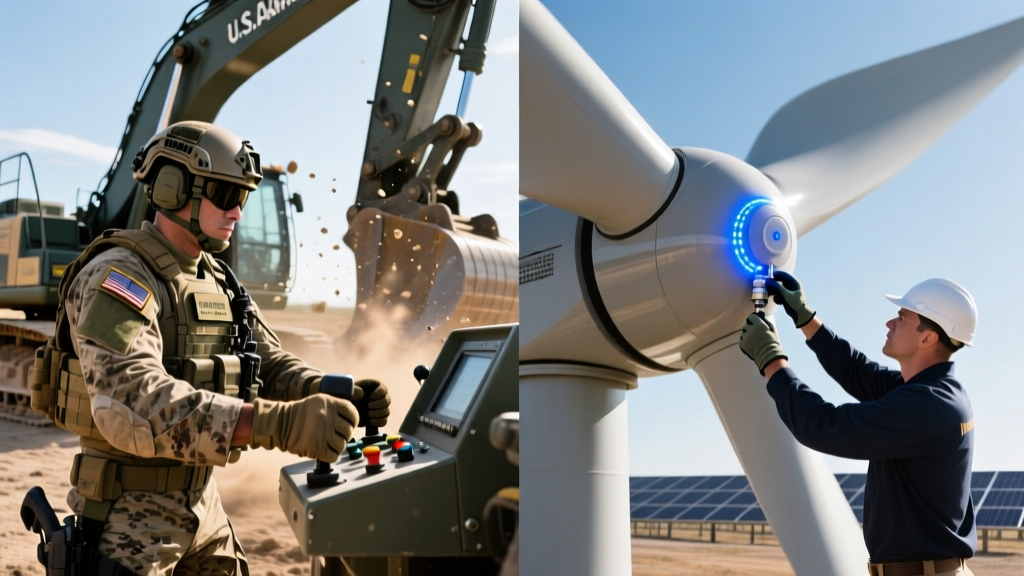
Transitioning from a military role to the civilian sector requires a precise understanding of how daily operations differ. For a USMC heavy equipment operator (MOS 1341), the primary mission revolves around combat engineering support: constructing expedient airfields, digging anti-armor ditches, berming, and route clearance. The operational tempo is dictated by tactical necessity, often in austere environments with minimal survey support.
Conversely, the renewable energy sector—specifically utility-scale solar and wind farm construction—operates on tight commercial margins, strict environmental regulations, and sub-inch grading tolerances. A civilian operator on a 1,500-acre solar site in Texas or a wind farm in Iowa is not just moving dirt; they are executing complex 3D machine control models to prepare ground for automated pile drivers or massive crane pads.
Quick Comparison Matrix: 2026 Outlook
- USMC MOS 1341 (E-4 Corporal): ~$65,000 total annual compensation (Base + BAH/BAS), 24/7 on-call status, global deployment.
- Renewable Energy Operator (Union): $115,000 - $145,000+ annual compensation (Hourly + Overtime + Per Diem), project-based travel, 50-60 hour work weeks.
- Primary Tech: USMC relies on basic GPS and traditional survey stakes; Renewables mandate 3D machine control (Topcon/Trimble) and drone topography.
Equipment Fleet Analysis: Military vs. Renewable Energy
The iron you operate dictates your skill set. The Marine Corps maintains a robust but generalized fleet, whereas renewable energy contractors utilize highly specialized, technology-dense machinery.
| Feature | USMC Fleet (Typical) | Renewable Energy Fleet |
|---|---|---|
| Dozers | Caterpillar D7G, John Deere 850L (Manual/Basic GPS) | CAT D6 XE, Komatsu D65PXi-18 (Full 3D Machine Control) |
| Excavators | CAT 320, CASE CX210D (Standard buckets, thumbs) | Volvo EC350E, Liebherr R 945 (Tiltrotators, grading buckets) |
| Cranes | Grove RT9150E (Rough terrain, tactical lifts) | Liebherr LR 13000, Manitowoc MLC300 (Lattice boom for nacelles) |
| Grading Tolerance | +/- 0.2 ft to 0.5 ft (Expedient standards) | +/- 0.05 ft (Required for solar tracker pile alignment) |
The most significant skill gap for a transitioning Marine is 3D machine control. According to the U.S. Department of Energy, the rapid scaling of utility solar requires massive earthmoving efficiency. Civilian operators use systems like Trimble Earthworks or Topcon MC-X1 to automatically control the dozer blade or excavator boom based on a digital terrain model. If you only have experience reading physical grade stakes from your time at Camp Lejeune or Twentynine Palms, you will need to undergo specific machine control certification before operating on a modern solar site.
Financial Breakdown: Base Pay vs. Prevailing Wage & Per Diem
Comparing military compensation to civilian construction requires looking beyond base pay. The financial divergence between a USMC heavy equipment operator and a civilian renewable energy operator is stark, particularly when factoring in union scales and travel per diems.
The USMC Compensation Structure
A Sergeant (E-5) with four years of service in 2026 earns a base pay of approximately $3,200 per month. When adding Basic Allowance for Housing (BAH) and Basic Allowance for Subsistence (BAS), total monthly compensation hovers around $6,000 to $7,000, depending on the duty station. While this provides excellent stability, comprehensive healthcare, and a pension, the hourly breakdown for a 50-hour work week often equates to less than $30 per hour.
The Renewable Energy Union Scale
Heavy equipment operators in the renewable sector are frequently represented by the International Union of Operating Engineers (IUOE) or work under prevailing wage agreements. In high-growth renewable markets like West Texas or the Midwest wind corridor, total compensation is structured differently:
- Base Hourly Rate: $42.00 to $58.00 per hour (varies by local union chapter and equipment class).
- Overtime: Time-and-a-half for hours over 40, double-time for Sundays or holidays. 60-hour weeks are standard during foundation pouring or turbine erection phases.
- Per Diem: $100 to $150 per day, tax-free, for operators working outside their home jurisdiction (e.g., traveling to a remote wind farm in New Mexico).
- Total Annual Earnings: Easily exceeds $130,000 for operators willing to travel and work overtime, as noted in Bureau of Labor Statistics data for specialized construction equipment operators.
Certification and Training Alternatives
The Marine Corps provides exceptional foundational training in equipment maintenance, situational awareness, and safety. However, the civilian renewable energy sector requires specific, verifiable certifications that MOS 1341 training does not cover.
"Veterans make the best heavy equipment operators because they understand preventive maintenance and don't panic when a machine throws a fault code in the middle of a critical lift. But they must unlearn the 'expedient' mindset and embrace the 'precision' mindset required for commercial renewable projects."
— Site Superintendent, National Wind Energy Contractor
Required Civilian Certifications for 2026
- OSHA 30-Hour Construction: Mandatory for almost all commercial solar and wind sites. Covers fall protection, trenching, and crane safety.
- NCCCO Crane Certification: If you intend to operate the massive crawler cranes used for wind turbine erection, you must pass the National Commission for the Certification of Crane Operators exams. The USMC rarely trains 1341s on lattice boom crawler cranes exceeding 300 tons.
- Machine Control Proficiency: Vendor-specific training (e.g., Caterpillar's 'Cat Connect' or Trimble certification) to prove you can navigate 3D grading interfaces without staking out the site manually.
- MSHA (Mine Safety and Health Administration) Part 48: Required if the solar or wind project involves significant rock quarrying or blasting for access roads.
Decision Framework: Which Path Fits Your Goals?
Choosing between reenlisting as a USMC heavy equipment operator or transitioning to the renewable energy sector depends on your personal risk tolerance, financial goals, and lifestyle preferences. Use this framework to evaluate your next move.
Choose the USMC Path If:
- You value long-term pension benefits, VA healthcare, and the GI Bill over immediate high cash flow.
- You want experience in diverse, extreme environments (arctic, desert, jungle) rather than repeating the same grading tasks on flat agricultural land.
- You are aiming for a commission, warrant officer track, or leadership roles within combat engineering (MOS 1371).
Choose Renewable Energy If:
- Your primary goal is maximizing immediate income ($120k+ annually) through overtime and tax-free per diems.
- You want to master cutting-edge civilian tech like drone topography, autonomous dozers, and 3D machine control.
- You prefer a predictable rotation (e.g., 3 weeks on a remote wind site, 1 week off) over the unpredictable deployment schedule of a Marine Expeditionary Unit.
Frequently Asked Questions
Do renewable energy contractors value USMC heavy equipment experience?
Yes, highly. Civilian contractors know that Marine operators are trained to perform daily track tensioning, greasing, and fluid checks without supervision. A Marine who can troubleshoot a blown hydraulic hose on a CAT 320 in a combat zone is highly trusted to keep a $600,000 dozer running on a remote solar site where mechanics are hours away.
What is the physical toll of wind farm excavation compared to Marine Corps operations?
Wind farm foundation excavation involves mass earthmoving in highly repetitive patterns. You may spend 10 hours a day in a Volvo EC480 excavator digging 60-foot by 60-foot pads for turbine bases. While it lacks the physical combat stress of the USMC, the sedentary nature of modern, climate-controlled civilian cabs requires operators to be proactive about ergonomics and physical fitness outside of work hours.
Can I use my GI Bill for heavy equipment civilian training?
Yes. Many veterans use their GI Bill benefits to attend specialized heavy equipment schools that offer NCCCO crane certifications and advanced machine control training, bridging the gap between military tactical dozer operation and civilian precision grading.