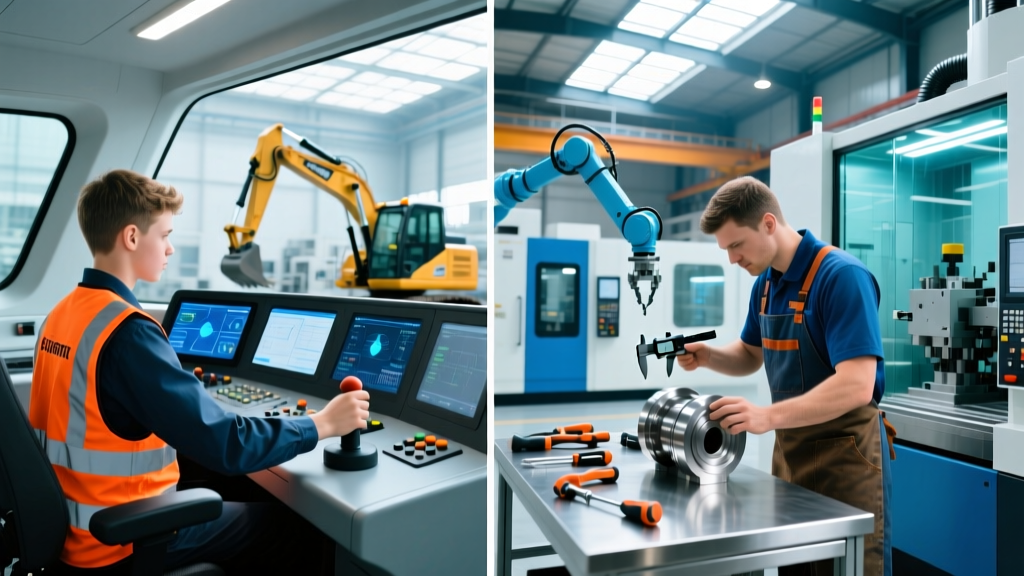
Troubleshooting Becoming a Heavy Equipment Operator vs. Dealer Sales
Diagnose your career path: compare becoming a heavy equipment operator vs. dealer sales. Explore salaries, technical requirements, and transition faults.
For heavy equipment technicians and mechanics hitting a ceiling in the service bay, pivoting to a new role requires the same systematic approach used to diagnose a faulty hydraulic pump. You must identify the symptoms, isolate the root cause of your career stagnation, and apply the correct fix. In the 2026 heavy machinery sector, two primary escape routes dominate: becoming a heavy equipment operator or transitioning into heavy equipment sales and dealer careers. Both paths heavily reward technical troubleshooting backgrounds, but they demand entirely different operational parameters.
Diagnostic Phase: Reading Your Career Fault Codes
Before swapping wrenches for joysticks or a sales tablet, run a diagnostic on your current professional dissatisfaction. In the repair world, a flashed check engine light demands a code pull. In career troubleshooting, your "fault codes" look like this:
- Code SPN-C1 (Physical Burnout): Chronic joint pain from crawling under 80,000-pound dozers. Prescription: Move to the cab or the showroom.
- Code SPN-C2 (Income Ceiling): Flat hourly wage capping at $42/hr despite ASE and OEM certifications. Prescription: Pivot to commission-based dealer sales or union operator scales.
- Code SPN-C3 (Technical Boredom): Tier 4 Final and Tier 5 emissions diagnostics feel repetitive rather than challenging. Prescription: Transition to technical sales, where you solve fleet-level efficiency problems rather than single-machine faults.
Path A: Becoming a Heavy Equipment Operator (The Cab Route)
When becoming a heavy equipment operator, a former mechanic holds a massive, often unquantified advantage over greenhorn recruits. Modern earthmoving is no longer just about moving dirt; it is about managing complex electro-hydraulic systems in real-time.
Technician’s Edge in the Cab: A standard operator might hear a high-pitch whine from the swing drive on a Cat 336 excavator and ignore it until the planetary gear seizes. A technician-turned-operator recognizes the acoustic signature of cavitation in the main hydraulic pump or a degrading swing brake, shutting down the machine before a $15,000 component failure occurs.Machine Control and Telematics Integration
The 2026 job site is governed by 3D machine control. Systems like Trimble Earthworks and Topcon MC-X require operators to interpret digital elevation models while managing GPS rovers. Technicians transition seamlessly into this environment because they already understand the sensor arrays, IMU (Inertial Measurement Unit) calibrations, and CAN bus networks that make automated blade and bucket control possible.
According to the U.S. Bureau of Labor Statistics, the median pay for construction equipment operators continues to climb as the industry faces severe labor shortages, with top-tier union operators in heavy civil infrastructure easily clearing $95,000 annually when factoring in overtime and per diems.
Path B: Heavy Equipment Sales and Dealer Careers
If the isolation of the cab or the physical toll of the job site is the primary fault code, heavy equipment sales and dealer careers offer a highly lucrative alternative. The modern OEM dealer network does not want "car salesmen"; they want technical consultants who can speak fluently with fleet maintenance managers.
Product Support and Technical Sales
Selling a $750,000 John Deere 944 X-Tier wheel loader requires more than quoting a price. It requires mapping out the total cost of ownership (TCO). A technician moving into dealer sales can confidently explain how the machine’s advanced DEF (Diesel Exhaust Fluid) consumption metrics and extended 1,000-hour hydraulic oil service intervals will reduce the buyer’s annual operating costs by 14%.
"The most successful territory managers in our network are former service technicians. When a quarry manager asks about the structural fatigue life of a loader linkage, the tech-turned-rep can pull up the FEA (Finite Element Analysis) data and explain the weld penetration specs. That closes deals." — Regional Director, Associated Equipment Distributors (AED) Member Dealership
The AED Foundation consistently reports that dealerships face a critical shortage of technically proficient front-line staff. Transitioning into a Product Support Sales Representative (PSSR) or Territory Manager role often yields a base salary of $75,000 to $90,000, with total first-year compensation frequently exceeding $130,000 once parts and service attachment commissions kick in.
Diagnostic Matrix: Operator vs. Dealer Sales
Use this comparison matrix to isolate which career path aligns with your operational tolerances.
| Parameter | Heavy Equipment Operator | Dealer Sales / PSSR |
|---|---|---|
| Primary Environment | Cab / Active Job Site / Dirt | Showroom / Fleet Yards / Office |
| 2026 Earning Potential | $65,000 - $110,000+ (Hourly/OT) | $90,000 - $180,000+ (Base + Comm) |
| Technical Depth Required | Applied Diagnostics, Machine Control, Fluids | Fleet Telematics, TCO Analysis, Emissions Tech |
| Physical Toll | Moderate (Vibration, Climate, Entry/Egress) | Low (Walking yards, driving company truck) |
| Core Stressor | Production Quotas, Weather Delays, Safety | Quarterly Targets, Supply Chain Delays, CRM Data |
Troubleshooting Common Transition Failures
Even with a deep mechanical background, technicians frequently stall out during their first year in a new role. Here is how to troubleshoot the most common career transition failure modes.
Failure Mode 1: The "Soft Skills" Circuit Breaker
Symptom: The former mechanic is alienating fleet buyers or site foremen.
Root Cause: In the shop, communication is binary: a part is either broken or fixed. In sales and operation, communication requires nuance, negotiation, and emotional intelligence.
The Fix: Invest heavily in CRM training (Salesforce, Microsoft Dynamics) and conflict resolution. For sales reps, shadow a senior PSSR specifically to observe how they deliver bad news regarding backordered DEF sensors or delayed engine harnesses. For operators, learn to communicate grade changes and soil conditions to the grade checker without resorting to shop-floor profanity.
Failure Mode 2: Underestimating Tier 5 and Electric Drivetrains
Symptom: Inability to sell or operate the newest 2026 machinery effectively.
Root Cause: Relying on legacy mechanical diesel knowledge while ignoring high-voltage battery-electric excavators (like the 24-ton class electric models entering the market) or advanced hydrogen-injection prototypes.
The Fix: Obtain OEM-specific certifications for alternative powertrains. The Associated Equipment Distributors (AED) offers specialized credentialing for technicians moving into sales roles that cover the liability and safety protocols of servicing and selling high-voltage heavy machinery.
Failure Mode 3: Ignoring the Telematics Data Stream
Symptom: Losing sales to competitors or getting pulled off high-production machines on the job site.
Root Cause: Treating telematics (Cat VisionLink, Deere JDLink, Komatsu KOMTRAX) as a GPS tracker rather than a predictive maintenance and production tool.
The Fix: Master the data dashboards. A dealer sales rep who can show a fleet manager a JDLink report proving that their current fleet is idling 38% of the time—and calculate the exact fuel burn wasted—will close the sale. An operator who understands how their machine's payload weighing system feeds directly into the site's cloud-based cut/fill tickets will never be demoted to a water truck.
Final Calibration
Whether you are becoming a heavy equipment operator to escape the physical grind of the shop floor, or leveraging your diagnostic expertise to dominate heavy equipment sales and dealer careers, the key is recognizing the value of your technical foundation. Do not abandon your mechanical mindset; recalibrate it. The industry is desperate for professionals who understand what happens inside the hydraulic valve stack and can translate that knowledge into production metrics or closed contracts. Pull your career fault codes, apply the correct operational fix, and get back to work.