Heavy Construction Equipment Operator Training: Renewables vs Traditional
Compare renewable and traditional heavy construction equipment operator training. Discover salary, machinery, and certification differences.
The global pivot toward utility-scale solar and onshore wind has fundamentally altered the heavy equipment sector. Operating a Cat 336 excavator on a commercial foundation site requires a vastly different skill set than maneuvering a Liebherr LR 11300 crawler crane to set a 115-ton wind turbine nacelle at 150 meters. For prospective operators, choosing between traditional civil construction and the renewable energy sector dictates not just the machinery you run, but the specific heavy construction equipment operator training you must complete.
This comparison analysis breaks down the operational realities, training curricula, compensation structures, and certification pathways across traditional earthmoving, utility-scale solar, and wind energy construction. Understanding these alternatives is critical for aligning your career trajectory with the 2026 infrastructure landscape.
The Machinery Matrix: What You Will Actually Operate
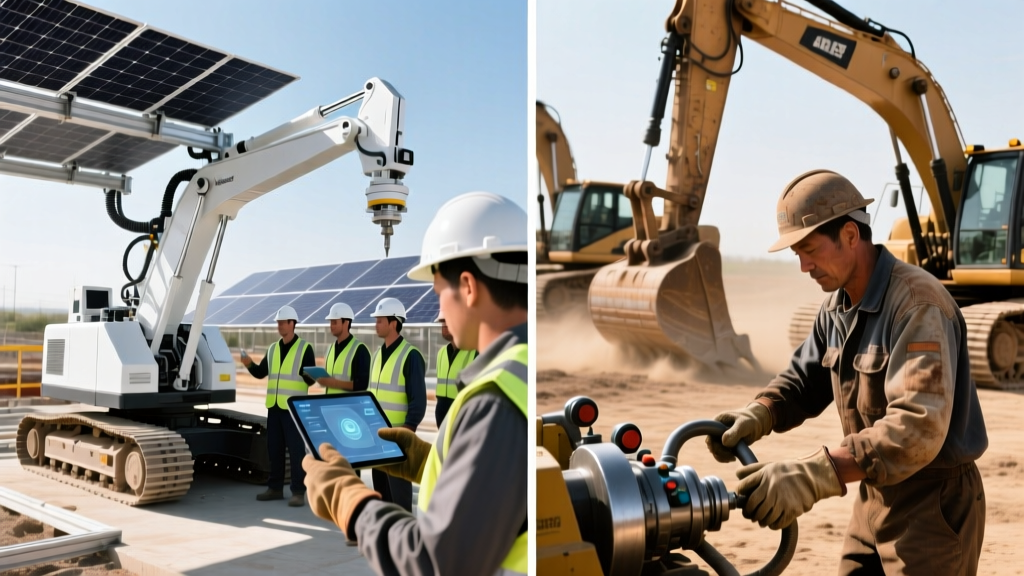
The equipment footprint in renewable energy diverges sharply from traditional commercial or residential construction. While traditional sites prioritize volume and trenching, renewable sites prioritize precision lifting, vast-area grading, and specialized compaction.
| Feature | Traditional Civil/Commercial | Utility-Scale Solar | Onshore Wind Energy |
|---|---|---|---|
| Primary Machinery | Cat 336 Excavators, D8 Dozers, Articulating Haul Trucks | Cat 14M Motor Graders, Compact Track Loaders, Pile Drivers | Liebherr LR 11300, Manitowoc MCL310 Crawler Cranes, Goldhofer trailers |
| Operational Focus | Mass earthmoving, trenching, production volume (cy/hr) | Precision grading (±0.10 ft), tracker pile alignment | Heavy lift, tandem rigging, millimeter-tolerance placement |
| Technology Integration | Standard 2D/3D machine control | Trimble Earthworks GPS, automated blade control | Load moment indicators (LMI), anemometer integration, ground-bearing pressure sensors |
| Site Environment | Confined urban or suburban lots, deep excavations | Massive open tracts (1,000+ acres), high dust, extreme sun | Remote ridgelines, high-altitude, severe wind shear zones |
Heavy Construction Equipment Operator Training: Core Curriculum Differences
The training required to operate safely and efficiently in these sectors reflects the distinct physical and environmental challenges of each job site.
Traditional Earthmoving and Civil Training
Standard heavy construction equipment operator training focuses heavily on production rates, soil mechanics, and trench safety. Operators learn to read civil blueprints, calculate cut-and-fill volumes, and manage ground disturbance near existing utilities. The primary failure modes addressed in training are trench cave-ins, utility strikes, and equipment rollovers on uneven stockpiles. Training facilities typically use standard simulators and mid-sized excavators (e.g., 20-ton class) to build foundational hand-eye coordination and spatial awareness.
Renewable Energy Specialized Training: Solar Grading
Utility-scale solar farms require vast, perfectly graded surfaces to ensure single-axis solar trackers function without binding. Training for solar grading operators centers on GPS-guided machine control. Operators must master systems like Trimble Earthworks or Topcon, learning to trust automated blade control over manual sight-leveling. A critical training module involves managing soil compaction and moisture content; over-compacting the soil can prevent the hydraulic pile drivers from penetrating the ground, while under-compacting leads to tracker foundation failure during high-wind events.
⚠️ High-Voltage Proximity Warning: Solar farm operators frequently work adjacent to active 345kV or 500kV substations. Specialized training in Minimum Approach Distances (MAD) and induced voltage hazards is mandatory. Standard OSHA 10 does not cover the arc-flash and step-potential risks inherent to utility-scale solar interconnection zones.Renewable Energy Specialized Training: Wind Turbine Erection
Wind energy training is fundamentally a heavy-lift and rigging discipline. Modern onshore turbines feature hub heights exceeding 150 meters and nacelle weights surpassing 110 tons. Operators of main erection cranes must undergo rigorous training in load chart interpretation, ground bearing pressure (GBP) calculations for crane mats, and dynamic wind-load management. Unlike traditional crane work, wind erection requires operators to monitor hub-height wind speeds via anemometers, often halting lifts when gusts exceed 20-25 mph. Training heavily emphasizes tandem lift coordination, where a main crawler crane and a tailing crane (often a hydraulic all-terrain crane) must synchronize to upend a 300-foot blade from a horizontal transport position to a vertical installation position.
Compensation, Travel, and Lifestyle Trade-offs
The financial and lifestyle realities of these career paths are as distinct as the machinery. According to the U.S. Bureau of Labor Statistics, the median pay for construction equipment operators hovers around $54,000 annually, but renewable energy specialists frequently shatter this baseline due to travel premiums and specialized hazard pay.
- Traditional Civil Operators: Typically earn $28 to $42 per hour. The lifestyle is highly localized. Operators usually work 40 to 50-hour weeks, return home nightly, and enjoy predictable weekends. Union scales (e.g., IUOE) provide strong pension and health benefits, but overtime is capped.
- Solar Grading & Pile-Driving Operators: Earn $32 to $48 per hour, heavily supplemented by per diem (typically $150-$185/day tax-free). Solar projects are often in remote, arid regions (West Texas, Nevada, Mojave). The schedule is usually 6 days on, 1 day off, or 14 days on, 2 days off, requiring operators to live in extended-stay hotels or man-camps for months at a time.
- Wind Erection Crane Operators: The highest earners, commanding $55 to $85+ per hour, plus massive per diem and travel bonuses. Wind crews follow the wind corridors (from the Texas panhandle to the Midwest ridge lines). The work is highly weather-dependent; operators may sit on standby for days during high-wind events, collecting 'show-up' pay, but the travel burden is immense, often keeping operators away from home for 8 to 10 months of the year.
Certification Pathways and Alternatives
While a standard commercial driver's license (CDL) and OSHA 30-hour construction card are baseline requirements across all sectors, the renewable sector demands specialized, verifiable credentials.
For wind energy, the National Commission for the Certification of Crane Operators (NCCCO) Mobile Crane Operator certification is non-negotiable. Specifically, operators need the Lattice Boom Crawler (LBC) and Lattice Boom Truck (LBT) designations. Furthermore, NCCCO Rigger Level I and II certifications are required for the crews assembling the cranes and rigging the turbine components. The cost for NCCCO written and practical exams ranges from $500 to $800, but employer-sponsored prep courses can push the total training investment to $4,000.
For solar and traditional sectors, manufacturer-specific certifications hold immense value. A Cat Certified Operator credential or a Trimble Machine Control certification instantly elevates a resume, proving to contractors that the operator can maximize the ROI on million-dollar GPS-equipped machinery without requiring extensive on-site supervision.
Decision Framework: Which Path Should You Choose?
Selecting the right training track requires an honest assessment of your lifestyle tolerance and mechanical aptitude. Use this framework to determine your optimal career route:
Choose Traditional Civil If:
- You prioritize family stability, local community ties, and a predictable 5-day workweek.
- You enjoy the variety of daily tasks, from digging basements to laying pipe and finishing grades.
- You prefer to master the physical 'feel' of hydraulic controls over relying on digital GPS interfaces.
Choose Utility-Scale Solar If:
- You are tech-savvy and want to master GPS machine control and automated grading systems.
- You are willing to travel regionally and work 6-day weeks to maximize per diem and overtime pay.
- You prefer operating in wide-open spaces without the extreme vertical hazards of wind turbine erection.
Choose Wind Energy Heavy Lift If:
- You possess a highly analytical mindset, capable of memorizing complex load charts and calculating ground bearing pressures.
- You thrive in high-stakes, high-stress environments where a single mistake can result in catastrophic equipment failure.
- You are unattached or have a family structure that supports 8+ months of continuous national travel.
Future-Proofing Your Career in 2026 and Beyond
The renewable energy sector is rapidly adopting remote-controlled and semi-autonomous machinery. According to the U.S. Department of Energy, the push for larger turbines and more complex terrain installations is driving innovation in operator safety. In 2026, we are seeing the deployment of remote-controlled dozers and compact track loaders used specifically for clearing and grading inside active high-voltage solar substations and steep wind-turbine pad approaches. Operators who cross-train in remote-control (RC) rigging and drone-assisted site surveying will command a distinct premium. By aligning your heavy construction equipment operator training with these emerging technologies, you transition from a traditional lever-puller to a highly compensated site-technology manager.