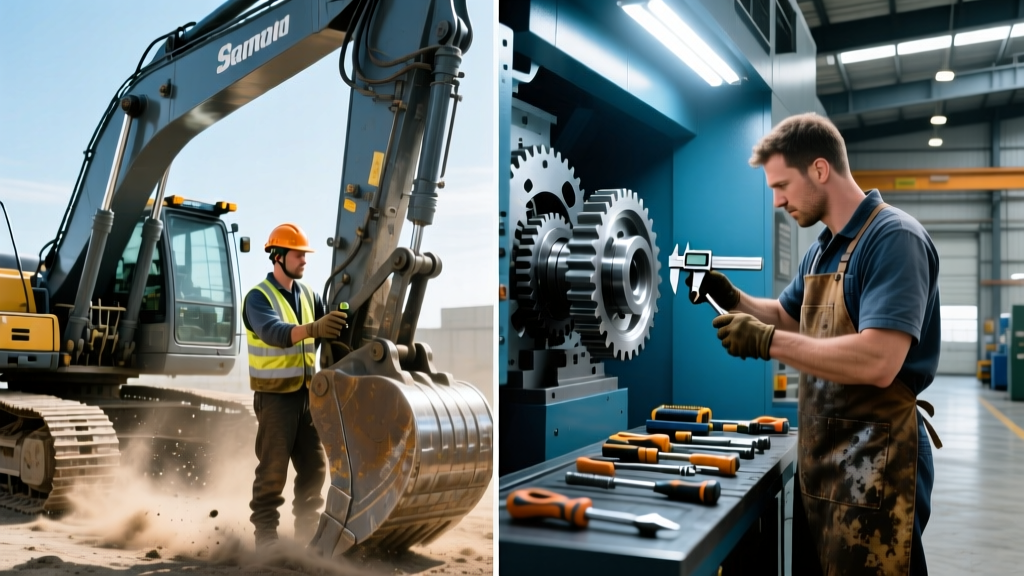
Online Heavy Equipment Certification vs. CDL Transport Rules
Understand the legal boundary between online heavy equipment certification and CDL requirements for transporting machinery on public roads.
The Regulatory Divide: Operating vs. Transporting
A common point of confusion in the construction and logistics sectors is the legal boundary between operating machinery on a closed job site and transporting it over public highways. Many fleet managers and operators pursue an online heavy equipment certification to satisfy OSHA site-entry requirements, mistakenly assuming these credentials cover the legalities of moving a 70,000-pound excavator across state lines. They do not.
The Department of Transportation (DOT) and the Federal Motor Carrier Safety Administration (FMCSA) enforce strict Commercial Driver’s License (CDL) mandates based on Gross Combination Weight Ratings (GCWR). While digital credentials are excellent for teaching load dynamics, trench safety, and machine controls, public road transport requires federally regulated, in-person CDL training and specific cargo securement endorsements.
⚠️ Compliance Warning: An online heavy equipment certification does not exempt a driver from CDL requirements. Operating a lowboy trailer carrying heavy machinery without a Class A CDL can result in federal fines exceeding $15,000 per violation, vehicle impoundment, and immediate disqualification from the job site.FMCSA Weight Thresholds: When a CDL is Mandatory
Federal law mandates a Class A CDL for any combination of vehicles with a GCWR of 26,001 pounds or more, provided the towed vehicle exceeds 10,000 pounds. When transporting heavy equipment, these thresholds are almost always breached. To understand the compliance reality, we must look at the actual operating weights of standard machinery paired with typical lowboy trailers.
| Equipment Model | Operating Weight | Trailer Weight (Est.) | Total Payload | CDL Class Required |
|---|---|---|---|---|
| Bobcat E85 (Compact Excavator) | 18,500 lbs | 8,000 lbs (Tag trailer) | 26,500 lbs | Class A (Borderline) |
| John Deere 850L (Crawler Dozer) | 44,500 lbs | 18,000 lbs (Lowboy) | 62,500 lbs | Class A |
| Caterpillar 330 (Hydraulic Excavator) | 75,400 lbs | 22,000 lbs (RGN Trailer) | 97,400 lbs | Class A + Oversize Permits |
As the data illustrates, anything larger than a compact utility machine immediately triggers Class A CDL requirements. Furthermore, hauling a Caterpillar 330 requires not just a CDL, but specialized oversize/overweight permits and route surveys, which are covered in advanced logistics training, not standard operator safety courses.
Where Online Certifications Actually Apply
This is not to diminish the value of digital training. An online heavy equipment certification is highly relevant for the loading and unloading phases of transport, as well as on-site operation. These platforms are critical for:
- OSHA Compliance: Meeting the 29 CFR 1926.1400 standards for crane and heavy equipment ground conditions and rigging.
- NCCCO Preparation: Serving as the theoretical foundation before taking the practical National Commission for the Certification of Crane Operators exams.
- Site-Specific Hazard Awareness: Training operators on blind spots, swing radius hazards, and utility line clearances before they step into the cab.
However, once the machine is loaded and the trailer tires touch a public roadway, jurisdiction shifts entirely from OSHA to the DOT.
Cargo Securement: The CDL Knowledge Gap
One of the most heavily audited areas during 2026 FMCSA compliance blitzes is cargo securement. Heavy equipment transport requires strict adherence to 49 CFR § 393.110, which dictates the minimum number of tie-downs based on equipment length and weight.
FMCSA Tie-Down Rule of Thumb: For heavy machinery, you must use one tie-down for every 10 feet of article length or fraction thereof. A 25-foot excavator requires a minimum of three tie-downs. However, industry best practice and most heavy-haul carriers mandate four tie-downs (one on each track or wheel corner) to prevent lateral shifting during emergency braking.
Calculating Working Load Limits (WLL)
CDL training rigorously tests a driver's ability to calculate WLL. The aggregate WLL of all tie-downs must equal at least 50% of the equipment's weight. For a 60,000 lb dozer, the tie-downs must provide a combined WLL of 30,000 lbs. Using four 3/8-inch Grade 70 transport chains (each with a WLL of 6,600 lbs) yields an aggregate of 26,400 lbs—a federal violation. Drivers must upgrade to 1/2-inch Grade 70 chains (11,300 lbs WLL each) to achieve the required 45,200 lbs aggregate capacity.
Investment Comparison: CDL Training vs. Online Operator Certs
Understanding the financial and temporal investment required for compliance helps fleet managers budget accurately for their personnel.
Class A CDL (Heavy Haul Focus)
- Cost: $5,000 - $9,000
- Timeline: 4 to 8 weeks (Full-time)
- Curriculum: Air brakes, combination vehicle dynamics, DOT cargo securement, logbook/ELD compliance.
- Testing: State-administered written and physical road tests.
Online Heavy Equipment Certification
- Cost: $150 - $600 (OSHA/Safety modules)
- Timeline: 4 to 12 hours (Self-paced)
- Curriculum: Machine controls, trench safety, load charts, daily inspection protocols.
- Testing: Digital multiple-choice exams.
Pre-Transit Compliance Checklist
Before dispatching a loaded lowboy onto public highways, dispatchers and drivers must verify the following compliance matrix. Failure at any point warrants an immediate halt to the transport.
- Verify CDL Class & Endorsements: Ensure the driver holds a valid Class A CDL. If the equipment pushes the GCWR over 80,000 lbs, verify state-specific overweight permits are in the cab.
- Check Equipment Dimensions: Measure the exact height of the loaded machine. If the boom is raised or the cab exceeds 13'6" (standard legal height limit), an oversize permit and escort vehicle are mandatory.
- Inspect Tie-Down WLL: Physically check the stamp on every chain and binder. Reject any chain with stretched links, gouges, or missing grade markings.
- Lock the Swing Mechanism: For excavators and cranes, ensure the swing lock pin is engaged and the bucket/attachment is resting flat on the trailer deck or secured to prevent pendulum swinging.
- Clean the Tracks: Remove caked mud and debris from steel tracks. The FMCSA can cite a driver under general cargo securement rules if falling mud clods or rocks pose a hazard to trailing vehicles.
Frequently Asked Questions
Can I transport a skid steer on a flatbed without a CDL?
It depends on the combined weight. A standard skid steer (e.g., Bobcat S770 at 9,700 lbs) loaded onto a 5,000 lb flatbed trailer, pulled by a 6,500 lb pickup truck, results in a Gross Combination Weight Rating (GCWR) of roughly 21,200 lbs. Because this is under the 26,001 lb federal threshold, a CDL is not required, provided the vehicle is not plated for commercial heavy haul. However, proper tie-downs are still legally required.
Does an online certification count toward my CDL renewals?
No. The FMCSA does not accept online heavy equipment certifications as a substitute for mandatory Entry-Level Driver Training (ELDT) or CDL refresher courses. Online certs are strictly recognized by OSHA for job-site safety compliance, not DOT transit compliance.
What happens if I get caught hauling equipment without the right CDL?
Penalties are severe. The driver will be placed out-of-service (OOS) immediately, meaning the truck and trailer cannot be moved until a legally qualified driver arrives to take over. The carrier faces fines ranging from $2,500 to $16,864 per violation, and the incident will permanently tarnish the company’s Compliance, Safety, Accountability (CSA) score, leading to higher insurance premiums and more frequent roadside inspections.