Heavy Equipment Operator Training vs Mechanic Tech Careers
Compare heavy equipment operator training and mechanic career paths. Explore tech trends, salary data, and AI-driven machinery skill requirements.
The modern earthmoving site is no longer just a dirt lot; it is a high-bandwidth mesh network. A 2026 Komatsu PC490LC excavator or a Caterpillar D11 dozer operates as a rolling IoT node, transmitting telemetry, fuel burn rates, and hydraulic pressure anomalies to the cloud in real-time. This technological leap has fundamentally fractured the traditional career trajectory of heavy machinery professionals, creating two distinct, highly specialized paths: the tech-enabled operator and the mechatronic diagnostic technician.
📊 The 2026 Tech Paradigm Shift: According to the Associated Equipment Distributors (AED) Foundation, the industry is facing a critical shortage of technicians capable of diagnosing multiplexed CAN bus systems, while simultaneously demanding operators who can interface with 3D machine control and semi-autonomous grade-assist algorithms.The Operator: Managing Algorithms and Dirt
The stereotype of the operator relying purely on 'feel' and seat-of-the-pants instinct is obsolete. Today’s operators are essentially heavy machinery systems managers. When evaluating heavy equipment operator training programs, the curriculum has shifted from basic lever manipulation to digital interface management.
Simulators and Digital Twin Integration
Top-tier training facilities now utilize CM Labs Vortex simulators or Cat Simulators to build muscle memory without burning $6-a-gallon diesel or risking undercarriage wear. Trainees learn to interpret digital payloads, manage Trimble Earthworks 3D grade control screens, and respond to proximity detection alerts (like Cat Detect) before ever touching a physical joystick. The integration of drone topography data directly into the operator's cab monitor means the operator must understand spatial data, not just dirt.
Semi-Autonomous Operations
With the proliferation of features like John Deere’s SmartGrade and Caterpillar’s Cat Assist, the operator’s role is transitioning from direct actuation to supervisory oversight. The machine handles the micro-adjustments of the blade or bucket; the operator manages the macro-strategy of the cut and fill, optimizing cycle times based on real-time fleet management software.
The Mechanic: Diagnosing Multiplexed Nervous Systems
Conversely, the heavy equipment mechanic has evolved from a grease-and-wrench specialist into a field-based IT and mechatronics engineer. A 2026 service technician spends as much time looking at oscilloscopes and diagnostic laptops as they do turning wrenches.
The Diagnostic Arsenal
Modern troubleshooting requires proficiency with proprietary software like Caterpillar ET (Electronic Technician) or John Deere Service Advisor. Mechanics must understand how to flash ECMs (Electronic Control Modules), calibrate DEF (Diesel Exhaust Fluid) dosing systems, and trace faults through J1939 CAN bus networks using hardware like the NEXIQ USB-Link 3. A single frayed wire in a multiplexed harness can ground a $750,000 wheel loader, and finding it requires reading voltage drop schematics, not just listening for knocks.
Predictive Maintenance and AR
Telematics platforms like Cat Connect and JDLink alert mechanics to hydraulic pump cavitation or bearing wear weeks before a catastrophic failure. Furthermore, field technicians are increasingly using Augmented Reality (AR) headsets, such as RealWear, to stream live video to master engineers at the OEM level, overlaying digital torque specs and wiring diagrams directly onto the physical engine block.
Head-to-Head Career Matrix
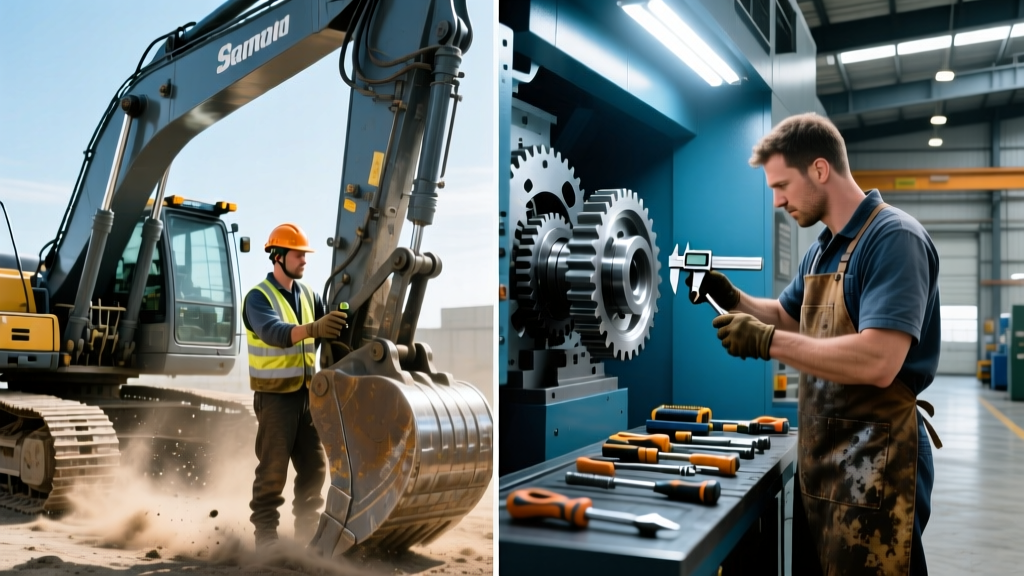
Choosing between the cab and the shop requires an honest assessment of your aptitude, physical tolerance, and financial goals. Below is a direct comparison of the two career trajectories based on current 2026 industry data.
| Metric | Heavy Equipment Operator | Heavy Equipment Mechanic |
|---|---|---|
| Average Salary Range | $68,000 - $95,000 | $78,000 - $115,000+ |
| Primary Work Environment | Climate-controlled cab, high vibration, UV exposure | Shop floor, field service trucks, extreme weather exposure |
| Tech Barrier to Entry | Moderate (UI/UX, 3D spatial awareness, GPS) | High (Electrical theory, networking, software flashing) |
| Physical Toll | Lower back/joint fatigue from vibration and sedentary posture | High impact (heavy lifting, awkward positioning, chemical exposure) |
| Automation Risk | Moderate (Remote-controlled and autonomous fleets expanding) | Near Zero (Complex physical diagnostics cannot be automated) |
Heavy Equipment Operator Training vs Mechanic Certifications
The educational pipelines for these roles look vastly different. According to the Bureau of Labor Statistics, operators typically enter through apprenticeships or specialized trade schools, focusing on safety, grade reading, and machine control. Programs heavily emphasize NCCER (National Center for Construction Education and Research) credentials and OSHA 30 certifications.
Mechanics, however, require a deeper academic foundation in applied physics and electronics. The BLS notes that employers increasingly prefer candidates with associate degrees in diesel technology or heavy equipment mechatronics. Certifications from ASE (Automotive Service Excellence) in the Medium-Heavy Truck and Off-Road Equipment categories are mandatory for top-tier dealership employment, alongside OEM-specific credentials from Volvo, Liebherr, or Komatsu.
⚠️ Warning on Tool Debt: While operators rely on company-provided machinery and software licenses, field mechanics are often expected to supply their own hand tools and diagnostic laptops. It is common for a journeyman heavy equipment mechanic to have $25,000 to $40,000 invested in personal tooling (Snap-on, Mac, Matco) and proprietary breakout boxes by year five of their career.Decision Framework: Which Path Aligns With Your Aptitude?
Do not choose based solely on starting pay. Use this framework to determine which technological evolution suits your cognitive profile.
- Choose the Operator Path if:
- You possess high spatial awareness and can translate 2D digital topography maps into 3D physical cuts.
- You prefer a controlled, seated environment and excel at sustained focus and multitasking via dual-monitor cab setups.
- You want to avoid the financial burden of accumulating personal tool debt.
- Choose the Mechanic Path if:
- You have a diagnostic mindset; you enjoy isolating variables in complex electrical or hydraulic circuits.
- You are comfortable with continuous education, as OEM software updates and emissions regulations (like Tier 5 standards) require constant retraining.
- You want maximum job security and leverage; a machine cannot generate revenue when it is down, making the person who can fix the ECM an indispensable asset.
The Emerging Hybrid: The Commissioning Technician
For those torn between the two, a new hybrid role is emerging in 2026: the Machine Control Commissioning Technician. These specialists do not dig trenches or rebuild transmissions. Instead, they use surveying rovers and proprietary software to calibrate the GNSS receivers and IMU (Inertial Measurement Unit) sensors on brand-new equipment, ensuring the operator's 3D grade control system is accurate to within 2 millimeters. This niche requires the diagnostic brain of a mechanic and the spatial understanding of an operator, commanding premium salaries that frequently exceed $120,000 annually.