Heavy Equipment Operator Simulator Buying Guide: Ergonomic Fitness
Discover how to select a heavy equipment operator simulator that tests physical fitness, ergonomics, and biometric readiness for fleet operators.
The Hidden Cost of Operator Physical Fatigue
Musculoskeletal disorders (MSDs) and cognitive fatigue account for over 30% of unplanned downtime and workers' compensation claims in heavy civil and mining sectors. When fleet managers and training academies invest in simulation technology, the focus traditionally lands on joystick muscle memory and spatial awareness. However, the most sophisticated organizations in 2026 are leveraging the heavy equipment operator simulator as a rigorous physical fitness and ergonomic assessment tool. Operating a 90-ton rigid haul truck or a Cat 980 wheel loader requires immense core stability, cervical endurance, and lower-limb strength. Procuring a simulator without evaluating its capacity to test and replicate these physical demands leaves a massive blind spot in your hiring and training pipeline.
According to the Centers for Disease Control and Prevention (NIOSH), prolonged exposure to whole-body vibration (WBV) accelerates lumbar spine degeneration and accelerates operator fatigue. Modern simulation hardware must do more than display a 3D environment; it must physically challenge the operator to determine if they possess the baseline fitness required to survive a 12-hour shift in a high-vibration cab.
Hardware Specifications for Physical Assessment
When evaluating simulator vendors, procurement officers must look past screen resolution and scrutinize the physical feedback mechanisms. A simulator that fails to replicate the physical resistance of the machine cannot accurately test an operator's physical readiness.
Motion Base Fidelity and WBV Replication
To accurately assess an operator's tolerance to physical fatigue, the simulator must replicate the 0.5 to 80 Hz frequency spectrum of whole-body vibration. Entry-level 3-DOF (Degrees of Freedom) motion bases are insufficient for this task, as they only simulate pitch, roll, and heave. Buyers must specify 6-DOF hexapod platforms capable of generating high-frequency, low-amplitude vibrations that mimic the harsh resonance of a dozer ripping through compacted shale. Testing a candidate on a 6-DOF platform for 45 continuous minutes will quickly reveal underlying back issues or poor core stabilization that would otherwise result in a field injury.
Pedal Force and Upper-Limb Resistance
Modern wheel loaders and motor graders feature electro-hydraulic controls, but emergency braking and heavy implement manipulation still demand significant physical exertion. For example, the brake pedal breakaway force on large articulated dump trucks can exceed 120 lbs. A high-fidelity simulator must feature programmable pneumatic pedal resistance and force-feedback joysticks. If a simulator utilizes lightweight, spring-loaded gaming pedals, it cannot test the lower-limb endurance required for real-world emergency stops, rendering the physical assessment invalid.
⚠️ Procurement Warning: Do not accept vendor claims of "force feedback" without requesting the specific torque output (measured in Newton-meters) of the joystick motors. True heavy-equipment force feedback requires a minimum of 15 Nm to simulate the hydraulic kickback experienced when an excavator bucket strikes bedrock. Anything less fails to test the operator's wrist and shoulder stability.Biometric Integration: The 2026 Standard
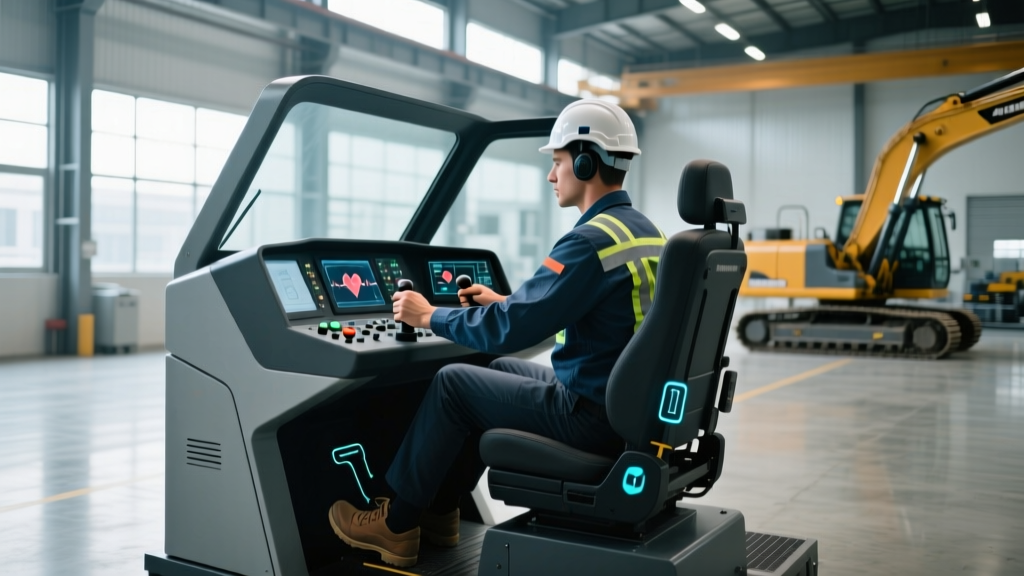
The latest generation of heavy equipment operator simulators integrates directly with biometric wearables and cab-embedded sensors to quantify cognitive and physical fatigue. When writing your RFP (Request for Proposal), ensure the software architecture supports real-time telemetry from the following physical metrics:
- Pupillometry and Saccade Tracking: Eye-tracking cameras mounted in the simulator's display bezel monitor saccade velocity. When an operator's saccade speed drops below 300 degrees/second, it indicates acute central nervous system fatigue, signaling that the operator lacks the visual-cognitive endurance for night-shift operations.
- Heart Rate Variability (HRV): Capacitive ECG sensors embedded in the simulator seat backrest monitor HRV. An HRV dropping below 20ms during high-stress simulation scenarios (e.g., working near trench edges) indicates poor cardiovascular stress recovery.
- Cervical Strain Mapping: Using infrared head-tracking, the software calculates the frequency and duration of extreme neck flexion. Operators who constantly rely on twisting their cervical spine rather than utilizing mirror and camera systems are flagged for ergonomic retraining.
Top Simulator Platforms for Ergonomic Screening
The following matrix compares leading enterprise-grade simulator platforms based on their physical assessment capabilities, motion fidelity, and biometric integration. Pricing reflects Q1 2026 enterprise configurations including hardware, motion bases, and multi-machine software licenses.
| Brand / Platform | Motion Base Spec | Biometric Integration | Est. Enterprise Price |
|---|---|---|---|
| CM Labs Vortex Simulator | 6-DOF Motion Platform (High-Frequency WBV capable) | Native Eye-Tracking, API for HRV wearables | $115,000 - $145,000 |
| Global Simulators (ProSeries) | 3-DOF to 6-DOF scalable, Pneumatic Pedal Resistance | Seat-embedded posture sensors, Fatigue scoring | $85,000 - $120,000 |
| Tenstar Simulation | Custom Hexapod, ISO 16121 Cab Adjustability | Cognitive load mapping, Reaction-time logging | $95,000 - $130,000 |
Designing a Physical Fitness Screening Protocol
Purchasing the hardware is only the first step. To extract ROI and reduce field injuries, HR and safety departments must implement a standardized simulator-based physical screening protocol for new hires and annual recertifications.
- The Baseline Ergonomic Fit (15 Minutes): The candidate enters the simulator cab. The assessor verifies that the seat, armrests, and monitors can be adjusted to fit the candidate's anthropometrics while maintaining clear sightlines. Failure to achieve a neutral spine posture within the physical confines of the cab replica is an automatic disqualification for specific machine classes, aligning with OSHA ergonomics guidelines for heavy machinery operation.
- The Endurance Stress Test (45 Minutes): The candidate operates a simulated motor grader on a rough, unpaved haul road. The 6-DOF motion base is set to maximum WBV replication. Assessors monitor the candidate's core stabilization and grip strength degradation over time via force-feedback telemetry.
- The Cognitive-Fatigue Reaction Drill (10 Minutes): Following the endurance test, the candidate is subjected to sudden hazard scenarios (e.g., a light vehicle pulling into a blind intersection). The simulator logs braking reaction times and pedal force. A reaction time degradation of more than 15% compared to their fresh baseline indicates poor cardiovascular recovery and high fatigue susceptibility.
- Post-Simulation Biometric Review: Safety officers review the eye-tracking and HRV data to determine if the operator experienced premature cognitive overload, assigning a "Fatigue Risk Score" that dictates whether they are cleared for 12-hour night shifts or restricted to 8-hour day shifts.
"We used to rely on standard medical physicals to clear operators, but a doctor's note doesn't tell you if a candidate's lower back can handle 10 hours of continuous scraping in a D11 dozer. Integrating biometric tracking into our 6-DOF simulators reduced our first-year ergonomic injury claims by 42%."
— Director of Fleet Training, Tier-1 Mining Contractor
The ROI of Ergonomic Simulator Procurement
Allocating an additional $25,000 to $40,000 per unit for 6-DOF motion bases and biometric software integration yields a rapid return on investment. A single workers' compensation claim for a herniated disc or cervical strain in the heavy equipment sector averages $65,000 in direct medical and indemnity costs, excluding the indirect costs of machine downtime and replacement hiring. By utilizing a heavy equipment operator simulator as a rigorous physical fitness gatekeeper, fleets effectively filter out high-risk candidates before they ever touch a $2 million asset. When drafting your next equipment selection RFP, mandate that vendors provide empirical data on WBV frequency replication and biometric API access—your operators' spines and your bottom line depend on it.
Procurement Checklist Summary
- ✅ Specify 6-DOF motion bases capable of 0.5–80 Hz WBV replication.
- ✅ Require pneumatic pedal resistance exceeding 120 lbs of breakaway force.
- ✅ Mandate native eye-tracking and HRV API compatibility in the software suite.
- ✅ Ensure cab dimensions and adjustability comply with ISO 16121 standards.
- ✅ Request vendor case studies demonstrating fatigue-reduction ROI in mining or heavy civil applications.