Pet Food Processing Machinery: Twin-Screw Extrusion vs Cold Pressing
Compare twin-screw extrusion and cold pressing pet food processing machinery. Analyze costs, throughput, and nutritional retention for 2026 production.
The global shift toward high-protein, functional, and raw-inspired pet diets has fundamentally altered capital equipment strategies in 2026. When evaluating pet food processing machinery, manufacturers face a critical bifurcation: traditional high-temperature twin-screw extrusion (TSE) versus low-temperature cold pressing and pelleting. This analysis dissects the engineering realities, CapEx thresholds, and FSMA compliance implications of both processing pathways to help facility engineers and investors make precise capital allocation decisions.
The Core Divergence: Thermal Gelatinization vs. Nutrient Preservation
The fundamental difference between these two machinery classes lies in starch gelatinization and thermal degradation. Twin-screw extruders operate with barrel temperatures ranging from 120°C to 150°C, achieving 85% to 95% starch gelatinization. This high gelatinization rate is crucial for the digestibility of standard kibble and provides the structural expansion necessary for a crunchy texture.
Conversely, cold pressing and low-temperature pelleting machinery restricts friction and processing temperatures to below 75°C. This preserves heat-labile vitamins (C, E, B-complex), native enzymes, and delicate amino acid profiles like taurine. However, the trade-off is a significantly lower starch gelatinization rate (typically 30% to 40%), which forces formulators to rely on alternative carbohydrate binders, pre-cooked ingredients, or high-hydrocolloid gums to maintain pellet durability.
Quick Decision Matrix for Line Selection
- Choose Twin-Screw Extrusion if: You are producing high-volume (>5 TPH) standard or premium kibble requiring high meat inclusion (up to 40% fresh meat), high expansion ratios, and a validated thermal kill step.
- Choose Cold Pressing if: You are manufacturing ultra-premium, holistic, or 'raw-coated' diets with a focus on native nutrient retention, lower throughput (1-4 TPH), and have the CapEx for secondary pathogen intervention systems.
Twin-Screw Extrusion (TSE): High-Throughput Engineering
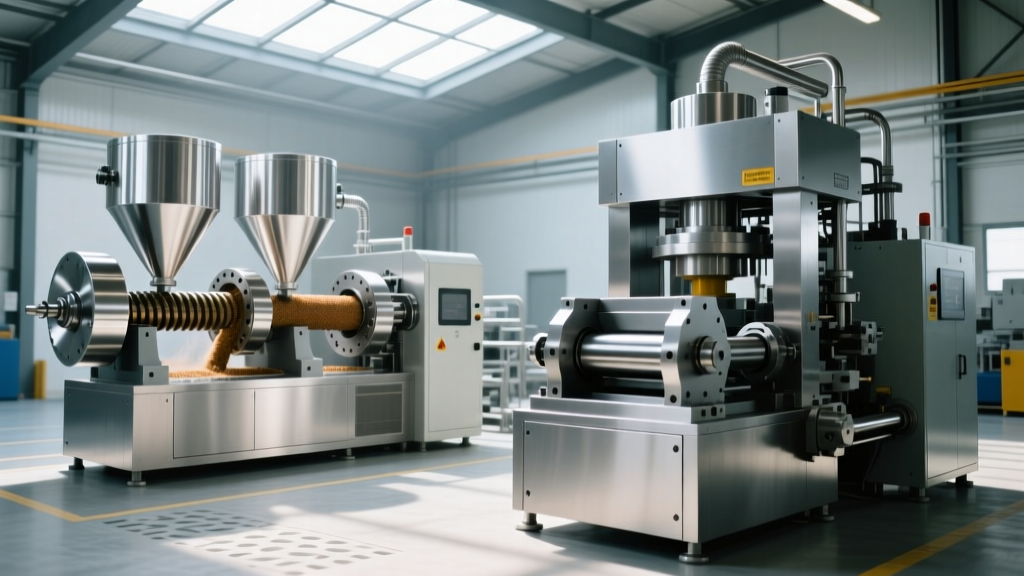
Modern TSE lines, utilizing platforms like the Coperion ZSK Mc18 or the Wenger TT3000 series, represent the apex of continuous thermal-mechanical processing. These systems rely on precise Specific Mechanical Energy (SME) inputs, typically ranging from 30 to 55 kWh per ton of product, combined with direct steam injection.
Capital & Operating Economics
A complete 5 to 10 TPH twin-screw extrusion line—including the preconditioner, extruder, multi-pass gas-fired dryer, and vacuum fat coater—requires a CapEx investment between $1.2 million and $2.5 million. Operating costs are heavily weighted toward energy consumption (dryer evaporation rates require removing 15% to 25% moisture post-extrusion) and wear parts. Tungsten carbide-lined barrels and specialized metallurgy for screw elements are mandatory when processing abrasive bone meal or high-mineral premixes, adding 15% to 20% to initial barrel costs but extending lifespan from 4,000 hours to over 12,000 hours.
Edge Cases & Failure Modes
When pushing fresh meat inclusion past 40%, TSE lines frequently encounter protein cross-linking at the die face. The intense shear and heat cause meat proteins to denature and form a rubbery matrix that blocks die apertures, leading to pressure surges and catastrophic die blowouts. To mitigate this, engineers must utilize dies with lower L/D (Length-to-Diameter) ratios (e.g., 16:1 instead of 24:1) and implement specialized anti-stick die coatings like chrome nitride.
Cold Pressing & Low-Temp Pelleting: The Premium Alternative
Cold pressing machinery, such as the KAHL pellet mills and expanders, utilizes a roller-and-die mechanism to compress ingredient mash into dense, unexpanded pellets. The mechanical friction inherently generates mild heat, but advanced models feature water-cooled dies and roller shells to strictly cap temperatures at 65°C to 70°C.
Equipment Specs & Limitations
A standard 3 TPH cold press line, including the mixer, conditioner, pellet mill, and counterflow cooler, typically costs between $250,000 and $600,000. The primary limitation of cold pressing is fat tolerance. Formulations exceeding 12% pre-press fat content will lubricate the die channels, resulting in severe pellet crumbling and 'mushing' inside the conditioner. High-fat formulations require a two-step process: pressing a low-fat base pellet, followed by a vacuum liquid coating application to infuse fats and palatants post-press.
Head-to-Head Equipment Comparison Matrix
| Parameter | Twin-Screw Extrusion (TSE) | Cold Pressing / Pelleting |
|---|---|---|
| Typical CapEx (Full Line) | $1.2M - $2.5M | $250k - $600k |
| Max Throughput | 10 to 30 TPH | 1 to 5 TPH |
| Peak Processing Temp | 120°C - 150°C | 65°C - 75°C |
| Starch Gelatinization | 85% - 95% | 30% - 40% |
| Max Fresh Meat Inclusion | Up to 40% (with specialized dies) | Up to 20% (requires binding agents) |
| In-Line Pathogen Kill Step | Yes (Thermal) | No (Requires secondary intervention) |
Navigating FSMA Compliance and Pathogen Kill Steps
The most critical regulatory differentiator between these machinery types is compliance with the FDA's FSMA guidelines regarding Hazard Analysis and Risk-Based Preventive Controls (HARPC). TSE inherently provides a validated thermal kill step. The combination of high shear, pressure, and temperatures exceeding 120°C for a minimum dwell time easily achieves a 5-log reduction of Salmonella and Listeria monocytogenes.
Cold pressing does not achieve a lethal thermal kill step. Facilities utilizing cold press machinery must integrate and validate secondary pathogen interventions to remain compliant. The industry standard in 2026 for cold-pressed diets is High Pressure Processing (HPP). By subjecting the sealed, packaged pellets to 87,000 psi of isostatic pressure for 3 to 5 minutes, manufacturers achieve pathogen destruction without applying heat. Alternatively, some facilities utilize organic acid surface treatments (e.g., propionic acid or buffered sodium bisulfate), though this can negatively impact palatability and requires strict residue testing.
The 2026 Hybrid Compromise: Expander-Pellet Mill Systems
For manufacturers attempting to bridge the gap between high gelatinization and nutrient retention, hybrid expander-pellet mill systems have gained significant traction. An expander operates similarly to an extruder but utilizes a shorter barrel and a hydraulic back-pressure cone instead of a die plate. This provides a high-shear, short-dwell (10 to 15 seconds) thermal shock that gelatinizes starches to approximately 70% while minimizing the degradation of heat-sensitive vitamins. The expanded, porous mash is then immediately fed into a pellet mill. This hybrid approach allows for higher fat absorption in the final pellet and reduces the overall thermal load compared to traditional TSE kibble lines.
Frequently Asked Questions
Can twin-screw extruders produce cold-pressed equivalent diets?
No. While TSE operators can reduce barrel temperatures and screw speeds to lower SME inputs, the minimum friction required to convey the dough through the die inherently generates temperatures exceeding 90°C. True 'cold-pressed' marketing claims require processing below 75°C, which is mechanically impossible on a standard continuous extruder without stalling the product flow.
How does moisture content affect dryer sizing in TSE lines?
In TSE processing, water is injected into the preconditioner and barrel to facilitate gelatinization, often pushing the dough moisture to 25% - 30%. To achieve a shelf-stable final moisture of 10%, the dryer must evaporate 15% to 20% of the product's weight. If a facility increases throughput by 20% without upgrading the multi-pass dryer's BTU capacity or belt square footage, the final product will exit with unsafe water activity (aw > 0.65), leading to mold proliferation. Dryer capacity must always be calculated based on evaporation rate (kg H2O/hour), not just dry product throughput.
What are the maintenance differences regarding die wear?
Extrusion dies experience extreme abrasive wear from bone meal, titanium dioxide, and mineral premixes, requiring replacement or re-machining every 2,000 to 4,000 hours depending on metallurgy. Cold press pellet dies experience compressive fatigue and abrasive wear from the roller nip, typically requiring replacement every 1,500 to 3,000 hours. However, cold press dies are generally 40% cheaper to replace than complex multi-orifice extrusion die plates.
For further reading on industry safety standards and ingredient handling, refer to the resources provided by the Pet Food Institute.