Maintenance by Industrial Meat Processing Equipment Manufacturers
Evaluate OEM maintenance schedules from leading industrial meat processing equipment manufacturers, comparing SLAs, costs, and IoT predictive tools.
Meat processing environments subject machinery to extreme operational stressors: high-pressure caustic washdowns, pervasive animal fats, bone dust, and continuous thermal cycling. Consequently, equipment degrades up to three times faster than in dry manufacturing sectors. When evaluating industrial meat processing equipment manufacturers, the initial capital expenditure is only a fraction of the total cost of ownership. The true financial differentiator lies in the post-sale maintenance architecture, Original Equipment Manufacturer (OEM) service schedules, and the integration of predictive telemetry.
Data Highlight: The True Cost of Unplanned DowntimeIn a mid-sized poultry or beef processing facility, an unplanned halt on a primary deboning or slicing line costs between $14,000 and $22,000 per hour in lost yield, labor idling, and cold-chain compliance risks. Optimizing OEM maintenance schedules reduces unplanned downtime by an average of 38%.
Decoding OEM Maintenance Frameworks
Leading industrial meat processing equipment manufacturers have shifted away from reactive repair models toward highly structured, condition-based preventive maintenance (PM) frameworks. Understanding how top-tier brands engineer their service schedules is critical for plant managers designing internal Computerized Maintenance Management System (CMMS) protocols.
Marel: Modular Swap-Out Architecture
Marel designs its StreamLine deboning systems and RevoPortion formers with modular maintenance in mind. Instead of scheduling extended line stoppages for internal gearbox repairs, Marel’s maintenance schedule dictates the swap-out of pre-refurbished cassettes. The OEM schedule requires line technicians to replace drive cassettes every 4,000 operational hours. The removed units are shipped back to Marel for factory-level refurbishment, ensuring that complex sanitary seal replacements and bearing alignments are handled in controlled environments rather than on the wet production floor.
Weber: Precision Slicer Servicing
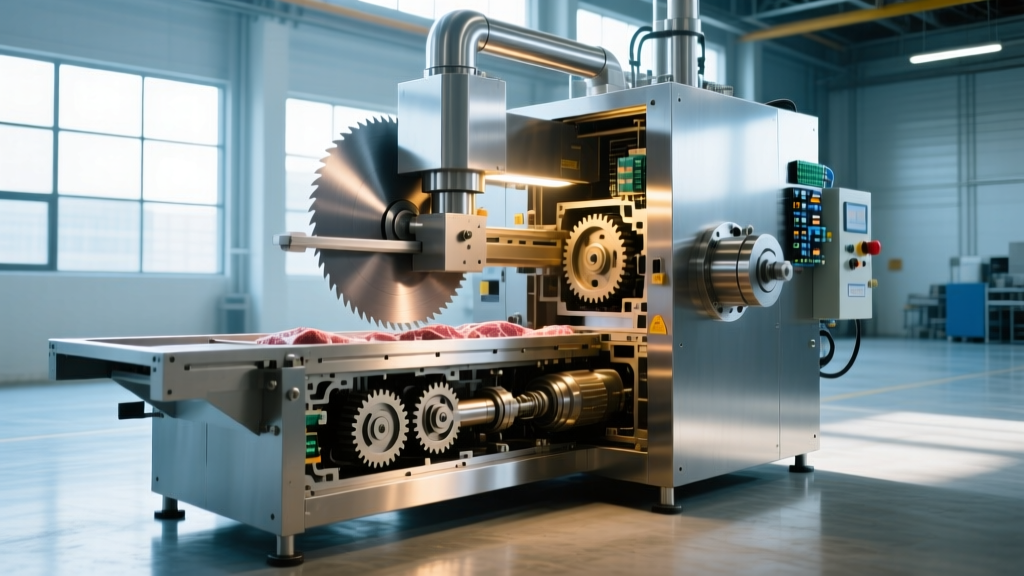
For high-speed slicers like the Weber Slicer 906, capable of up to 1,500 cuts per minute, maintenance is dictated by blade metallurgy and carriage rail lubrication. Weber mandates automated stropping cycles every 8 hours of runtime. However, the critical OEM service interval involves the carriage drive servos. Because these slicers operate in high-moisture environments, Weber requires the replacement of the FDA-approved bellows seals on the linear guides every 1,200 hours to prevent peracetic acid (PAA) washdown ingress into the servo motors.
Provisur: Heavy-Duty Forming Maintenance
Provisur’s Formax F-26 patty formers rely on immense hydraulic and mechanical torque. The OEM maintenance schedule focuses heavily on the pump drive and feed auger timing. Provisur mandates a quarterly laser-alignment check on the main drive motor and pump coupling. Misalignment as slight as 0.05mm can cause accelerated wear on the universal joints, leading to catastrophic failure during high-volume runs.
Comparative OEM Service Level Agreement (SLA) Matrix
When negotiating with industrial meat processing equipment manufacturers, understanding the tiered SLA structures is vital. Below is a comparison of standard enterprise maintenance contracts for a complete primary processing line.
| Manufacturer | Standard PM Interval | IoT Predictive Capability | Avg. Annual Contract Cost | Guaranteed Response SLA |
|---|---|---|---|---|
| Marel | 500 Hours / Monthly | Full Telemetry (Marel Connect) | $38,000 - $45,000 | 4 Hours Remote / 24 Hours On-site |
| Weber | Quarterly / 1,200 Hours | Vibration & Temp Monitoring | $22,000 - $28,000 | 8 Hours Remote / 48 Hours On-site |
| Provisur | Bi-Annual / 2,500 Hours | Motor Current Signature Analysis | $18,000 - $24,000 | 12 Hours Remote / 72 Hours On-site |
| Handtmann | 1,500 Hours (Vane Pump) | Vacuum Pressure Telemetry | $15,000 - $19,000 | 6 Hours Remote / 36 Hours On-site |
Critical Component Service Intervals and Failure Modes
Generic preventive maintenance checklists fail in meat processing. Maintenance schedules must be tailored to the specific failure modes induced by animal proteins, fats, and aggressive sanitation chemicals. Below are the exact OEM-specified intervals for high-wear components.
1. Vacuum Fillers (e.g., Handtmann VF 800)
- Component: Vane pump sanitary seals and gearbox oil.
- Failure Mode: Fat and myoglobin ingress past degraded seals, contaminating the gearbox lubricant and causing vane scoring.
- OEM Schedule: Replace FDA-grade EPDM or FKM (Viton) seal kits every 1,500 hours. Drain and replace gearbox oil with NSF H1-registered synthetic lubricant (e.g., Mobilgrease FM 222 equivalent) every 3,000 hours.
- Cost Impact: A $450 seal kit prevents a $12,000 vane pump rebuild.
2. Industrial Smokehouses (e.g., Maurer-Atmos)
- Component: Circulation fan bearings and damper actuators.
- Failure Mode: Creosote and tar buildup from smoke generators seizes damper linkages and unbalances circulation fans, leading to uneven product cooking and motor burnout.
- OEM Schedule: Quarterly ultrasonic cleaning of actuator linkages. Monthly vibration analysis on circulation fan bearings to detect early-stage pitting caused by thermal expansion and contraction.
3. Portioning and Grinding (e.g., Provisur Weiler Dominator)
- Component: Cutting plates, knives, and feed auger bushings.
- Failure Mode: Bone fragments cause micro-fractures in cutting plates. Worn auger bushings allow metal-on-metal contact, introducing physical hazards into the meat stream.
- OEM Schedule: Inspect and rotate grinding plates every 40 hours of runtime. Replace ultra-high-molecular-weight polyethylene (UHMWPE) auger bushings every 800 hours.
Sourcing non-OEM sanitary seals to cut costs is a critical compliance risk. Substituting food-grade FKM with standard industrial NBR (Nitrile) seals violates FDA cGMP regulations regarding food-contact surfaces. Furthermore, using unauthorized parts immediately voids the OEM’s IoT telemetry warranty, leaving the plant fully liable for catastrophic drive failures.
The 2026 Shift: Predictive Telemetry vs. Calendar Maintenance
The most significant evolution among industrial meat processing equipment manufacturers is the transition from calendar-based maintenance to condition-based predictive servicing. Modern equipment is now outfitted with Motor Current Signature Analysis (MCSA) and tri-axial vibration sensors.
Instead of replacing a slicer carriage bearing every 12 months regardless of condition, the OEM’s edge-computing module monitors the specific harmonic frequencies generated by the bearing. When the sensor detects a 15% deviation in the baseline vibration signature—indicating early-stage lubricant starvation or raceway spalling—it automatically generates a work order in the plant’s CMMS. This prevents both premature part replacement (wasting money) and unexpected failures (wasting yield).
Lockout/Tagout (LOTO) Integration in Modern Servicing
Maintenance schedules are useless if technicians cannot safely execute them. Meat processing has one of the highest rates of LOTO-related injuries in manufacturing. Recognizing this, top-tier manufacturers now engineer maintenance access points with integrated safety bleeds.
For example, modern hydraulic formers feature automated pneumatic and hydraulic bleed valves that engage the moment the main disconnect is locked out, dropping stored energy to zero PSI. This engineering control aligns directly with OSHA’s Lockout/Tagout standards, reducing the time required for safe energy isolation from 15 minutes to under 90 seconds, thereby increasing maintenance compliance rates among floor technicians.
Structuring Your Master Maintenance Calendar
To effectively manage a fleet of equipment from various industrial meat processing equipment manufacturers, plant engineers must synthesize OEM manuals into a unified master schedule. Follow this framework:
- Audit Washdown Chemicals: Cross-reference your sanitation department’s chemical concentrations (e.g., 200ppm Peracetic Acid, 2.5% Sodium Hydroxide) with the OEM’s material compatibility charts. If your chemicals exceed OEM baselines, accelerate seal and exterior paint replacement intervals by 25%.
- Map IoT Alerts to CMMS: Integrate the OEM’s API directly into your maintenance software. Ensure that predictive alerts automatically generate purchase requisitions for the specific OEM part number, eliminating procurement delays.
- Align with USDA Sanitation Windows: Schedule heavy mechanical PMs (like gearbox oil changes) immediately following the daily USDA FSIS sanitation performance windows. This ensures that any lubricant spills or particulate dislodged during maintenance are completely sanitized before the next production shift begins.
Frequently Asked Questions
Can third-party technicians service IoT-enabled meat processing equipment?
While third-party technicians can handle basic mechanical swaps, accessing the proprietary diagnostic software required to recalibrate IoT sensors, servo drives, and vision systems is typically restricted to certified OEM engineers. Utilizing unauthorized technicians for software-level maintenance often results in the OEM disabling remote support capabilities.
How do high-pressure washdowns affect lubrication schedules?
High-pressure (800+ PSI) foaming and rinsing physically strip grease from external fittings and chain drives. If your facility utilizes automated COP (Clean-Out-of-Place) or high-pressure washdown systems, OEM lubrication intervals for external chains and guide rails must be reduced from weekly to daily, utilizing high-tack, water-resistant NSF H1 greases.
Related reading
Meat Processing Equipment Manufacturers: 2026 Technical Guide

Code and Standards Compared: Navigating FDA, USDA, Codex, ISO 22000, and BRCGS in Food Processing