Top Industrial Food Processing Equipment Manufacturers: Case Studies
Analyze how top industrial food processing equipment manufacturers optimize dairy and poultry lines with UHT homogenizers and vision-guided portioning.
The Capital Reality of 2026 Food Plant Expansions
Scaling a mid-tier food production facility into a high-throughput operation requires more than just buying larger vats. When plant engineers evaluate industrial food processing equipment manufacturers, the focus has shifted from standalone machine capacity to integrated line architecture, automated Clean-In-Place (CIP) efficacy, and real-time yield telemetry. In 2026, the margin for error in dairy pasteurization and poultry evisceration is measured in fractions of a percent, where a 0.5% yield loss can erase a facility's quarterly profit.
This analysis examines two distinct deployment scenarios—high-throughput UHT dairy processing and automated poultry portioning—to illustrate how leading OEMs solve specific mechanical and sanitary engineering challenges.
Case Study 1: UHT Dairy Line Integration and Thermal Recovery
Upgrading a 50,000-liter-per-day fluid milk facility to a 200,000-liter UHT (Ultra-High Temperature) operation requires a complete overhaul of the homogenization and thermal regeneration stack. The primary engineering bottleneck in legacy systems is the degradation of heat transfer efficiency due to protein fouling on the heat exchanger plates, which forces frequent CIP cycles and destroys Overall Equipment Effectiveness (OEE).
Equipment Selection: GEA Ariete Homogenizers and Tubular Heat Exchangers
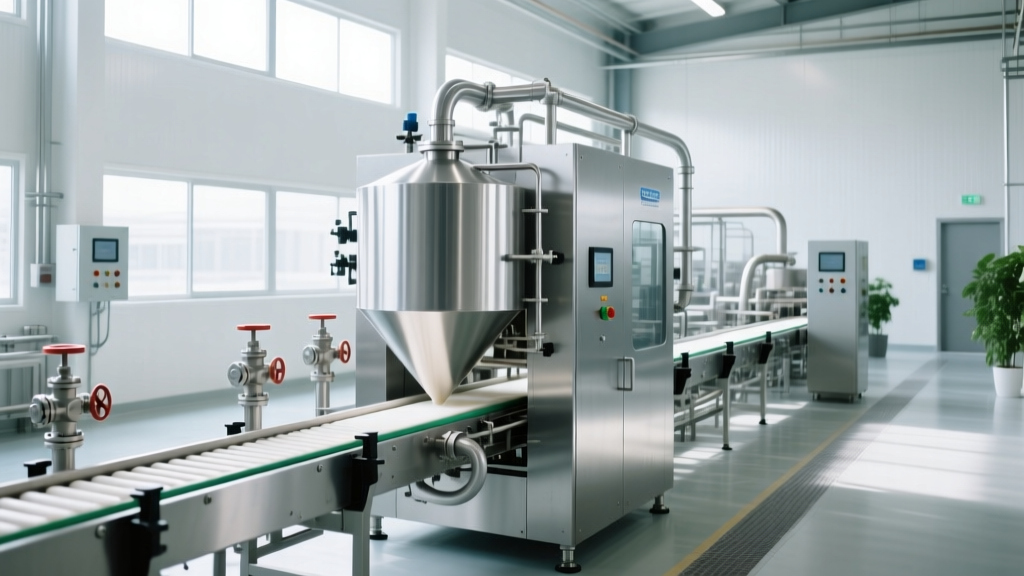
For continuous UHT operations, plant engineers frequently specify the GEA Ariete series homogenizers paired with tubular heat exchangers. Unlike plate heat exchangers, tubular systems handle high-viscosity dairy products and maintain structural integrity at the 140°C to 150°C temperatures required for UHT sterilization.
Engineering Callout: CIP Flow Velocity RequirementsA common failure mode in newly installed dairy lines is inadequate CIP fluid velocity. To achieve the necessary turbulent flow for soil removal in tubular heat exchangers, the CIP supply pump must guarantee a minimum flow velocity of 1.5 meters per second (m/s) at the furthest endpoint. Undersized return lines frequently cause cavitation and leave protein biofilms intact, leading to premature spoilage.
| Metric | Legacy Plate System (Pre-2020) | Modern Tubular UHT Stack (2026 Standard) |
|---|---|---|
| Thermal Regeneration Efficiency | 75% - 80% | 90% - 94% |
| Continuous Run Time Before CIP | 8 - 12 hours | 24 - 36 hours |
| Homogenization Pressure | 150 bar (Single-stage) | 250 bar (Two-stage) |
| Product Shear Damage | Moderate (Fat globule clumping) | Minimal (Uniform dispersion) |
By implementing a two-stage homogenizer operating at 250 bar, manufacturers prevent fat globule coalescence, which is critical for extending the shelf life of UHT milk to 6-9 months without refrigeration. The 92% thermal regeneration rate drastically cuts steam consumption, reducing the facility's thermal energy overhead by approximately 18% compared to older plate-based systems.
Case Study 2: Vision-Guided Yield Optimization in Poultry Processing
While dairy processing relies on thermal dynamics, poultry processing is an exercise in high-speed biomechanical precision. A standard broiler plant processing 14,000 birds per hour (BPH) cannot rely on manual evisceration or fixed-gauge portioning. The integration of vision-guided robotics by top industrial food processing equipment manufacturers has redefined yield recovery.
Marel Nuova Eviscerator and IRIS Vision Systems
The transition from legacy mechanical eviscerators to intelligent systems like the Marel Nuova eviscerator represents a shift from fixed-position tooling to adaptive processing. The Nuova system utilizes a specialized spoon design that adjusts to the anatomical variance of the carcass, reducing the incidence of gall bladder rupture—a critical defect that results in immediate carcass condemnation under USDA FSIS Compliance Guidelines.
'In high-throughput poultry lines, a 0.5% improvement in breast meat yield recovery translates to over $2.5 million in annualized revenue for a standard 14,000 BPH facility. Vision systems are no longer optional; they are the primary lever for margin protection.' — Industrial Poultry Processing Engineering Report, 2025
Downstream, the IRIS vision system captures 3D topographical data of each carcass at line speed. This data is instantly routed to the Intelligent Portioning System (IPS), which calculates the optimal cutting paths for breast fillets to maximize weight while avoiding the keel bone. The mechanical cutters adjust their blade angles in milliseconds based on the IRIS telemetry.
Sanitary Design and the 3-A Standard
High-speed poultry equipment faces severe bio-load challenges. All modern portioning and evisceration equipment must adhere strictly to 3-A Sanitary Standards and EHEDG guidelines. This dictates the use of 316L stainless steel for all product-contact surfaces, continuous welds with a maximum Ra (surface roughness) of 0.8 µm, and the total elimination of dead legs in lubrication lines. Manufacturers that fail to provide IP69K-rated enclosures for their servo motors and vision cameras will inevitably face premature electrical failures during the high-pressure, high-temperature washdown cycles required by the Food Safety Modernization Act (FSMA) preventive controls.
Predictive Maintenance and IoT Sensor Integration
Modern OEMs are no longer just selling mechanical hardware; they are deploying edge-computing nodes directly onto the processing line. In high-throughput environments, unplanned downtime costs facilities upwards of $30,000 per hour. To mitigate this, leading manufacturers now integrate tri-axial vibration sensors and acoustic emission monitors directly into the gearboxes of heavy-duty mixers and homogenizers.
For example, monitoring the high-frequency acoustic signatures of a UHT homogenizer's pump valves allows the edge controller to detect micro-cavitation weeks before a catastrophic seal failure occurs. This data is fed into a digital twin of the processing line, allowing maintenance teams to schedule part replacements during planned CIP cycles rather than suffering mid-run breakdowns. When evaluating equipment bids, requiring native MQTT or EdgeX Foundry compatibility ensures that the OEM's sensors will seamlessly feed your plant's predictive maintenance algorithms without requiring expensive third-party middleware.
Evaluating Manufacturers: A Technical Decision Matrix
When procuring capital equipment, plant managers must look beyond the initial purchase price. Use this framework to evaluate competing bids from industrial OEMs:
- Automation Stack Interoperability: Does the equipment natively support OPC-UA or PackML protocols? Proprietary, closed-loop PLCs will severely limit your ability to integrate the machine into a plant-wide SCADA system for OEE tracking.
- Hygienic Zoning Capability: Can the machine operate across different hygienic zones (e.g., raw to ready-to-eat) without requiring a physical barrier? Look for manufacturers that design equipment with integrated air-over-pressure systems to prevent aerosolized cross-contamination.
- Spare Parts Lead Times: Require contractual guarantees on critical wear parts (e.g., homogenizer pistons, vision camera lenses, eviscerator spoons). In 2026, acceptable lead times for tier-1 critical spares should not exceed 72 hours via regional depots.
- CIP Chemical Compatibility: Verify that all elastomers and gaskets (typically EPDM or Viton) are chemically validated for the specific caustic and peracetic acid concentrations used in your facility's CIP recipes.
The Verdict on Line Integration
The distinction between a profitable food plant and a struggling one often lies in the micro-efficiencies of its processing line. By selecting industrial food processing equipment manufacturers that prioritize thermal regeneration in dairy and adaptive, vision-guided tooling in meat processing, engineers can secure measurable gains in yield, energy consumption, and regulatory compliance. The capital expenditure is significant, but the mathematical reality of modern food manufacturing demands equipment that pays for itself through defect reduction and uptime maximization.