Food Processing Industry Machinery: 2026 Buyer Guide
Navigate CapEx, sanitary design, and automation for food processing industry machinery. A comprehensive 2026 procurement framework for plant managers.
Procuring food processing industry machinery requires balancing immediate capital expenditure (CapEx) against long-term operational efficiency, sanitary compliance, and utility consumption. In 2026, the margin for error in equipment selection has narrowed; supply chain lead times for specialized components remain volatile, and regulatory scrutiny regarding allergen cross-contact and biofilm harborage is at an all-time high. This guide provides plant managers and procurement engineers with a technical framework for evaluating, sizing, and integrating core processing assets.
Capital Allocation: Mapping Machinery to Production Scale
Equipment pricing fluctuates based on throughput capacity, metallurgical requirements, and automation tiers. When evaluating food processing industry machinery, buyers must align the asset's maximum continuous rating (MCR) with their target Overall Equipment Effectiveness (OEE). Specifying a machine with 30% excess capacity 'for future growth' often results in severe product degradation during partial-load runs and inflated utility baselines.
| Equipment Category | Benchmark Models (2026) | Estimated CapEx Range | Target Throughput |
|---|---|---|---|
| Continuous Thermal (Frying) | Heat and Control MasterCook | $250,000 - $650,000 | 2,000 - 8,000 lbs/hr |
| Precision Portioning | Marel I-Cut 130 | $120,000 - $280,000 | 130 cuts per minute |
| Aseptic Filling | Tetra Pak A3/CompactFlex | $800,000 - $1.8M+ | 9,000 - 15,000 packs/hr |
| Scraped Surface Heat Exchanger | GEA Contherm Core | $90,000 - $180,000 | 500 - 3,000 liters/hr |
The Sanitary Design Imperative: Beyond Basic Stainless
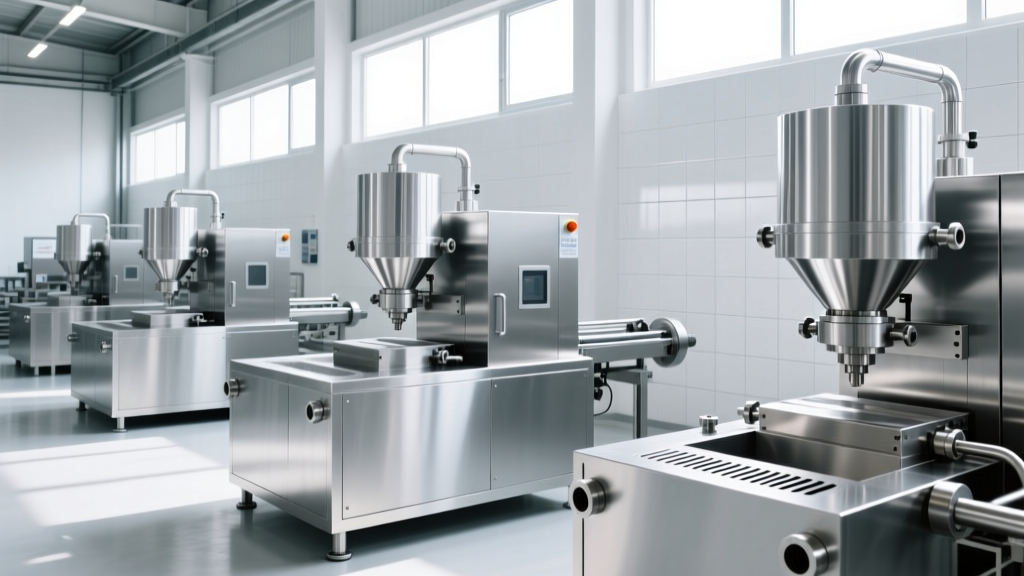
Specifying 'stainless steel' is insufficient for modern food safety compliance. The specific alloy, surface finish, and geometric design dictate whether a machine will pass a FDA FSMA Part 117 preventive controls audit or become a chronic source of Listeria monocytogenes contamination.
Material Selection Matrix:304 Stainless Steel: Acceptable for dry zones, packaging areas, and low-moisture environments.
316L Stainless Steel: Mandatory for high-chloride environments, raw protein zones, and areas subjected to aggressive caustic or acidic Clean-in-Place (CIP) chemicals. The 'L' denotes low carbon, preventing sensitization and intergranular corrosion during welding.
Surface finishes must be mechanically polished and electropolished to a roughness average (Ra) of ≤ 0.8 µm (micrometers). Any surface exceeding 0.8 µm provides microscopic valleys where biofilms can anchor, rendering standard CIP chemical concentrations ineffective. Furthermore, all horizontal surfaces must be eliminated or pitched at a minimum 3-degree angle to ensure self-draining. Tubing and piping must be free of 'dead legs'—defined by 3-A Sanitary Standards as any branch or pocket where the length exceeds the inner diameter of the pipe.
Automation Architecture and Edge Analytics
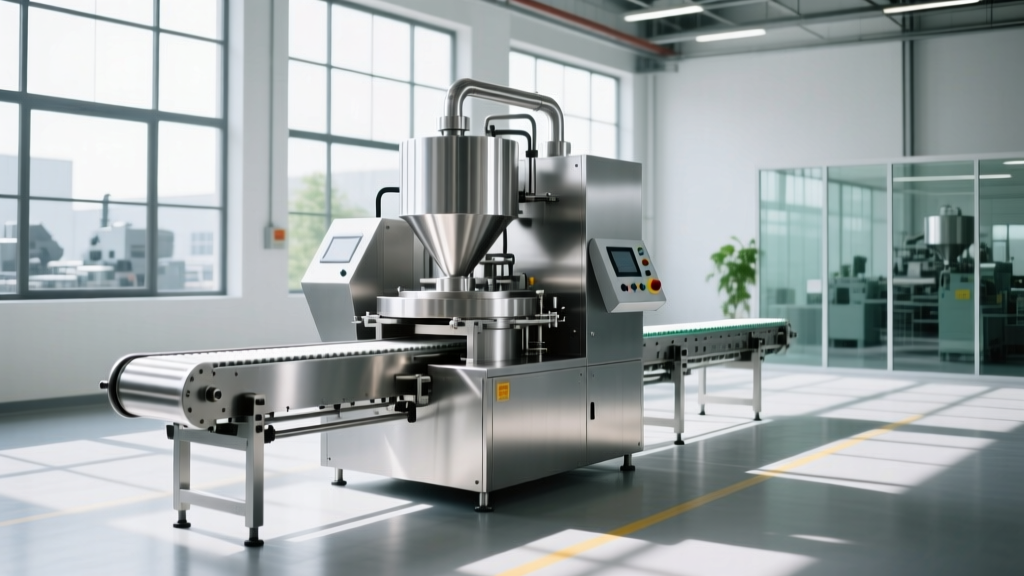
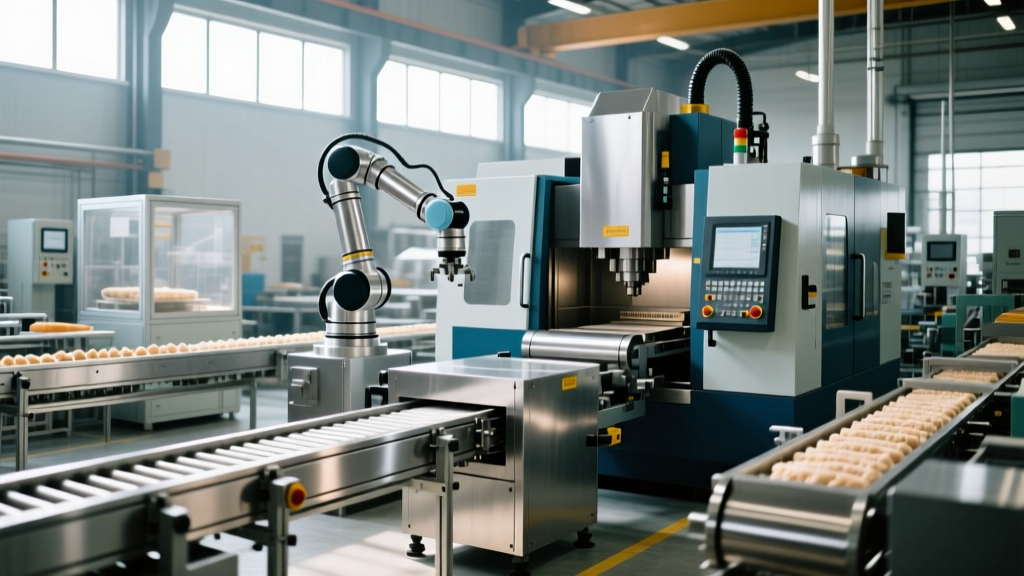
The era of isolated PLCs is over. Modern food processing industry machinery must integrate seamlessly into plant-wide SCADA (Supervisory Control and Data Acquisition) systems and support edge computing for real-time OEE tracking. When reviewing electrical schematics, mandate the use of standardized industrial protocols like OPC UA or MQTT, rather than proprietary, closed-loop communication networks.
'Facilities that mandate open-architecture PLCs (such as Rockwell PlantPAx or Siemens SIMATIC PCS 7) during the procurement phase reduce long-term integration costs by up to 40%. Proprietary black-box controllers lock plants into single-vendor service contracts and prevent the deployment of third-party predictive maintenance sensors.' — Industrial Automation Engineering Review, 2025
Look for machinery equipped with smart motor control centers (MCCs) featuring integrated power monitoring. These systems track amperage spikes at the component level, allowing maintenance teams to predict bearing failures in mixers or conveyor drives weeks before a catastrophic seizure occurs. Aligning your equipment with NIST smart manufacturing frameworks ensures your data architecture is scalable for future AI-driven process optimization.
TCO and the Hidden Costs of Utility Integration
The purchase price of food processing industry machinery typically represents only 25% to 30% of its Total Cost of Ownership (TCO) over a 10-year lifecycle. The remaining costs are absorbed by utility consumption, sanitation labor, and spare parts. Procurement teams must evaluate the following utility metrics before issuing a Purchase Order:
- CIP Flow Requirements: Ensure the machine's internal piping diameter supports a minimum turbulent flow velocity of 1.5 to 2.0 meters per second. If the equipment requires a higher flow rate than your facility's CIP return pump can deliver, you will need to upgrade your central CIP skid—an often-overlooked $75,000+ hidden cost.
- Motor Efficiency Ratings: Reject standard IE2 motors. Mandate IE4 (Super Premium) or IE5 (Ultra Premium) efficiency ratings on all drive motors. The energy savings on a 15kW mixer running 16 hours a day will pay the motor upgrade differential in under 14 months.
- Washdown Ingress Protection: Electrical enclosures and HMI screens in wet processing zones must carry an IP69K rating, certifying they can withstand close-range, high-pressure (100 bar), high-temperature (80°C) washdowns without moisture ingress.
- Compressed Air Consumption: Pneumatic actuators are standard for diverters and valves, but they are notoriously inefficient. Specify equipment that utilizes electric servo-driven actuators for high-cycle movements to eliminate compressed air leaks and reduce compressor load.
FAT/SAT Protocol: The Final Procurement Gate
Never accept delivery of complex food processing machinery without executing rigorous Factory Acceptance Testing (FAT) and Site Acceptance Testing (SAT). The FAT must be conducted at the OEM's facility using your actual raw materials, not surrogate products. Water or dummy loads will not reveal how the machine handles the specific viscosity, particulate size, or fat content of your formulation.
Critical FAT Verification Steps:
- Sanitary Tear-Down: Physically dismantle all product-contact wear parts (gaskets, scraper blades, seals). Time the reassembly process. If it requires specialized tools or takes operators more than 15 minutes, reject the design for sanitation inefficiency.
- Thermal Mapping: For ovens, fryers, and pasteurizers, run a multi-point data logger through the thermal process. Verify that the temperature variance across the product bed does not exceed ±1.5°C.
- Software Fail-Safes: Intentionally trigger E-stops, drop network connections, and simulate sensor failures. The PLC must default to a safe state, retain batch recipe data in non-volatile memory, and require manual, authenticated intervention to restart.
For comprehensive sanitary design benchmarks, refer to the 3-A Sanitary Standards index to ensure your specific product category (dairy, meat, beverage) aligns with the required geometric and material mandates. By enforcing these technical specifications during the RFP stage, plant engineers can eliminate chronic downtime, ensure regulatory compliance, and secure a rapid return on capital invested.