Troubleshooting Drum Vibration Faults in Roller Heavy Equipment
Diagnose and repair vibratory drum failures, hydraulic cavitation, and eccentric bearing faults in roller heavy equipment with expert protocols.
The True Cost of Vibratory Circuit Downtime
When a 21-ton soil compactor like the Bomag BW 213 or Caterpillar CS54 loses its vibratory function, production rates drop by up to 45%, forcing contractors to make additional passes to achieve the required 95% Proctor density. In roller heavy equipment, the vibratory circuit is a closed-loop hydrostatic system that operates under extreme stress. Diagnosing these faults requires moving beyond superficial symptom-checking and directly measuring hydraulic volumetric efficiency and mechanical tolerances. A misdiagnosed vibratory fault can lead to unnecessary pump replacements, costing upwards of $7,000 in parts and labor, when the root cause may be a $40 charge pressure relief valve.
CRITICAL SAFETY PROTOCOL
Never open a vibratory drum inspection cover without locking out the engine and relieving hydraulic accumulator pressure. Stored kinetic energy in the eccentric weights can cause fatal crushing injuries. Always adhere to OSHA heavy equipment safety guidelines and utilize mechanical drum locks before servicing internal components.
Symptom-to-Failure Diagnostic Matrix
Field technicians often misattribute mechanical binding to hydraulic failure. Use this matrix to isolate the faulty subsystem before tearing down components.
| Primary Symptom | Hydrostatic Cause | Mechanical Cause | Definitive Diagnostic Test |
|---|---|---|---|
| Drum hums but won't vibrate | Charge pressure dropping below 20 bar (290 psi) | Sheared splined coupling between motor and drum | Install case drain flow meter; inspect coupling via inspection port |
| Erratic vibration frequency (surging) | Air ingestion in suction line or clogged charge filter | Eccentric weight out of balance due to shifted internal lead | Check reservoir breather cap; measure vacuum at pump inlet |
| High-pitch whine at max RPM | Pump cavitation (fluid ISO code > 20/18/15) | Spherical roller bearing spalling | Take 100ml fluid sample; run accelerometer on drum bearing housing |
| Vibration stops after 10 minutes of operation | Internal pump bypass due to thermal expansion of worn pistons | Overheating bearing seizing in housing | Monitor case drain flow as fluid temp rises from 40°C to 70°C |
Deep Dive: Hydraulic Pump Cavitation and Micro-Spalling
The vibratory pumps in modern roller heavy equipment—typically Danfoss Series 90 or Rexroth A4VG variable displacement axial piston pumps—rely on a precise charge pressure to keep the rotating group lubricated and prevent cavitation. The factory charge pressure specification is usually 22 to 28 bar (320 to 400 psi). When the charge relief valve spring fatigues or the charge pump gear set wears, pressure drops.
Fluid Cleanliness and ISO Targets
Cavitation is frequently exacerbated by microscopic particulate contamination. According to SAE hydraulic fluid standards, closed-loop hydrostatic systems require an ISO 4406 cleanliness code of 18/16/13 or better. If your fluid sample returns a code of 22/20/17, the silica particles are acting as lapping compound on the piston slipper pads. As of 2026, replacing a factory-remanufactured Danfoss Series 90 vibratory pump ranges from $5,200 to $7,100, whereas a high-efficiency 10-micron breather filter and offline kidney-loop filtration setup costs under $1,800.
Eccentric Weight Bearing Failures: Tolerances and Grease Specs
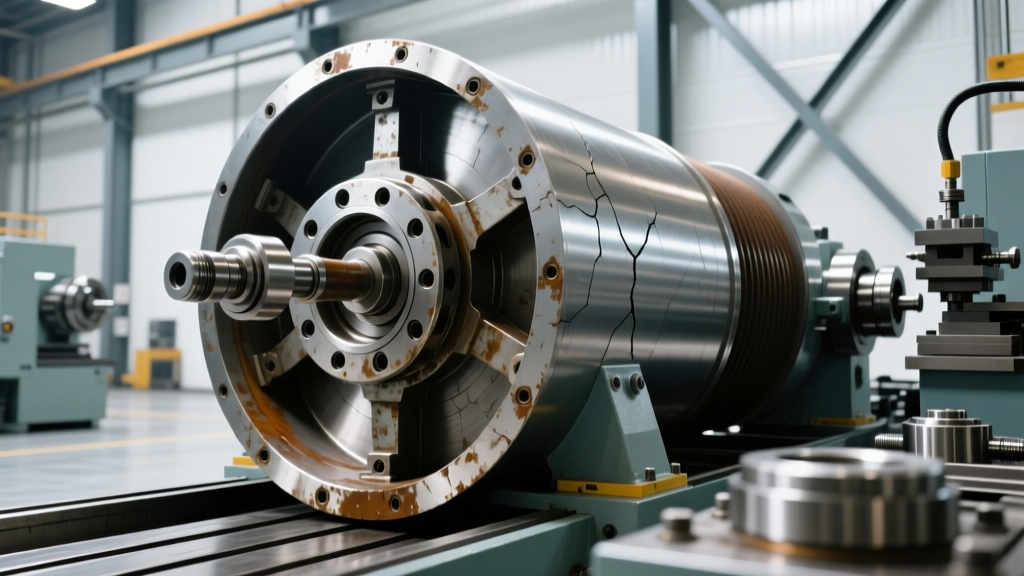
If the hydraulic circuit tests within spec, the fault lies inside the drum. The eccentric weights rotate at up to 2,000 RPM, generating centrifugal forces exceeding 300 kN (67,000 lbs). This load is supported by heavy-duty spherical roller bearings, such as the SKF 22320 E series.
Expert Insight: Internal Clearance Matters
Never replace a vibratory drum bearing with a standard C0 (Normal) internal clearance bearing. The operational heat generated inside the drum (often reaching 85°C / 185°F) causes the inner race to expand. You must specify a C3 or C4 internal clearance bearing. Installing a standard clearance bearing will result in radial preload and catastrophic seizure within 40 to 60 operating hours.
Lubrication Chemistry
Standard multi-purpose lithium grease will melt and channel out of the bearing race under high-frequency vibration. You must use an NLGI Grade 2 Lithium Complex grease fortified with 3% to 5% Molybdenum Disulfide (MoS2). The MoS2 provides a solid-film boundary lubricant that protects the bearing during the high-shock shock loads when the roller changes direction on soft asphalt. Maintenance intervals for re-greasing these bearings should strictly follow AEMP preventive maintenance guidelines, typically requiring 80 to 100 grams of grease every 250 hours, depending on the drum diameter.
Step-by-Step Isolation Procedure for Closed-Loop Systems
Follow this exact sequence to isolate a vibratory fault without removing the pump from the machine.
- Tee-in the Charge Pressure Gauge: Locate the charge pressure test port on the pump manifold. Connect a 0-600 psi liquid-filled gauge. Start the engine and engage the vibration at high amplitude. If pressure drops below 250 psi, replace the charge relief valve cartridge before condemning the gear pump.
- Measure High-Pressure Relief: Deadhead the vibratory circuit by mechanically blocking the drum from rotating (using the factory lock pin). Momentarily engage the vibration to spike the pressure. The high-pressure relief valve should crack open at exactly 420 bar (6,000 psi). If it opens at 350 bar, the system cannot generate enough torque to turn the eccentric weights, resulting in a 'humming' drum.
- Quantify Case Drain Flow: Disconnect the case drain line from the vibratory hydraulic motor and route it into a calibrated flow meter bucket. Run the system at 2,000 RPM. A healthy motor will leak less than 0.3 GPM (1.1 L/min) internally. If you measure 1.5 GPM or more, the motor's internal piston seals are blown, and the motor requires a $2,400 reseal or replacement.
- Check the Electrical Solenoid: Modern rollers use proportional electro-hydraulic solenoids to control the swashplate. Use a multimeter to verify the solenoid is receiving the full 12V/24V PWM signal from the ECU. A corroded Deutsch connector dropping voltage to 9V will result in partial swashplate stroke, yielding low-amplitude, weak vibration.
Preventive Maintenance Intervals
Reactive repairs on roller heavy equipment destroy project margins. Implementing a strict condition-based monitoring program prevents catastrophic failures. Sample the hydrostatic fluid every 500 hours for particle counting and moisture analysis. Inspect the drum shock absorbers (isolation mounts) every 1,000 hours; degraded rubber mounts transfer destructive harmonic vibrations directly into the machine's mainframe and hydraulic fittings, causing stress fractures and hose blowouts. By treating the vibratory circuit as a precision aerospace system rather than a blunt construction tool, equipment managers can reliably extend the service life of the drum assembly past 12,000 operating hours.