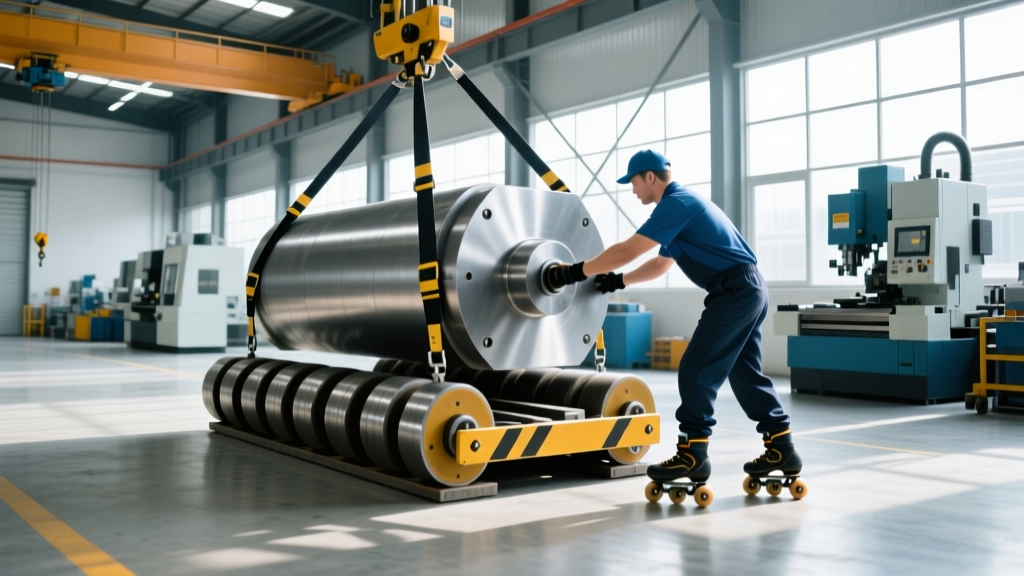
Operator Training: Roller Skids for Moving Heavy Equipment Safely
Master operator training for roller skids for moving heavy equipment. Learn load calculations, rigging best practices, and safety protocols.
The Physics of Relocating Heavy Compaction Machinery
Relocating heavy compaction equipment—such as 22-ton single-drum vibratory rollers or 15-ton pneumatic tire compactors—across finished surfaces requires precision. Driving a vibratory roller under its own power across an epoxy-coated plant floor or a sensitive, pre-graded subbase can cause severe shear damage, rutting, or surface contamination. In these scenarios, operators must rely on roller skids for moving heavy equipment to translate massive static loads into controlled, low-friction lateral movement.
Understanding the physics of rolling resistance is the foundation of operator training. The force required to initiate movement (breakaway thrust) is always higher than the force required to maintain it. For a 46,000 lb (20,800 kg) machine like the Bomag BW 226, the breakaway thrust on polyurethane wheels over smooth concrete requires approximately 15% of the total weight (6,900 lbs of force). Once rolling, the coefficient of friction drops to roughly 0.05 to 0.10, requiring only 2,300 to 4,600 lbs of continuous pulling force. Operators must size their electric tuggers or forklifts based on the breakaway metric, not the rolling metric, to prevent equipment stall and steering bar failure.
⚠️ Critical Warning: Center of Gravity (CG) Bias in CompactorsCompaction equipment is inherently unbalanced. A typical vibratory soil compactor has up to 65% of its total mass concentrated over the rear articulation joint, engine compartment, and cab. Never use a standard equidistant 4-point skid layout without calculating the specific axle load. The rear tandem skids must be rated to handle at least 70% of the machine's total operating weight to prevent catastrophic skid buckling during transit.
Skid Wheel Material Selection Matrix
Selecting the correct roller skid wheel material is dictated by the floor condition and the point-load limits of the surface. Using steel wheels on finished concrete will instantly spall and crack the surface, while using nylon wheels on rough asphalt will lead to immediate wheel binding and polyurethane delamination.
| Wheel Material | Max Load per Skate | Ideal Surface | Rolling Resistance (μ) | Primary Failure Mode |
|---|---|---|---|---|
| Forged Steel | 50+ Tons | Steel plates / heavy timber | 0.05 | Surface gouging, high noise |
| Polyurethane | 5 - 25 Tons | Smooth concrete / epoxy | 0.10 | Flat-spotting from static loads |
| Nylon | 2 - 15 Tons | Asphalt / rough concrete | 0.08 | Brittle fracture on debris |
Step-by-Step Rigging and Placement Protocol
Proper placement of roller skids under heavy machinery requires strict adherence to jacking and load-transfer procedures. According to OSHA 1926.251 Rigging Equipment Standards, all load-bearing points must be verified before lifting. Follow this exact sequence when moving a heavy vibratory roller:
- Verify Floor Bearing Capacity: Standard 4,000 PSI concrete can safely support a skid footprint of 25 square inches carrying 10,000 lbs (400 PSI). However, if the skid pivots on a 2-inch steering bolt, localized pressure spikes to 2,500 PSI. Always use steel load-spreading plates under the skids if the floor is aged or degraded.
- Block and Crib the Machine: Before lifting, engage the parking brake, chock the articulation joint to prevent swinging, and place 6x6 timber cribbing under the chassis as a secondary fail-safe.
- Position Hydraulic Toe Jacks: Use toe jacks with a minimum 1.5x safety factor (e.g., a 15-ton jack for a 10-ton lift point). Lift the machine exactly 2.5 inches—no higher than necessary to clear the skid height.
- Insert Skids and Connect Steering: Slide the skids into position. Connect the steering bars using the heavy-duty shear pins provided by the manufacturer (e.g., Hilman Rollers or Jung). Never substitute shear pins with standard grade-5 bolts, as they lack the necessary shear strength for lateral torsion.
- Lower and Transfer Load: Slowly release the hydraulic pressure on the toe jacks, ensuring the load transfers evenly onto the skid suspension systems.
"The most common mistake operators make when skidding heavy compactors is ignoring the articulation hinge. If you place a skid directly under the articulation point of a tandem drum roller, the machine will pivot unpredictably when pulled. Always place skids at the extreme corners of the front drum frame and the rear axle housing."
— Lead Rigging Supervisor, Industrial Training International (ITI)
Calculating Required Thrust and Tugger Sizing
Operators must calculate the required pulling force to select the correct prime mover. The formula for breakaway thrust is F = W × μ(start). If you are moving a 50,000 lb pneumatic tire compactor on polyurethane skids over a slightly dusty concrete floor, the starting friction coefficient (μ) may rise to 0.15.
Calculation: 50,000 lbs × 0.15 = 7,500 lbs of breakaway thrust.
A standard 10,000 lb capacity forklift may struggle to initiate this movement without spinning its tires. Operators should utilize specialized electric industrial tuggers rated for a minimum of 8,000 lbs of horizontal drawbar pull, or use a 12,000 lb forklift with polyurethane drive tires for maximum traction.
Common Operator Failure Modes and Troubleshooting
Even with meticulous planning, moving 20-ton compaction equipment introduces severe mechanical stresses. Operators must be trained to identify and mitigate the following failure modes:
- Polyurethane Delamination (Flat-Spotting): Leaving a heavy vibratory roller resting on polyurethane skids over a weekend will cause the wheels to permanently deform, creating flat spots. This leads to violent vibrations and steering bar oscillation when movement resumes. Solution: Always lower the machine onto timber blocks if it will remain stationary for more than 4 hours.
- Steering Bar Shear Pin Failure: When navigating a corner, the inside skid travels a shorter radius than the outside skid. If the floor has high friction or debris, the torsional load can snap the steering linkage. Solution: Sweep the path completely and apply a light dusting of talcum powder or specialized floor lubricant on tight turns to reduce lateral scrubbing.
- Jack-Point Punch-Through: Modern compactors often feature lightweight, high-tensile steel chassis components. Placing a toe jack on a hollow cross-member will crush the frame. Solution: Only jack from designated lift points marked on the machine's chassis, typically reinforced with 1/2-inch steel gussets.
Safety and Compliance for Skid Operations
Compliance with ASME B30.20 Below-the-Hook Lifting Devices standards is mandatory when utilizing machinery skids, as they are classified as load-manipulating devices. Operators must conduct a pre-shift visual inspection of all skid bearings, wheel treads, and steering linkages.
Furthermore, the NIOSH Manual Material Handling Guidelines emphasize the ergonomic hazards of manual pushing and pulling. If the calculated rolling resistance exceeds 500 lbs of required force, mechanical assistance (tuggers or winches) is strictly required to prevent severe lumbar and shoulder injuries. Never allow personnel to walk alongside or behind the load path of a skidded compactor; a snapped tow strap or steering bar can cause the 20-ton machine to veer unpredictably. Maintain a minimum 10-foot exclusion zone around the moving equipment at all times.
Related reading

How To Match Machinery With Manufacturers: A Practical Field Guide for Compaction Professionals
Troubleshooting Drum Vibration Faults in Roller Heavy Equipment