Vietnam CNC Machining for International Markets: ISO vs AS9100
Compare ISO 9001 and AS9100 certifications when sourcing Vietnam CNC machining for international markets. Learn which standard fits your production needs.
Sourcing precision components from Southeast Asia has shifted from a cost-saving experiment to a strategic necessity. When evaluating Vietnam CNC machining for international markets, buyers quickly encounter a bifurcated supplier landscape: shops holding general ISO 9001:2015 certifications and those maintaining the rigorous AS9100 Rev D aerospace standard. Selecting the wrong certification tier for your specific application results in either unnecessary margin erosion or catastrophic supply chain failures.
This analysis breaks down the operational, financial, and quality differences between ISO 9001 and AS9100 machine shops in Vietnam's primary manufacturing hubs, such as Thang Long Industrial Park (Hanoi) and Saigon Hi-Tech Park (Ho Chi Minh City). We provide a concrete decision framework to align your engineering requirements with the correct quality management system (QMS).
The Baseline: ISO 9001:2015 in Vietnamese Machine Shops
ISO 9001:2015 is the foundational QMS standard. In the context of Vietnamese contract machining, an ISO 9001 certification indicates that the shop has documented processes for quality control, non-conformance handling, and continuous improvement. However, it is fundamentally a generic standard. It dictates that a process must exist, not what the specific technical parameters of that process must be.
Operational Realities on the Shop Floor
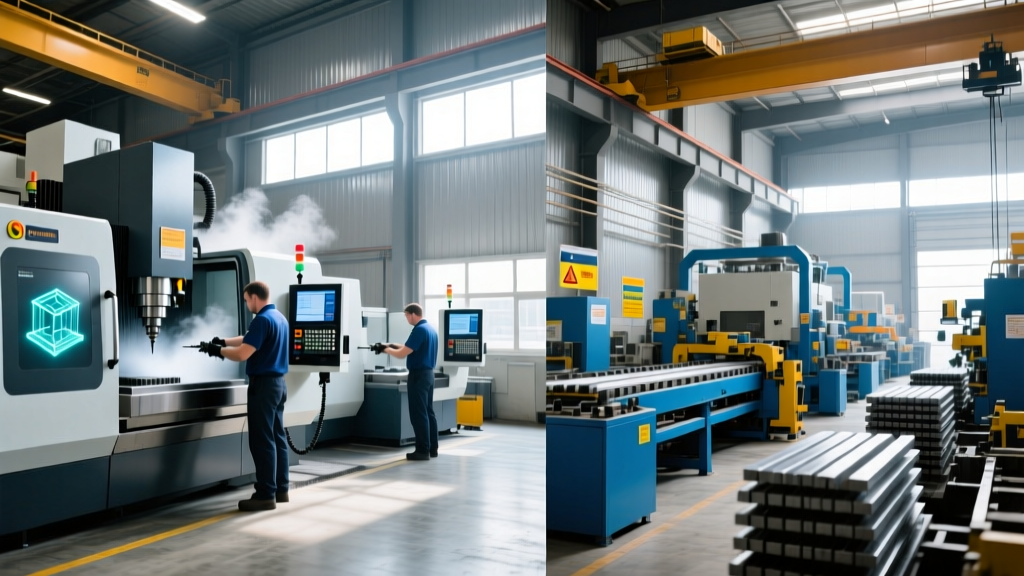
A typical ISO 9001-certified 5-axis CNC shop in Binh Duong province will utilize standard inspection protocols. They will likely employ calibrated Mitutoyo or Starrett hand tools and basic CMM (Coordinate Measuring Machine) routines. Material traceability is usually maintained at the batch level via mill certificates, but heat-lot tracking down to the individual serialized part is rarely enforced unless explicitly mandated by the purchase order.
Cost Benchmark: Maintaining ISO 9001 certification costs a mid-sized Vietnamese machine shop approximately $8,000 to $12,000 USD annually in audit fees and QMS administration. This low overhead allows these shops to offer highly aggressive piece-part pricing, typically 25% to 35% lower than domestic US or Western European equivalents.The Aerospace Standard: AS9100 Rev D Requirements
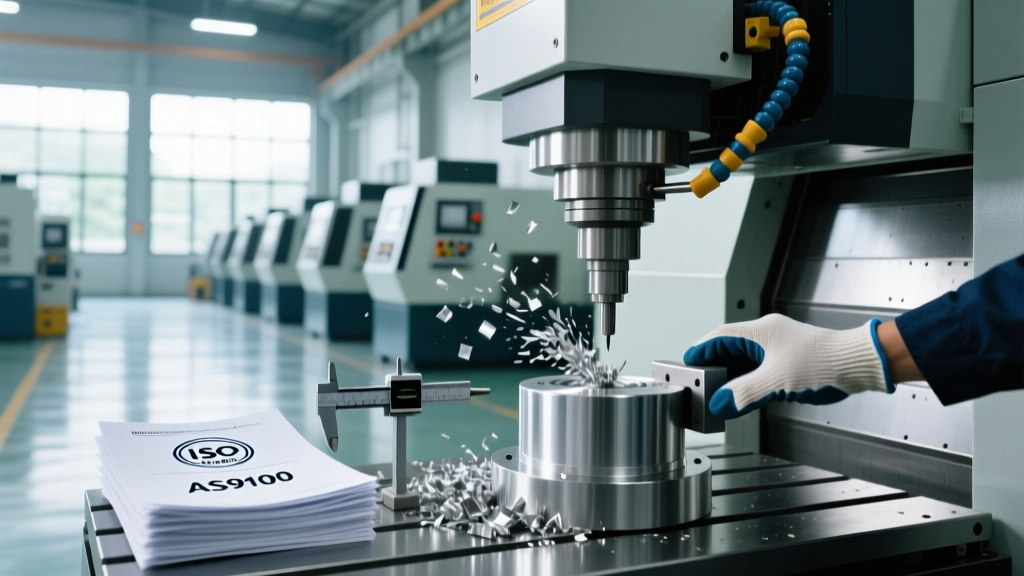
AS9100 Rev D incorporates the entirety of ISO 9001:2015 but adds over 100 specific requirements tailored to the aerospace, space, and defense sectors. For international buyers sourcing critical flight hardware or high-reliability medical implants from Vietnam, AS9100 is not optional—it is a risk mitigation tool.
Critical Differentiators in Precision Machining
- Counterfeit Parts Prevention (Clause 8.1.4): AS9100 shops must have strict protocols to prevent the introduction of counterfeit raw materials. This means purchasing aluminum (e.g., 7075-T6) or titanium (Ti-6Al-4V) only from approved, audited distributors, with mandatory verification of chemical and physical test reports.
- First Article Inspection (FAI): AS9100 shops operate under the AS9102 standard for FAIs. Every dimensional callout, material spec, and process note on your drawing must be accounted for in a comprehensive 3-form FAI package before production scales.
- Foreign Object Debris (FOD) Control: Machining environments must implement strict FOD prevention programs, including specialized chip removal protocols, clean-room assembly areas, and strict tool crib management to prevent broken tap extraction failures in finished parts.
Comparison Matrix: ISO 9001 vs. AS9100 for Offshore Sourcing
The following matrix contrasts the practical implications of sourcing from each certification tier in Vietnam.
| Feature | ISO 9001:2015 Shop | AS9100 Rev D Shop |
|---|---|---|
| Material Traceability | Batch/Lot level (Mill certs on file) | Heat-lot to individual serial number |
| CMM Calibration | Annual 3rd party calibration | Annual + daily/shift validation with master artifacts |
| Part Pricing Premium | Baseline (0%) | +14% to 22% (due to QMS overhead) |
| FAI Lead Time Impact | 1-3 days (basic dimensional report) | 2-4 weeks (full AS9102 3-form package) |
| Ideal Application | Commercial electronics, automotive, general industrial | Aerospace structural, medical implants, defense optics |
Hidden Costs and Lead Time Impacts of AS9100
Buyers often assume that an AS9100 certification simply guarantees better parts. In reality, it guarantees better documentation, which inherently alters production economics. When sourcing Vietnam CNC machining for international markets under AS9100, expect the following structural shifts in your supply chain:
The Documentation Tax
An AS9100-certified shop in Hanoi will assign dedicated quality engineers to your account. For a complex 5-axis titanium impeller, the quality team will spend upwards of 40 hours generating the AS9102 FAI documentation, ballooning the initial NRE (Non-Recurring Engineering) costs. Furthermore, every revision to your CAD model triggers a mandatory delta FAI, adding 2 to 3 weeks to your engineering change order (ECO) lead time.
Scrap and Concession Protocols
If an ISO 9001 shop machines a bore 0.0005 inches out of tolerance, they may scrap it or ask for a simple email concession. Under AS9100, non-conforming parts require a formal Material Review Board (MRB) process. The shop must document the root cause, implement corrective action, and the buyer's engineering team must formally approve the use-as-is or rework disposition. This administrative friction protects the end-user but severely slows down rapid prototyping cycles.
Warning: Do not force an ISO 9001 shop to perform to AS9100 standards via purchase order notes. Without the systemic infrastructure, audit trails, and calibrated culture of an AS9100 QMS, the shop will simply generate 'paper compliance'—fabricating documentation after the fact to appease the buyer, which introduces severe liability risks in critical applications.Decision Framework: Which Certification Do You Actually Need?
Use this diagnostic flow to determine the required certification tier for your specific component portfolio.
- Assess the Failure Consequence: If the part fails in the field, does it result in injury, loss of life, or catastrophic system failure (e.g., flight control actuator housing)?
- Yes: Mandate AS9100 Rev D.
- No (e.g., commercial drone chassis, industrial pump housing): Proceed to step 2.
- Evaluate Regulatory Requirements: Is the component subject to FDA Class II/III medical device regulations or ITAR/EAR defense controls?
- Yes: Mandate AS9100 (or ISO 13485 for pure medical).
- No: Proceed to step 3.
- Analyze Volume and Margin Sensitivity: Are you producing high-volume (10,000+ units/year) consumer or commercial parts where a 15% piece-part cost reduction dictates market competitiveness?
- Yes: Utilize ISO 9001:2015 shops to preserve margin.
- No: Default to ISO 9001, but implement strict incoming CMM inspection at your domestic facility.
Verifying Vietnamese Certifications: Avoiding the Paper Mill Trap
The rapid expansion of Vietnam's manufacturing sector has attracted illegitimate brokers who claim certifications they do not hold. Verifying the authenticity of a shop's QMS is a non-negotiable step in the supplier onboarding process.
How to Verify ISO 9001
Request the shop's ISO 9001 certificate and locate the accreditation body logo (e.g., UKAS, ANAB, JAS-ANZ). Cross-reference the certificate number on the official ISO 9001 certification body database or the specific registrar's website. Ensure the certificate scope explicitly includes 'CNC Machining of Precision Metal Components' rather than a vague 'Manufacturing Services'.
How to Verify AS9100
AS9100 certifications are strictly managed by the International Aerospace Quality Group (IAQG). Every legitimate AS9100 certificate is uploaded to the OASIS (Online Aerospace Supplier Information System) database. Demand the shop's OASIS ID and verify their status directly. If a Vietnamese supplier claims their AS9100 certification is 'pending' or managed by an unrecognized local body not affiliated with the IAQG, disqualify them immediately for aerospace work.
Aligning your engineering risk profile with the correct QMS standard ensures that your offshore manufacturing strategy yields both financial efficiency and uncompromised part integrity.