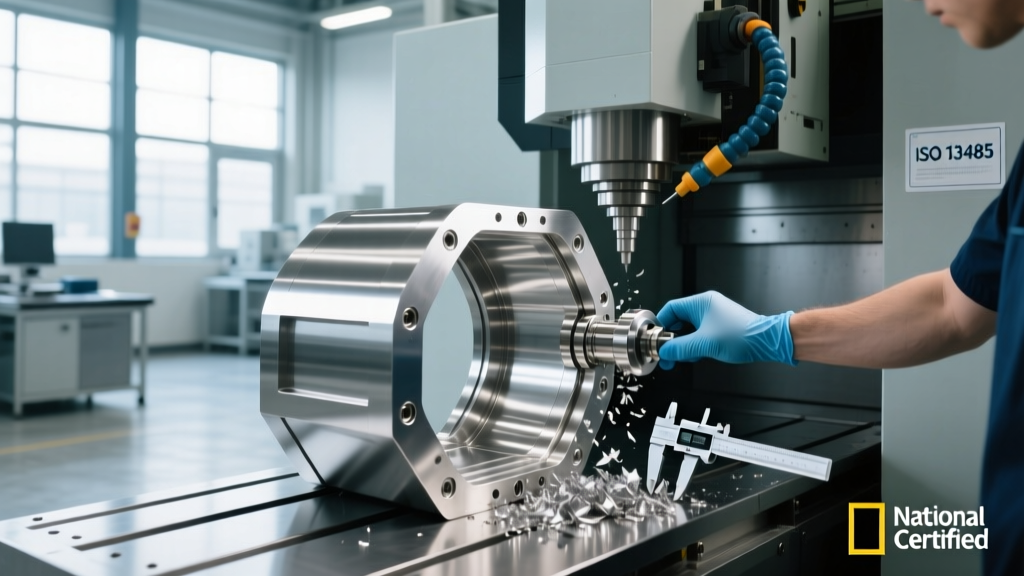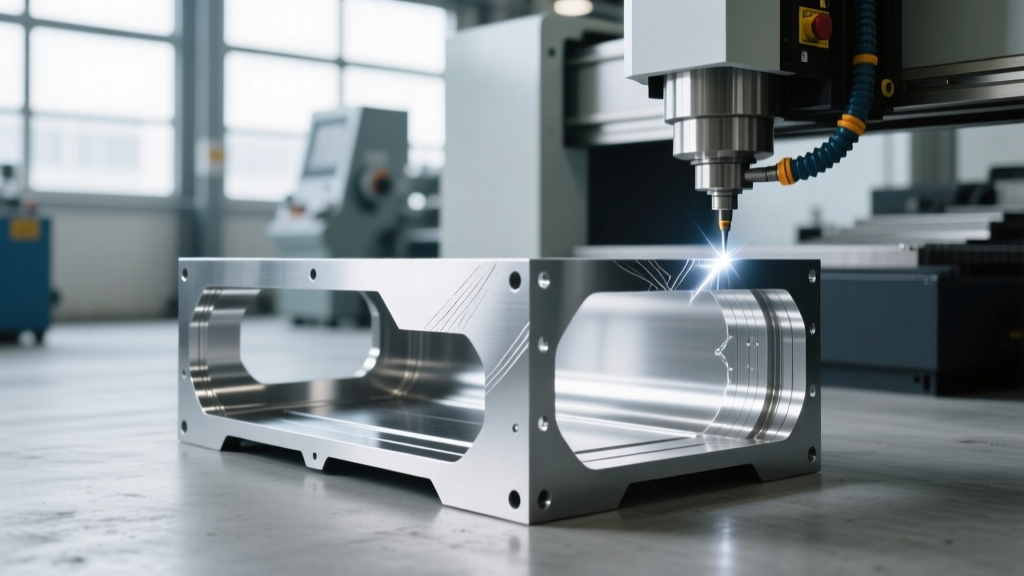
Operator Training: Adapting Oil and Gas CNC Machining for Aerospace
Master operator training best practices when transitioning from oil and gas CNC machining to aerospace components. Learn AS9100, titanium, and Inconel tips.
Machine shops diversifying their portfolios often attempt to leverage existing oil and gas CNC machining expertise to capture aerospace contracts. While the fundamental physics of metal removal remain constant, the operational paradigms, metallurgical challenges, and quality management systems differ drastically. An operator who excels at roughing out 13% Chrome valve bodies for API 6A wellhead equipment requires targeted, rigorous retraining before touching a 5-axis mill destined for Ti-6Al-4V aerospace structural brackets. Transitioning from heavy-industry energy components to flight-critical aerospace hardware demands a complete recalibration of speeds, feeds, toolpath strategies, and inspection protocols.
The Paradigm Shift: API 6A vs. AS9100 Rev D
The most critical hurdle in cross-training operators is shifting their quality mindset. Oil and gas machining is heavily governed by API Standards, focusing on pressure containment, heavy-wall integrity, and NACE MR0175 sour gas compliance. Tolerances are generally held to ±0.001 inches, and surface finishes are forgiving unless dealing with seal seats.
Aerospace machining, governed by AS9100 Rev D and specific SAE International Aerospace Material Specifications (AMS), prioritizes fatigue life, weight reduction, and absolute traceability. Operators must understand that a microscopic surface tear in a titanium landing gear component can propagate into a catastrophic fatigue failure. Training must emphasize Foreign Object Debris (FOD) prevention, rigorous first-article inspection (FAI), and the severe financial and scheduling impacts of scrapping a near-net-shape aerospace forging that has already undergone months of pre-machining heat treatments.
CRITICAL MINDSHIFT FOR OPERATORSIn oil and gas, if a heavy roughing pass leaves a slight chatter mark on a non-sealing surface, it is often acceptable. In aerospace, chatter marks act as stress concentrators. Operators must be trained to halt the machine and adjust parameters at the first sign of harmonic vibration, rather than 'letting it ride' to save cycle time.
Material Science & Tooling Matrix
Operators transitioning from the energy sector are accustomed to machining 4140 alloy steel, duplex stainless steels, and 13Cr martensitic stainless. These materials allow for aggressive material removal rates (MRR) and predictable tool wear. Aerospace components rely heavily on Ti-6Al-4V (Titanium) and Inconel 718 (Nickel-based superalloys), which require entirely different tooling geometries and cutting parameters.
According to the Sandvik Coromant Knowledge Base, machining nickel-based alloys requires strict adherence to positive rake angles and continuous cutting motion to avoid work hardening. Below is a comparative matrix that should be laminated and placed at every CNC workstation during the transition period.
| Parameter | Oil & Gas (4140 / 13Cr) | Aerospace (Ti-6Al-4V) | Aerospace (Inconel 718) |
|---|---|---|---|
| Cutting Speed (SFM) | 400 - 600 | 150 - 200 | 80 - 120 |
| Feed Rate (IPR) | 0.008 - 0.012 | 0.004 - 0.006 | 0.003 - 0.005 |
| Coolant Pressure | 300 - 500 PSI | 1,000+ PSI (Through-tool) | 1,500+ PSI (Through-tool) |
| Tool Coating | TiCN / PVD | AlTiN / PVD | AlCrN / PVD |
| Coolant Concentration | 5 - 7% Semi-Synthetic | 10 - 12% w/ EP Additives | 10 - 12% w/ EP Additives |
Toolpath Strategies and Thermal Management
Oil and gas operators are trained to maximize chip load and use conventional milling for heavy roughing. When machining aerospace titanium, this approach will rapidly destroy cutting edges due to the material's low thermal conductivity. Titanium does not dissipate heat into the chip; instead, heat concentrates directly at the cutting edge.
Implementing Trochoidal and Adaptive Milling
Operators must be trained to verify and utilize adaptive clearing toolpaths in the CAM software. These toolpaths maintain a constant radial engagement and constant chip thickness. Operators should be taught to never allow the tool to dwell in the cut. If a machine alarm pauses the spindle while the tool is engaged in Inconel 718, the material will instantly work-harden at the pause point, likely breaking the tool upon restart. Best practice dictates retracting the tool immediately if a feed hold is required.
WARNING: Titanium Fire HazardsUnlike the bulky, manageable chips produced in oil and gas steel machining, titanium generates fine, stringy chips and highly flammable dust. Operators must be trained to never use compressed air to blow out a titanium workpiece or machine enclosure. Use high-volume coolant flushing or specialized industrial vacuums rated for combustible dust to prevent catastrophic machine fires.
Metrology and In-Process Inspection
In the energy sector, Go/No-Go thread gauges, calipers, and basic CMM (Coordinate Measuring Machine) routines are standard. Aerospace components require advanced metrology. Operators must be cross-trained on 5-axis scanning CMMs equipped with ruby or silicon nitride styluses to verify true position within ±0.0002 inches on complex contoured surfaces.
Furthermore, surface finish requirements shift from basic Ra (Roughness Average) to Rz (Maximum Peak-to-Valley Height) and Rmr (Material Ratio) specifications to ensure proper fatigue resistance. Operators must learn to use contact profilometers correctly, ensuring the skid travels perpendicular to the lay of the tool marks. They must also understand that aerospace parts often require Fluorescent Penetrant Inspection (FPI); therefore, avoiding embedded tool steel or shop dirt in the part surface during machining is mandatory, as contaminants will cause false FPI indications.
Scrap in oil and gas costs material and machine time; scrap in aerospace costs material, machine time, and potentially delays a multi-million dollar assembly line. The cost of a scrapped Inconel turbine blisk can exceed $40,000 in raw material and prior processing alone.
The 4-Week Crossover Training Syllabus
To systematically transition your oil and gas CNC machinists into aerospace precision operators, implement this structured, four-week training framework on the shop floor:
- Week 1: Quality Systems & FOD Control. Focus on AS9100 Rev D requirements, traveler routing, material traceability (heat lot tracking), and strict FOD prevention protocols. Implement shadow-boarding for all hand tools.
- Week 2: Aerospace Metallurgy & Tooling. Classroom and hands-on training on Ti-6Al-4V and Inconel 718. Teach operators how to identify work hardening, select proper AlTiN/AlCrN coatings, and set up through-tool high-pressure coolant systems (minimum 1,000 PSI).
- Week 3: Advanced Toolpath Verification. Train operators to read CAM simulation data, understand constant-engagement milling, and manually override feed rates at the machine control to optimize chip color and shape (aiming for straw-colored titanium chips, not dark blue or burnt).
- Week 4: Precision Metrology & Deburring. Hands-on CMM operation, surface profilometry, and aerospace-specific deburring techniques. Emphasize that edge break requirements (e.g., 0.005' - 0.010' radius) are critical for fatigue life and must be verified with optical comparators or replica tape.
Successfully bridging the gap between oil and gas CNC machining and aerospace precision manufacturing requires more than just buying new tooling; it requires a fundamental rewiring of the operator's approach to metal removal, thermal management, and quality assurance. By investing in targeted, data-driven training, machine shops can unlock high-margin aerospace contracts while maintaining the heavy-duty efficiency they developed in the energy sector.