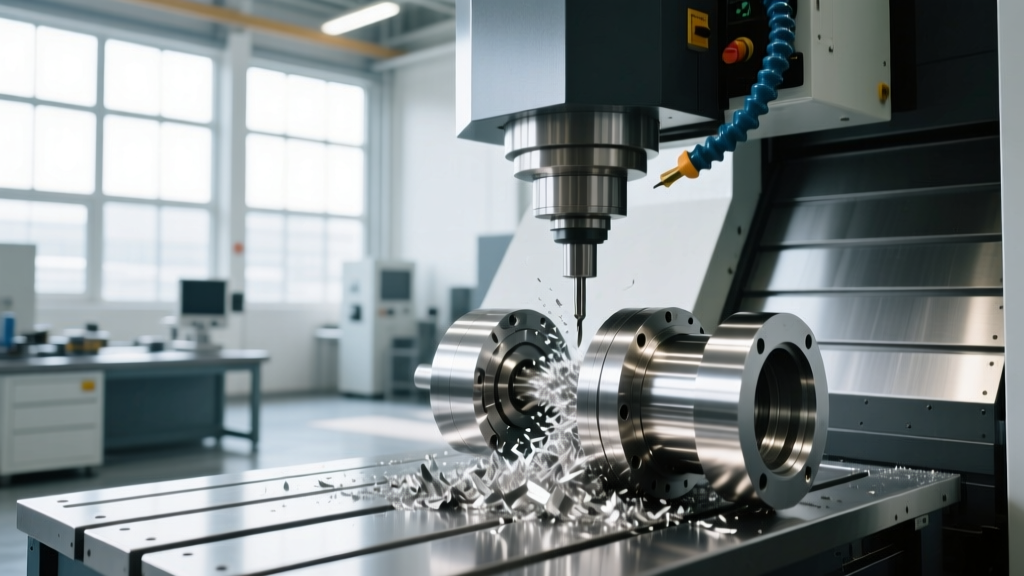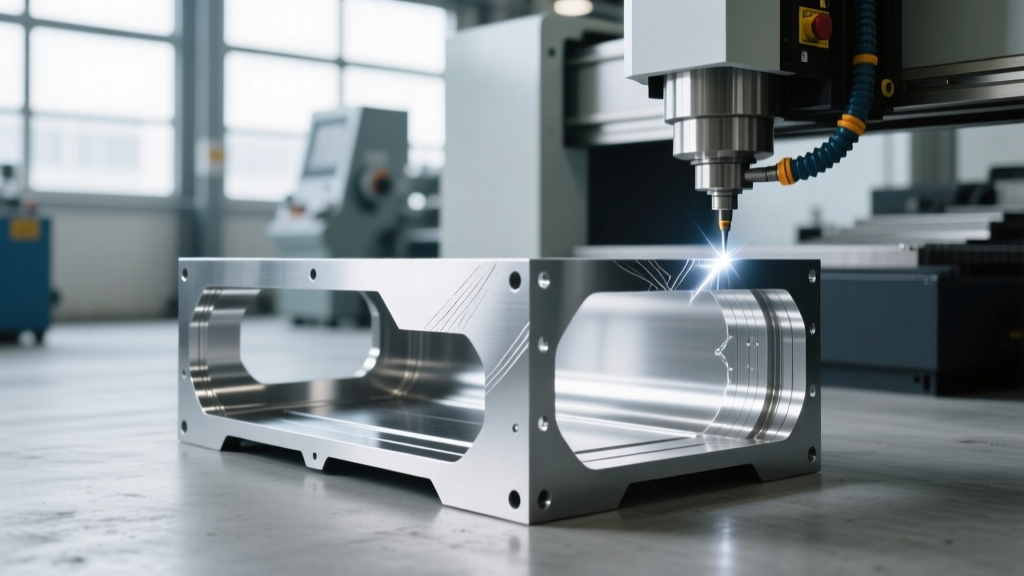
CNC Machining and Welding Services for Electronics Enclosures
Explore how integrated CNC machining and welding services achieve ±0.001" tolerances and IP67 sealing for custom aluminum electronics enclosures.
The EMI and Thermal Paradox in Edge Computing Hardware
Ruggedized electronics enclosures for aerospace, autonomous mining, and industrial IoT edge nodes face a contradictory set of engineering demands. They must dissipate massive thermal loads from high-performance processors, block electromagnetic interference (EMI) at frequencies exceeding 10 GHz, and maintain IP67 environmental sealing in high-vibration environments. While monolithic 5-axis CNC machining can produce complex heat-sink geometries, it generates massive material waste and drives unit costs above $600 for mid-volume production. Integrating CNC machining and welding services into a unified manufacturing workflow resolves this paradox, reducing material costs by up to 40% while maintaining the tight tolerances required for RF shielding and static O-ring sealing.
Material Matrix: 6061-T6 vs. 5052-H32 for Welded Chassis
The most common failure point in outsourced enclosure manufacturing is the specification of 6061-T6 aluminum for heavily welded assemblies. While 6061-T6 is the undisputed king of CNC machinability, its magnesium-silicide (Mg2Si) precipitates make it highly susceptible to hot cracking in the heat-affected zone (HAZ) during fusion welding. According to metallurgical guidelines from The Aluminum Association, welding 6xxx series alloys without appropriate filler material or precise thermal control compromises structural integrity and EMI continuity.
| Alloy & Temper | Yield Strength (ksi) | CNC Machinability | Weld Crack Sensitivity | Optimal Enclosure Application |
|---|---|---|---|---|
| 6061-T6 | 40 | Excellent (Short chips) | High (Requires ER4043 filler) | Monolithic lids, heat sinks, machined flanges |
| 5052-H32 | 28 | Fair (Gummy, requires high rake) | Very Low (Autogenous capable) | Welded chassis bases, deep drawn/welded housings |
| 6061-O (Annealed) | 8 | Poor (Smearing) | Moderate | Post-weld stress-relieved structural frames |
Engineering Synthesis: For complex edge computing nodes, the optimal approach is a hybrid assembly. Machine the complex heat-sink lids and connector flanges from 6061-T6 billets, while fabricating the main chassis tub from 5052-H32 sheet or plate, utilizing laser welding for the primary seams.
The "Machine-Weld-Machine" Sequence for ±0.001" Tolerances
Welding introduces localized thermal expansion and residual stress, which can distort a precision-machined part by 0.015" or more. To achieve the ±0.001" (±0.025mm) tolerances required for mating EMI gaskets and MIL-SPEC circular connectors, contract manufacturers must employ a strict "Machine-Weld-Machine" sequence.
⚠️ Critical Warning: Fixturing and Thermal Mass
Never weld an electronics enclosure without a custom-machined copper or aluminum chill fixture. The fixture acts as a heat sink, pulling thermal energy away from the HAZ at a rate of up to 400 BTU/min, drastically reducing distortion. Furthermore, internal expanding mandrels must be used to hold bore tolerances during the welding cycle.
- Rough CNC Milling: Machine the 5052-H32 chassis and 6061-T6 lid to +0.010" oversize on all critical mating surfaces and connector bores. Use trochoidal milling toolpaths with 3-flute AlTiN-coated carbide endmills to manage heat and prevent work hardening in the 5052 alloy.
- Precision TIG or Laser Welding: Assemble the rough-machined components into the chill fixture. Advanced fiber laser techniques detailed by Lincoln Electric demonstrate that wobble-head laser welding (using an IPG fiber laser at 2kW with a 4 m/min travel speed and Argon shielding at 15 CFH) minimizes the HAZ to less than 0.5mm, preserving the H32 strain-hardened temper of the chassis.
- Sub-Critical Stress Relief: Bake the welded assembly at 650°F (343°C) for 60 minutes to relieve residual welding stresses without artificially aging or softening the base metals.
- Finish CNC Boring and Facing: Return the assembly to a 5-axis CNC mill (e.g., Haas UMC-750). Skim-cut the mating flanges and finish-bore the connector ports to the final ±0.0005" tolerance. This guarantees perfect planarity for EMI finger-stock compression.
Case Study: IP67 LIDAR Enclosure for Autonomous Mining (2026 Data)
In early 2026, a Tier-1 autonomous vehicle supplier required 2,500 units of a ruggedized LIDAR processing enclosure. The initial design called for a monolithic 6061-T6 machined housing.
Monolithic 5-Axis
Material Cost: $145 / unit
Machine Time: 4.5 hours
Total Unit Cost: $680
RF Leakage: -40 dB (Excellent)
Hybrid Machined + Welded
Material Cost: $38 / unit
Machine/Weld Time: 2.1 hours
Total Unit Cost: $410
RF Leakage: -42 dB (Superior seam continuity)
By transitioning to a hybrid CNC machining and welding service model, the supplier saved $675,000 over the production run. More importantly, the continuous laser-welded seams eliminated the micro-gaps present in screwed-together flange designs, improving EMI shielding effectiveness by 2 dB at 18 GHz frequencies.
O-Ring Gland Design and Surface Finish for IP67 Sealing
Welding and machining services must be tightly coordinated when designing static O-ring glands for environmental sealing. A welded enclosure will experience microscopic warping; therefore, face-seal glands are vastly superior to radial (piston-style) seals for large electronics lids.
- Gland Standard: Design to AS568 dash sizes (e.g., -2XX series for standard 1/8" cross-section O-rings).
- CNC Surface Finish: The machined sealing surface must be held to a maximum of 32 µin (0.8 µm) Ra. A finish that is too smooth (<16 µin) will cause the O-ring to slip and roll during lid compression; a finish that is too rough (>63 µin) will abrade the Buna-N or Viton elastomer, causing micro-leaks under hydrostatic pressure.
- Compression Limiter Bores: Machine precision counterbores for stainless steel compression limiters. This prevents the CNC-machined aluminum lid from crushing the O-ring beyond its 25% maximum compression set when torqued to 15 in-lbs.
Sourcing Checklist for Contract Manufacturers
Not all machine shops possess the metallurgical expertise to execute tight-tolerance welded enclosures. When auditing a potential partner for CNC machining and welding services, demand proof of the following capabilities:
"A shop that only knows how to cut metal will destroy a welded enclosure's tolerance stack-up. You need a facility that treats welding as a precision metrology process, not just a fabrication step. Ask to see their CMM (Coordinate Measuring Machine) reports on post-weld machined bores."
— Senior Manufacturing Engineer, Aerospace Defense Contractor
Mandatory Equipment and Certifications
- Welding Certification: ISO 3834 (Quality requirements for fusion welding of metallic materials) or AWS D17.1 (Aerospace Fusion Welding).
- Laser Capability: Fiber lasers with programmable wobble-heads (e.g., IPG or TRUMPF) to control bead width and heat input on thin-walled (0.060" - 0.125") aluminum chassis.
- Metrology: Zeiss or Hexagon CMMs capable of scanning 3D surface profiles to verify flange planarity within 0.001" across a 12-inch span.
- In-House Stress Relieving: Access to calibrated vacuum or inert-atmosphere ovens to prevent surface oxidation during the post-weld thermal treatment cycle.
Integrating precision CNC milling with advanced laser welding transforms electronics enclosure manufacturing from a brute-force material removal exercise into an optimized, high-yield engineering process. By respecting the metallurgical limits of aluminum alloys and sequencing operations to manage thermal distortion, manufacturers can achieve aerospace-grade tolerances at commercial IoT price points.