Multi-Axis Precision CNC Machining & Mold Manufacturing Costs
Analyze the true costs of multi-axis precision CNC machining & mold manufacturing. Learn budget frameworks for 5-axis complex geometry production.
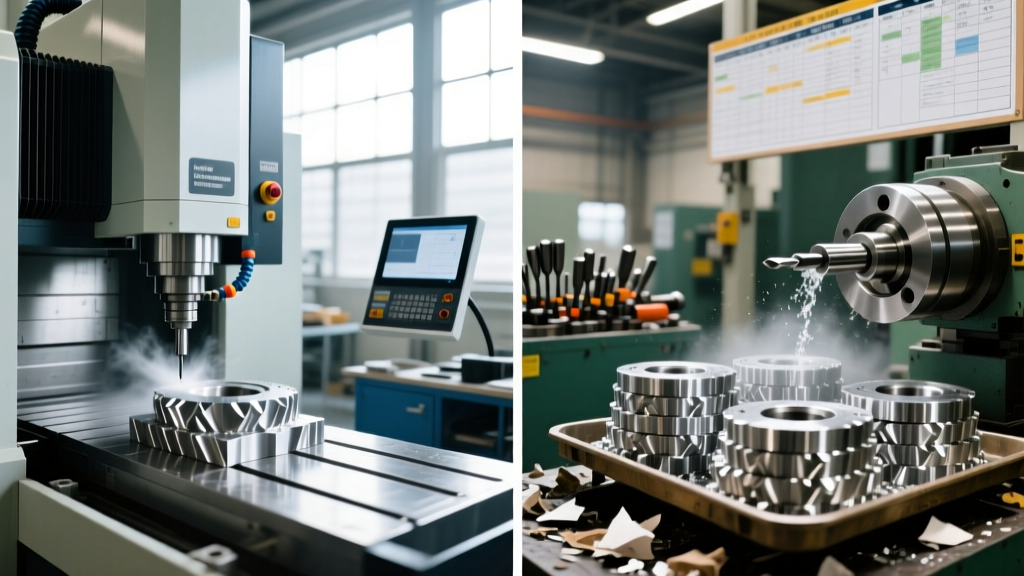
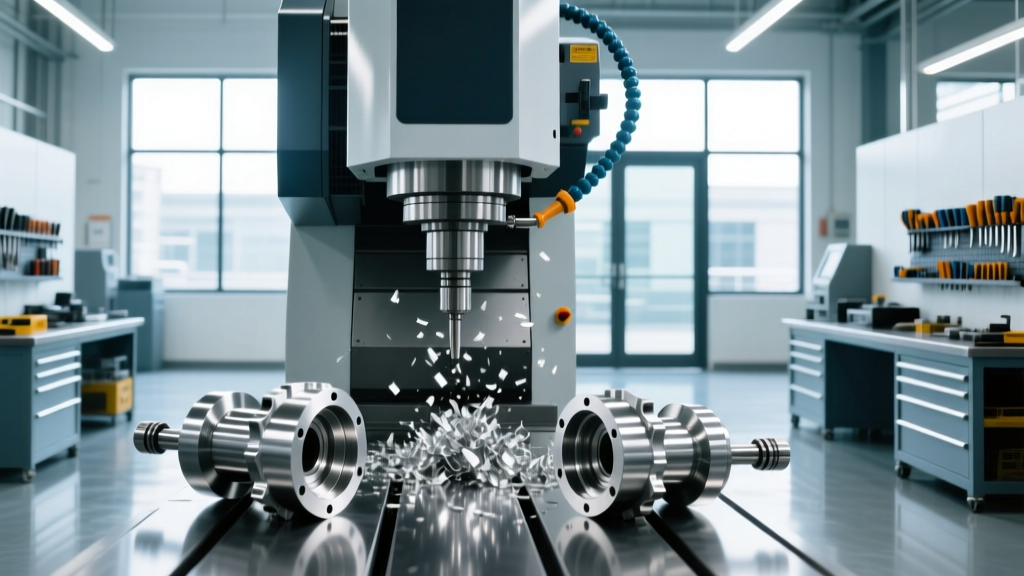
When engineering complex injection molds, die-casting dies, or aerospace forming tools, the transition from 3-axis to multi-axis precision CNC machining & mold manufacturing introduces non-linear cost variables. Procurement teams and shop floor managers frequently miscalculate the total landed cost by focusing solely on spindle hourly rates. In reality, simultaneous 5-axis machining alters the entire cost architecture—from CAM programming overhead and tooling attrition to metrology and fixturing.
The True Cost Architecture of 5-Axis Mold Making
To build an accurate budget, you must first establish the baseline operational expenditures for multi-axis equipment. In 2026, standard 3-axis Vertical Machining Center (VMC) shop rates average $75 to $95 per hour. In contrast, simultaneous 5-axis machining commands $130 to $185 per hour. This premium is driven by the capital expenditure of the machinery; a standard Haas UMC-500SS with high-speed options sits around the $220,000 mark, while a fully equipped DMG MORI DMU 50 3rd Generation easily exceeds $450,000.
However, evaluating cost purely on a per-hour basis is a fundamental budgeting error. The financial advantage of 5-axis machining lies in the elimination of setups.
The Setup Multiplier: A complex mold core requiring deep pockets and compound draft angles might need 4 to 5 separate setups on a 3-axis machine. Each setup requires custom soft jaws, edge finding, and WCS (Work Coordinate System) probing, adding 2 to 3 hours of non-cutting time per setup. A 5-axis machine utilizing a zero-point clamping system reduces this to a single setup, effectively cutting $600 to $900 in non-value-added labor per mold half.Cost Matrix: 3-Axis Indexing vs. Simultaneous 5-Axis
| Metric | 3-Axis + Indexing | Simultaneous 5-Axis | Financial Impact |
|---|---|---|---|
| Fixture Engineering | $800 - $1,200 (Custom jigs) | $150 - $300 (Zero-point plates) | Saves $500+ per project |
| Setup / Probing Time | 4 - 6 hours | 0.5 - 1 hour | Saves $350+ in machine rate labor |
| Tool Reach Requirements | High (Long L/D ratio tools) | Low (Tool tilting avoids deep reach) | Reduces tooling cost by 20-30% |
| CAM Programming Time | 8 - 12 hours | 16 - 24 hours | Adds $800 - $1,500 in engineering |
| Surface Finish (Ra) | 1.2 - 1.6 µm (Scallop marks) | 0.4 - 0.8 µm (Continuous contouring) | Eliminates $400+ in manual benching |
CAM Programming and Toolpath Verification Overhead
Multi-axis precision CNC machining & mold manufacturing requires advanced toolpath generation. Programming a 5-axis toolpath for a mold cavity with tight corner radii (e.g., under 0.030 inches) and varying draft angles demands premium CAM software like Mastercam or hyperMILL. The software licensing alone costs upwards of $15,000 annually for multi-axis modules, a cost baked into the shop's hourly rate.
More critically, machine simulation via software such as VERICUT is mandatory. In 5-axis contouring, the spindle head and tool holder operate in close proximity to the workpiece and clamps. A single calculation error in tool vector orientation can result in a catastrophic spindle crash, leading to $30,000+ in repair costs and weeks of downtime. Budget an additional 15% to 25% in engineering hours for 5-axis CAM verification compared to standard 3-axis milling.
Tooling Attrition in Hardened Steels and Exotics
Mold manufacturing frequently involves machining pre-hardened P20 (30-34 HRC) or fully hardened H13 and Stavax (48-52 HRC). Multi-axis machining allows for optimal tool lead angles, keeping the cutting action away from the fragile, zero-surface-speed center of a ball end mill. This technique drastically alters the tooling budget.
- Standard 3-Axis Plunging: Utilizes the center of the ball mill, causing rapid edge chipping in 50+ HRC steels. Tool life averages 45-60 minutes.
- 5-Axis Tilting: Engages the peripheral cutting edge. Using specialized tooling like the Sandvik Coromant CoroMill 316 exchangeable head end mill with a TiAlN coating extends tool life by roughly 35% to 50%.
When budgeting for deep cavity finishing, factor in $180 to $250 per tool replacement cycle for specialized reach tools. Furthermore, 5-axis machines equipped with high-pressure through-spindle coolant (TSC) at 1,000 PSI are required to evacuate chips from deep, contoured pockets, preventing recutting and premature tool failure. Ensure your vendor's quote specifies TSC capabilities, as dry or flood-only machining in 5-axis mold work will artificially inflate consumable tooling costs.
Warning: The Hidden Cost of CMM MetrologyYou cannot manually inspect a 5-axis contoured parting line or a complex optical mold insert with hand tools. Budgeting must include 5-axis CMM (Coordinate Measuring Machine) programming or 3D optical scanning (e.g., Zeiss T-SCAN or GOM ATOS). Expect Quality Assurance and metrology costs to consume 12% to 18% of the total machining budget for high-tolerance molds holding ±0.0002" (5µm) on critical shut-off surfaces.
Decision Framework: 5-Axis Milling vs. Sinker EDM
A common budgeting mistake is attempting to mill every feature using 5-axis CNC, even when Electrical Discharge Machining (EDM) is more economically viable. Use the following threshold framework when planning your mold manufacturing routing:
- Evaluate the Rib Depth-to-Width Ratio: If the rib depth-to-width ratio exceeds 4:1 and the corner radius is below 0.015 inches, the required Length-to-Diameter (L/D) ratio of the cutting tool will exceed 10:1.
- Assess Chatter Risk: At a 10:1 L/D ratio, harmonic chatter becomes unavoidable during finishing passes, ruining the surface finish (Ra > 1.0 µm) and requiring extensive manual polishing.
- The Financial Pivot: In this scenario, roughing the cavity via 5-axis and finishing the deep ribs via Sinker EDM (using machined graphite electrodes) reduces overall cycle time, guarantees sharp internal corners, and saves $400+ in scrapped micro-end mills.
Strategic Sourcing and Vendor Auditing
When outsourcing multi-axis precision CNC machining & mold manufacturing, the lowest hourly rate rarely yields the lowest total cost. A shop charging $160/hour on a modern DMG MORI with integrated probing and zero-point fixturing will often deliver a lower final invoice than a shop charging $110/hour on an older, retrofitted 3-axis machine requiring manual setups and extensive hand-benching.
Require prospective vendors to provide a detailed setup sheet and CAM simulation video during the quoting phase. If a vendor cannot demonstrate their 5-axis tool vector strategy or their CMM inspection plan for complex geometries, their initial quote likely excludes the secondary operations required to bring the mold to final specification.