Advanced CNC Machining Techniques for Medical Device Manufacturing
Explore advanced CNC machining techniques for medical device manufacturing, including titanium implant milling, Swiss turning, and FDA compliance.
The High-Stakes Reality of Medical Subtractive Manufacturing
Medical device manufacturing operates at the absolute limit of subtractive manufacturing. Unlike aerospace or automotive components, where a minor deviation might result in accelerated wear, a 0.001-inch tolerance stack-up in a cervical spinal cage or a neurosurgical probe can lead to catastrophic patient outcomes. Contract machine shops serving the medical sector must deploy highly specialized CNC machining techniques that balance extreme precision, complex geometries, and strict biocompatibility requirements.
The barrier to entry in this sector is defined by regulatory oversight and material science. Facilities must adhere to stringent quality management systems, such as the FDA 21 CFR Part 820 Quality System Regulation, while simultaneously mastering the unpredictable cutting dynamics of medical-grade alloys and polymers. This guide dissects the specific machining strategies, material matrices, and real-world case studies that define modern medical CNC production.
Core CNC Machining Techniques for Implantable Devices
5-Axis Simultaneous Milling for Orthopedic Implants
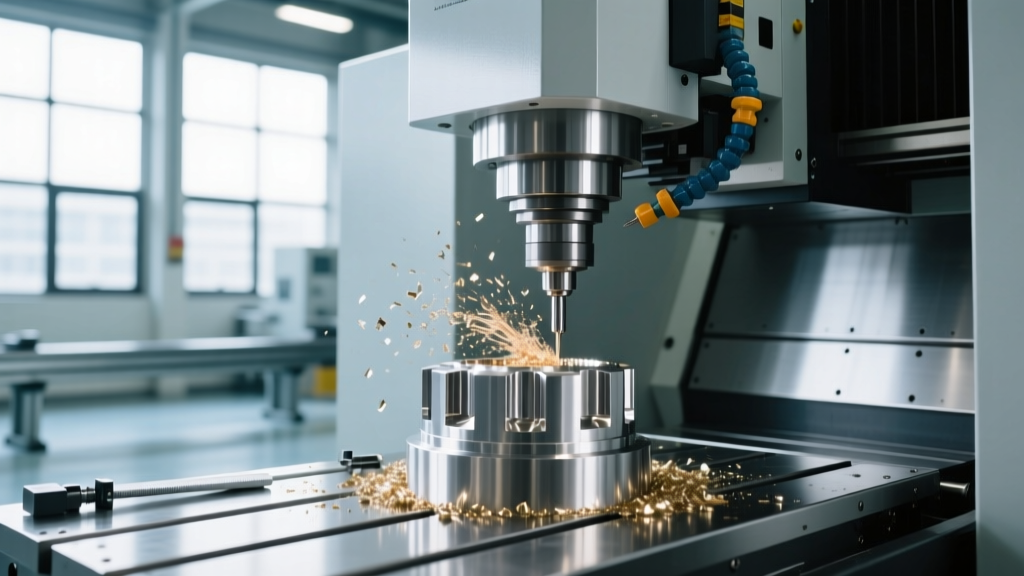
Orthopedic implants, particularly knee and hip replacements, feature complex organic contours that require continuous 5-axis simultaneous machining. The primary material, Ti-6Al-4V ELI (Extra Low Interstitial), is notorious for its low thermal conductivity and high chemical reactivity at elevated temperatures.
To prevent work hardening and tool edge chipping, advanced shops utilize trochoidal milling toolpaths. This technique maintains a constant radial engagement and chip thickness, distributing heat evenly into the chip rather than the workpiece or the cutting tool. When machining the porous trabecular structures often required for bone ingrowth, machinists rely on high-speed machining (HSM) strategies with spindle speeds exceeding 20,000 RPM on machines like the DMG MORI DMU 50 3rd Generation, utilizing through-tool coolant at 1,000 PSI to evacuate stringy titanium chips from deep, narrow pockets.
Swiss-Type Turning for Minimally Invasive Surgical Tools
Minimally invasive surgery relies on elongated, ultra-precise instruments such as arthroscopic shavers and biopsy forceps. These components are predominantly manufactured using Swiss-type CNC lathes, such as the Tsugami S206 or Citizen L20.
The defining advantage of the Swiss technique is the guide bushing, which supports the bar stock within 1mm to 2mm of the cutting tool. This eliminates the deflection that would plague a standard chucker lathe when turning long, slender shafts out of 17-4 PH stainless steel or Nitinol. For neurosurgical guidewires requiring tip radii under 0.005 inches, Swiss turning is often paired with micro-milling attachments, allowing the completion of off-center cross-holes and flats in a single, unclamped operation.
Material-Specific Machining Strategy Matrix
Selecting the correct cutting parameters is only half the battle; matching the tooling substrate and coating to the specific biomaterial is critical for surface finish and fatigue life. Below is a decision matrix for common medical materials.
| Biomaterial | Primary Application | Optimal Tooling & Coating | Critical Failure Mode to Avoid |
|---|---|---|---|
| Ti-6Al-4V ELI | Spinal cages, joint replacements | Micro-grain carbide with AlTiN or TiAlN coating | Built-up edge (BUE) and thermal tool degradation |
| 316L Stainless Steel | Surgical forceps, bone screws | Sharp uncoated carbide or TiCN; high positive rake | Work hardening due to dwell time or low feed rates |
| CoCr (Cobalt Chrome) | Dental frameworks, femoral heads | PCBN (Polycrystalline Cubic Boron Nitride) or SiAlON ceramics | Rapid flank wear and catastrophic edge chipping |
| PEEK / CF-PEEK | Interbody fusion devices, trauma plates | Uncoated polished carbide or PCD (Polycrystalline Diamond) | Thermal expansion causing out-of-tolerance bores; burring |
Case Study: Overcoming Tool Deflection in PEEK Spinal Cages
Polyetheretherketone (PEEK) has become the gold standard for spinal fusion cages due to its radiolucency and modulus of elasticity, which closely matches human cortical bone. However, machining PEEK presents a unique thermal challenge. Unlike metals, PEEK is an insulator. Heat generated at the cutting zone does not dissipate into the chips; it transfers directly into the workpiece.
Critical Warning: Glass Transition Temperature (Tg)PEEK has a Tg of approximately 143°C (289°F). If localized machining temperatures exceed this threshold, the polymer matrix softens. This results in severe burr formation, poor surface finish, and dimensional inaccuracies that will fail CMM (Coordinate Measuring Machine) inspection once the part cools and shrinks.
The Problem: A contract manufacturer was experiencing a 14% scrap rate on a complex lordotic PEEK spinal cage. The bores for the titanium insertion pins were measuring 0.0015 inches undersize after cooling, despite machining perfectly to nominal dimensions while clamped.
The Solution: The engineering team overhauled their CNC machining techniques by implementing three specific changes:
- Tool Geometry: Switched from standard 3-flute end mills to highly polished, 2-flute uncoated carbide routers with a 40-degree helix angle to aggressively shear the material rather than rubbing it.
- Coolant Strategy: Abandoned mist coolant in favor of high-volume flood coolant with a chiller unit maintaining the fluid at 68°F (20°C) to actively pull heat from the cutting zone.
- CAM Toolpath Adjustment: Implemented a roughing-to-finishing allowance of 0.020 inches, followed by a light finishing pass at high feed rates and low depth of cut (0.002 inches) to minimize heat generation.
The Result: The scrap rate dropped to under 1.2%, and cycle times were reduced by 18% due to the elimination of secondary deburring operations.
Navigating FDA Compliance and Traceability
Executing advanced CNC machining techniques is useless if the part cannot be traced back to its raw material lot. Medical machine shops must operate under strict ISO 13485:2016 Medical devices quality management standards and FDA regulations. Every machined component requires a Device History Record (DHR).
'In medical machining, the paperwork is as critical as the part itself. If a raw material certificate of conformance (C of C) cannot be linked to a specific serialized implant via the shop's ERP system, the part is legally unsalable, regardless of how perfectly it was machined.'
Modern medical machine shops integrate laser marking directly into the CNC workflow. Using 5-axis machines equipped with integrated laser marking heads, shops engrave Unique Device Identification (UDI) codes and lot numbers directly onto the titanium or stainless steel components before they are ever unclamped from the fixture. This ensures permanent traceability and eliminates the handling damage associated with secondary marking operations.
Cost Drivers and Quoting Realities in Medical CNC
Procurement managers and design engineers must understand the true cost structure of medical CNC services. The premium pricing is not merely a reflection of expensive raw materials; it is driven by validation, inspection, and machine hour rates.
- Machine Hour Rates: While standard 3-axis job shop rates hover around $80–$110 per hour, certified 5-axis medical machining typically commands $180–$280 per hour. Swiss-turning for medical micro-components averages $120–$160 per hour.
- Non-Recurring Engineering (NRE): Expect NRE costs ranging from $2,500 to $15,000 for initial medical projects. This covers custom fixture design (often requiring soft jaws machined from Delrin to prevent marring polished implant surfaces), CAM simulation, and First Article Inspection (FAI) reporting.
- Inspection Overhead: Medical parts require 100% inspection of critical dimensions. The cost of programming and running CMM routines, optical comparators, and surface roughness testers (Ra profiling) often adds 20% to 30% to the total unit cost compared to commercial industrial parts.
By designing for manufacturability (DFM)—such as standardizing internal corner radii to match common end mill diameters and avoiding deep, narrow channels that require expensive micro-tooling—medical device companies can significantly reduce both cycle times and the risk of tool breakage during production runs.