Machine Maintenance for Aerospace Copper CNC Machining Services
Discover specialized maintenance schedules for CNC machines producing aerospace copper components. Optimize uptime, coolant management, and AS9100 compliance.
The Metallurgical Toll of Aerospace Copper on CNC Hardware
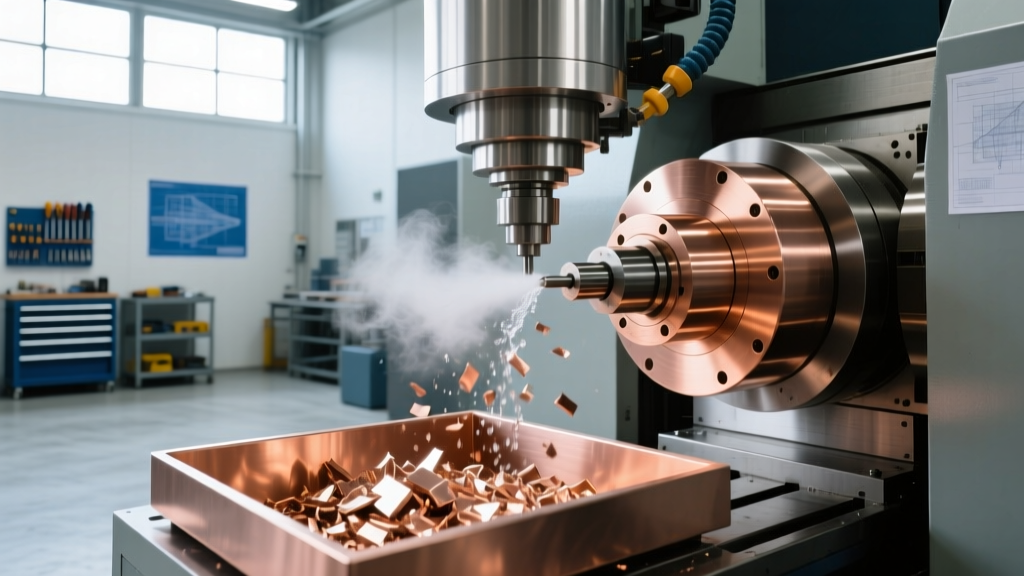
When contract shops provide specialized copper cnc machining services for aerospace payloads, standard OEM maintenance schedules are insufficient. Aerospace components like RF waveguides, thermal management straps, and cryogenic heat sinks rely on C10100 (Oxygen-Free Electronic) and C11000 (Electrolytic Tough Pitch) copper alloys. According to the Copper Development Association, these alloys exhibit extreme thermal conductivity and ductility. Unlike 6061-T6 aluminum, which produces brittle, easily evacuated chips, copper generates long, stringy swarf and micro-fines that adhere to machine surfaces, infiltrate seals, and fundamentally alter the maintenance requirements of the CNC equipment.
Material Alert: The Lapping Compound EffectCopper micro-fines that bypass way wipers mix with standard lithium-based way lubricants. This combination creates an abrasive lapping compound that accelerates ball screw wear and degrades linear guideway precision, directly threatening the ±0.0002 in. tolerances required for aerospace RF components.
Coolant Chemistry and Filtration Intervals
Copper is highly reactive to the sulfur and chlorine additives found in standard heavy-duty cutting fluids, which can cause part staining and coolant rancidity. For aerospace copper cnc machining services, shops must transition to semi-synthetic coolants specifically formulated for non-ferrous metals, such as Trim MicroSol 585XT or Master Fluid Solutions TRIM E709. Maintaining the correct concentration and managing tramp oil is critical to preventing chemical degradation of the machine's internal seals.
Optimized Filtration Protocol
Standard 50-micron paper band filters allow copper fines to recirculate, leading to pump wear and surface finish defects on thermal straps. Upgrading to a 20-micron filtration system with an automatic tramp oil skimmer is mandatory. Skimmers must be serviced weekly; copper fines bind with tramp oil, creating a thick sludge that can clog coolant distribution lines and cause localized thermal growth in the spindle.
Preventative Maintenance Matrix for Copper Milling
The following schedule overrides standard OEM guidelines, specifically addressing the abrasive and adhesive properties of copper swarf in a high-mix, high-precision aerospace environment.
| Interval | Component | Action Required | Copper-Specific Rationale |
|---|---|---|---|
| Daily | Way Wipers | Inspect and clean polyurethane wipers | Copper fines embed in wiper lips, scratching way covers. |
| Weekly | Coolant System | Skim tramp oil; verify 8-10% concentration | Prevents copper oxidation and seal degradation. |
| Monthly | Ball Screws | Purge and re-grease with copper-free NLGI #2 | Flushes out abrasive copper-lubricant lapping compounds. |
| Bi-Annual | Spindle Nose | Check taper runout and clean with isopropyl | Copper dust transfers heat to the toolholder, altering Z-axis growth. |
| Annual | Way Covers | Full removal, deep clean, and seal inspection | Prevents catastrophic ball screw failure from accumulated swarf. |
Way Cover Degradation and Seal Integrity
The most frequent point of failure in machines dedicated to copper cnc machining services is the telescopic way cover. Copper swarf, particularly from roughing operations on thick thermal plates, tends to nestle into the crevices of the way covers. As the machine axes move, this trapped material acts as a wedge, bending the stainless steel cover plates and tearing the internal polyurethane seals.
In aerospace machine shops, waiting for a way cover to fail completely is a liability. Once copper dust breaches the primary seal and enters the ball screw raceway, the axis will lose repeatability within 40 to 60 hours of operation, instantly failing AS9100 calibration checks. Proactive cover replacement at the first sign of seal fraying is non-negotiable.
Replacing a standard X-axis way cover on a mid-sized vertical machining center (e.g., Haas VF-2 or Makino PS65) costs between $2,800 and $3,500 in parts and labor. Conversely, replacing a contaminated ball screw and linear guide assembly on the same axis exceeds $12,000 and requires up to a week of machine downtime.
Spindle Thermal Growth and AS9100 Compliance
Aerospace quality management systems, governed by the SAE International AS9100 standard, demand strict adherence to dimensional tolerances and traceable calibration. Copper's high thermal conductivity means that heat generated at the cutting zone is rapidly transferred up the tool shank and into the spindle nose. If the spindle's internal cooling jacket is not maintained, this heat transfer causes Z-axis thermal growth that can easily exceed 0.0005 in. over a 4-hour production run.
Calibration and Compensation Strategies
To maintain compliance with NIST-traceable metrology standards, shops must implement aggressive thermal compensation protocols. This involves:
- Spindle Chiller Maintenance: Verify the spindle chiller fluid level and clean the heat exchanger fins monthly. A drop in chiller efficiency directly correlates to Z-axis drift during long waveguide milling cycles.
- Probe Calibration: Utilize tool-setting probes (like the Renishaw OMP48-2) to map thermal growth every 45 minutes during lights-out machining operations, automatically updating the Z-axis work offset.
- Toolholder Taper Cleaning: Copper dust is electrostatically charged and clings to toolholder tapers. Automated taper cleaners must be integrated into the ATC (Automatic Tool Changer) to prevent runout caused by microscopic copper particle interference.
Financial Impact: Reactive vs. Preventative Maintenance
Contract manufacturers often underestimate the hidden costs of reactive maintenance when bidding on aerospace copper projects. The following breakdown illustrates the financial risk of neglecting copper-specific service schedules on a standard 3-axis VMC operating two shifts daily.
Reactive Repair Costs
- Ball Screw Replacement: $7,500
- Spindle Rebuild (Heat Damage): $14,000
- Axis Realignment & Laser Calibration: $3,200
- Downtime (7 Days @ $150/hr shop rate): $8,400
- Total Estimated Loss: $33,100
Preventative Schedule Costs
- Premium Semi-Synthetic Coolant (Annual): $2,400
- 20-Micron Filter Media (Annual): $850
- Way Wiper & Seal Kit (Bi-Annual): $450
- Spindle Chiller Service (Annual): $600
- Total Annual Investment: $4,300
Frequently Asked Questions
Why does copper machining cause more spindle wear than titanium?
While titanium is harder and requires more cutting force, it produces distinct, manageable chips and is typically machined with high-pressure coolant that keeps heat away from the spindle. Copper, conversely, generates fine, abrasive dust and transfers cutting heat directly into the toolholder due to its massive thermal conductivity. This heat transfer degrades spindle bearings and grease over time if the spindle chiller is not perfectly maintained.
Can I use standard way oil for machines cutting C10100 copper?
Standard ISO 68 way oils are susceptible to washout and do not possess the tackiness required to repel copper micro-fines. Shops should upgrade to a high-tack, non-foaming way lubricant specifically designed to resist emulsification in semi-synthetic coolants, ensuring a physical barrier that prevents copper dust from adhering to the linear guideways.
How often should I recalibrate my machine when cutting aerospace waveguides?
For internal waveguide dimensions holding ±0.0002 in., volumetric calibration should be verified bi-annually using a laser interferometer. However, daily thermal compensation checks using a calibrated artifact and a spindle probe are mandatory to account for the rapid heat transfer inherent in copper milling operations.