How Malones CNC Machining Inc Machines Architectural Facades
Explore the technical specs, 5-axis toolpaths, and material matrices used by shops like Malones CNC Machining Inc for architectural facade milling.
The Engineering Behind Architectural CNC Milling
Machining architectural metalwork and building facades requires bridging the gap between heavy industrial milling and micron-level precision. Unlike standard production parts, facade components—such as custom mullions, parametric sunshades, and structural node connectors—often span 10 to 30 feet in length while demanding strict flatness tolerances to prevent water ingress and visible seam misalignment. When evaluating high-end contract manufacturing, studying how specialized facilities like Malones CNC Machining Inc approach architectural facades reveals the rigorous technical specifications required for large-format, high-precision metalwork.
Architectural CNC machining is governed by strict industry guidelines, such as those published by the American Architectural Manufacturers Association (AAMA), which dictate allowable deflections and joint tolerances for curtain wall systems. Achieving these tolerances on oversized aluminum and stainless extrusions requires specialized 5-axis gantry mills, advanced vacuum workholding, and highly specific toolpath strategies.
Machine Envelope and Thermal Compensation
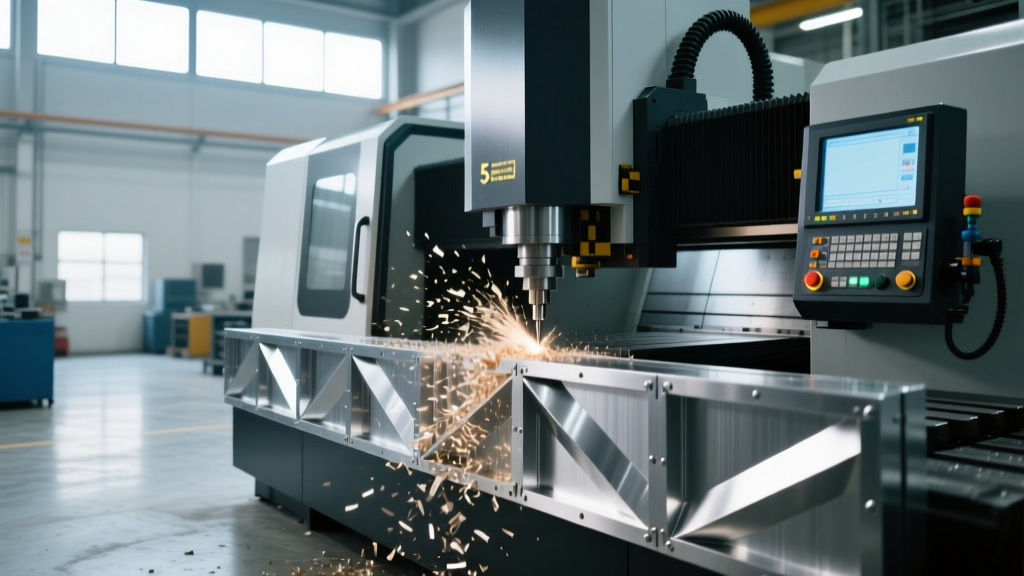
Standard vertical machining centers (VMCs) max out at work envelopes of roughly 60 x 30 inches, rendering them useless for continuous facade panels. Instead, high-tier machine shops deploy 5-axis CNC gantry routers and bridge mills, such as the Zimmermann FZ30 or Fidia GTF series. These machines offer X-axis travels exceeding 4,000mm (157 inches) and Z-axis clearances of 1,200mm.
Technical Callout: Thermal Expansion in Large-Format MillingAluminum expands at a rate of approximately 13 parts per million (ppm) per degree Fahrenheit. When machining a 20-foot (240-inch) 3003-H14 aluminum facade panel, a mere 10°F fluctuation in shop temperature from morning to afternoon induces 0.031 inches of linear growth. Advanced shops combat this by utilizing in-situ Renishaw spindle probes to map the part geometry immediately before finishing passes, dynamically updating the work coordinate system (WCS) to account for thermal drift.
Material Matrix: Alloys, Tooling, and Parameters
Architectural facades rely heavily on specific alloys chosen for their corrosion resistance, anodizing potential, and structural rigidity. Selecting the correct cutting tool geometry and coating is critical to preventing Built-Up Edge (BUE) and ensuring a mirror-finish surface quality that requires minimal post-processing.
| Material (Alloy) | Primary Use | Recommended Tooling | Feeds & Speeds (1/2" Endmill) |
|---|---|---|---|
| 3003-H14 Aluminum | Formed facade panels, sunshades | 3-Flute Carbide, ZrN Coated, 45° Helix | 12,000 RPM / 180 IPM |
| 6061-T6 Aluminum | Structural mullions, node connectors | 3-Flute Carbide, Uncoated Polished | 10,000 RPM / 140 IPM |
| 316L Stainless Steel | Marine environments, high-load brackets | 4-Flute AlTiN Coated, Variable Pitch | 3,500 RPM / 45 IPM |
| Corten (A606) | Decorative weathering steel screens | 2-Flute Carbide, TiAlN Coated | 2,800 RPM / 35 IPM |
Note: Zirconium Nitride (ZrN) coatings are mandatory for high-silicon and softer architectural aluminum alloys to prevent material adhesion to the cutting edge, a common failure mode detailed in Sandvik Coromant's aluminum machining guidelines.
Step-by-Step: 5-Axis Facade Production Workflow
Producing a parametric architectural facade component involves a highly sequenced workflow designed to minimize residual stress and part distortion.
- CAM Programming & Toolpath Strategy: Programmers utilize adaptive clearing (trochoidal milling) for roughing to maintain constant tool engagement. This prevents shock-loading the spindle when transitioning from air-cutting to heavy material removal on thick extrusion walls.
- Workholding Setup: Mechanical clamps induce localized stress that warps thin panels upon release. Instead, shops utilize modular vacuum pod systems generating up to 800 mbar of holding pressure. For porous extrusions, custom urethane gaskets are CNC-milled to match the exact perimeter profile of the part.
- Roughing Passes: Material is removed leaving exactly 0.020" of stock on all critical mating surfaces. This ensures that the bulk of the residual stress from the original extrusion process is relieved before the final dimensions are cut.
- Stress Relief & Re-Probing: The part is unclamped, allowed to settle for 2 to 4 hours, and then re-secured with minimal vacuum pressure. The spindle probe maps the new surface topology.
- Finishing Passes: A 5-axis simultaneous swarf cut is employed to draft the sidewalls of mullion extrusions, ensuring a perfectly continuous surface finish that matches the architectural lighting design intent.
Troubleshooting: Mitigating the "Oil Canning" Defect
One of the most persistent edge cases in architectural CNC machining is "oil canning" or "pillowing"—a phenomenon where thin, flat webs of aluminum facade panels vibrate during machining, leaving visible chatter marks and causing the panel to flex inward or outward when installed.
Expert Insight: Oil canning is rarely a material defect; it is a toolpath and harmonic issue. When machining 0.125" thick aluminum webs on a 4x10 foot panel, utilizing a standard 1/2" endmill will excite the natural frequency of the panel. The fix is to switch to a 1/4" diameter, 5-flute variable-pitch endmill, increase the spindle speed to 18,000 RPM, and reduce the radial depth of cut (RDOC) to 0.010". This shifts the cutting harmonics above the resonant frequency of the thin sheet.
Process Selection Framework: CNC vs. Waterjet vs. Laser
Contract manufacturers must frequently decide which cutting technology to deploy for specific facade elements. While CNC milling is unparalleled for 3D profiling and tight-tolerance joinery, it is not always the most economical choice for simple 2D cutouts.
- 5-Axis CNC Milling: Required for structural nodes, mullion extrusions requiring angled draft walls, and parts needing ±0.005" tolerances for watertight gasket compression. 2026 Hourly Rate: $160 - $240/hr.
- Abrasive Waterjet: Ideal for thick Corten steel or 316L stainless decorative screens where a taper of 0.010" is acceptable. Avoided for parts requiring tapped holes or precise depth-pocketing. 2026 Hourly Rate: $90 - $130/hr.
- Fiber Laser Cutting: Deployed exclusively for 2D flat stock cutting (up to 1" thick steel or 3/4" aluminum) prior to CNC press-braking. Provides the fastest cycle times for simple bracket profiles but cannot machine 3D topographies. 2026 Hourly Rate: $110 - $150/hr.
By understanding the deep technical specifications—from thermal expansion mathematics to harmonic chatter mitigation—facilities like Malones CNC Machining Inc and other elite architectural job shops deliver facade components that fit seamlessly on the first installation attempt, saving general contractors millions in field-rework costs. For further reading on large-format machining strategies, industry professionals frequently consult the technical archives at Modern Machine Shop.