Large Part CNC Precision Machining for Medical Devices
Explore large part CNC precision machining for medical devices, covering MRI components, material strategies, metrology, and ISO 13485 compliance.
Manufacturing oversized medical equipment—such as CT scanner gantries, MRI gradient coil formers, and robotic surgery bases—presents a unique engineering paradox. These components demand massive physical envelopes, often exceeding 2,000 mm in diameter, yet they require micron-level geometric tolerances to ensure imaging accuracy and mechanical safety. When executing large part CNC precision machining for medical imaging systems and surgical platforms, standard heavy-duty machining practices fall short. The intersection of high-mass material removal and medical-grade traceability requires specialized machine tools, advanced metrology, and strict thermal management.
Key Industry Metrics:- Average CT Gantry Ring Diameter: 1,800 mm – 2,500 mm
- Standard True Position Tolerance: ±0.015 mm across full span
- Typical Setup Cost (Custom Fixturing): $18,000 – $45,000
- Primary Metrology Tool: Laser Tracker (e.g., Leica AT960, API Radian)
The Metrology and Tolerance Paradox
In conventional heavy machining, holding a tolerance of 0.05 mm on a 3-meter part is considered standard. In medical device manufacturing, that same 3-meter part—perhaps a baseplate for a next-generation radiosurgery system—may demand a flatness and true position tolerance of 0.015 mm. Standard bridge Coordinate Measuring Machines (CMMs) typically max out at 3,000 mm to 4,000 mm in the X-axis, making them impractical for fully assembled large medical structures.
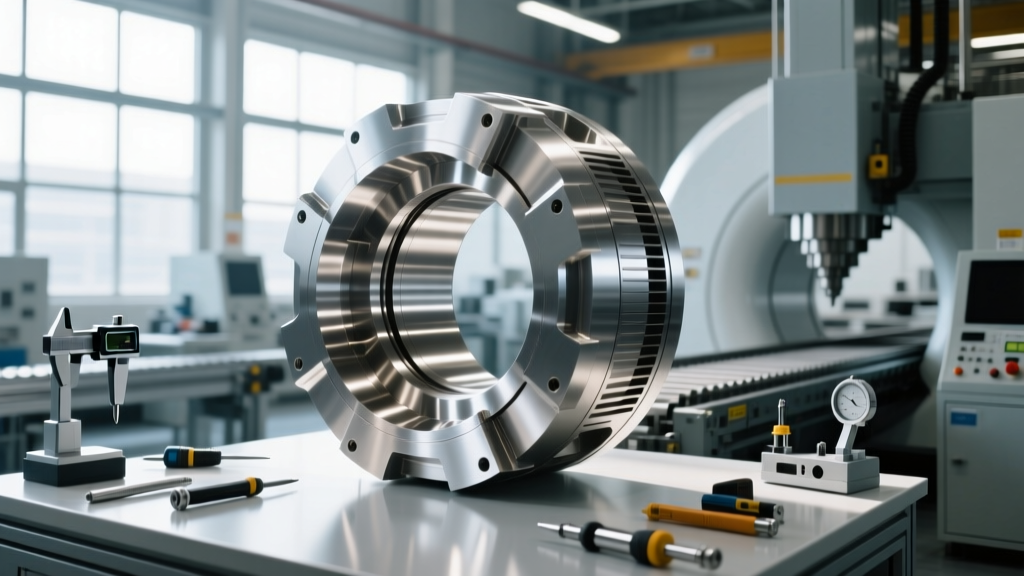
To bridge this gap, machine shops must integrate portable, large-volume metrology directly onto the shop floor. Laser trackers and portable articulated arms are mandatory. For instance, inspecting the bearing raceway of an MRI bore requires a laser tracker to map the cylindrical profile across a 2,200 mm span, compensating for ambient temperature variations in real-time. According to ISO 13485 standards for medical device quality management, the validation of these non-traditional inspection methods must be rigorously documented, requiring shops to perform Gauge Repeatability and Reproducibility (GR&R) studies specifically calibrated for large-volume optical metrology.
Material Specifications and Tooling Strategies
Medical devices require materials that offer biocompatibility, non-magnetic properties, or high stiffness-to-weight ratios. Machining these materials at scale introduces severe tool wear and harmonic vibration challenges.
| Material | Medical Application | Machining Challenge & Solution |
|---|---|---|
| 316L VM (Vacuum Melted) | MRI structural supports, surgical tables | High work-hardening rate. Requires high-pressure coolant (min 1,000 PSI) and AlTiN coated carbide tooling to prevent built-up edge (BUE). |
| Ti-6Al-4V ELI (Grade 23) | Large implantable structural frames | Poor thermal conductivity leads to alpha-case formation. Demands flood coolant and strict speed limits (typically under 60 m/min) as outlined in Sandvik Coromant titanium machining guidelines. |
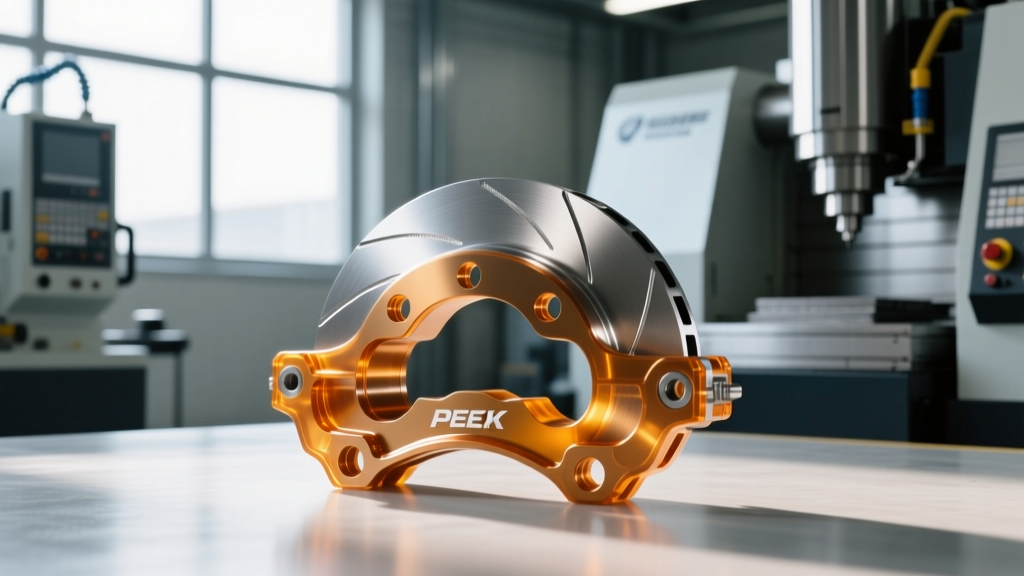
| PEEK GF30 | Radiolucent imaging beds, CT patient tables | Delamination risk during roughing. Requires sharp PCD (Polycrystalline Diamond) tooling and high-speed, low-feed finishing passes. |
| Carbon Fiber Composites | Proton therapy gantry housings | Extreme abrasiveness and dust hazards. Requires diamond-coated tools and specialized vacuum extraction enclosures on the CNC. |
Case Study: Machining a 3-Tesla MRI Gradient Coil Former
Project Parameters
- Component: Gradient Coil Support Cylinder
- Dimensions: 1,100 mm OD × 2,200 mm length × 45 mm wall thickness
- Material: 316L VM Stainless Steel (approx. 1,800 kg raw forging)
- Critical Tolerance: 0.02 mm concentricity between inner and outer bearing journals.
The Engineering Challenge
At a 2,200 mm length and a thin 45 mm wall, the cylinder is highly susceptible to harmonic chatter and deflection during heavy roughing passes. Furthermore, any residual stress left in the 316L VM material from the forging process will cause the part to warp once removed from the chuck, destroying the 0.02 mm concentricity requirement.
The Machining Execution
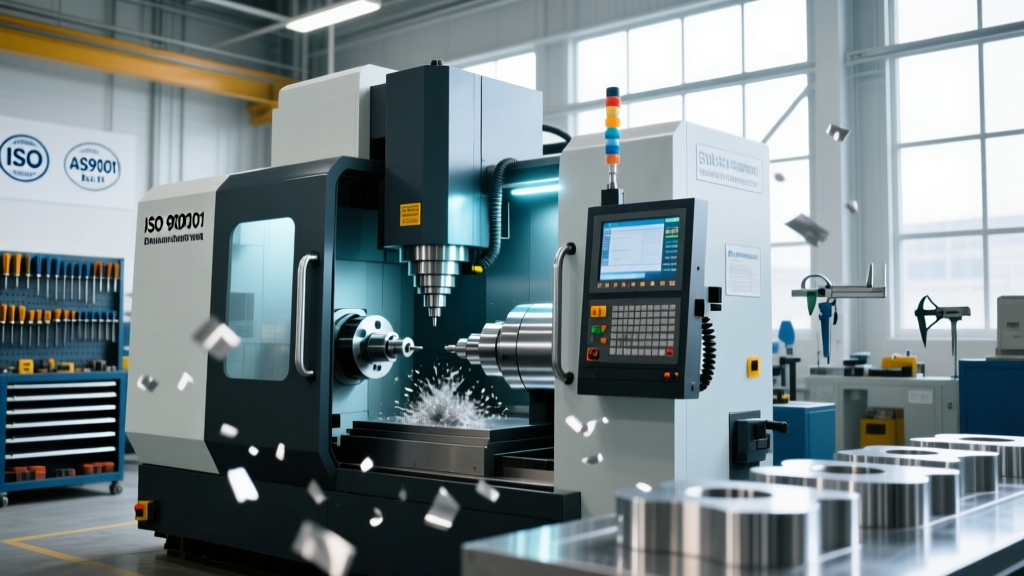
- Machine Selection: A Mazak INTEGREX e-1850V multi-tasking machine was utilized for its massive turning capacity and integrated 5-axis milling spindle, allowing complete machining in a single setup.
- Stress Relief: The raw forging underwent a sub-critical annealing process prior to machining to normalize the grain structure and eliminate internal stresses.
- Fixturing & Support: A custom hydraulic steady rest with polyurethane-lined jaws was programmed to dynamically follow the cutting tool, providing localized support and dampening vibrations.
- Toolpath Strategy: Instead of conventional turning, trochoidal milling was used for the roughing of the inner bore to maintain constant tool engagement and reduce radial cutting forces by 60%.
Thermal Management in Large-Format Machining
Thermal expansion is the silent killer of precision in large part CNC precision machining. The coefficient of thermal expansion for 316L stainless steel is approximately 16.0 µm/m·°C. If a 2-meter-long medical gantry ring experiences a localized temperature increase of just 2°C due to cutting friction or ambient shop drafts, it will grow by 64 microns (0.064 mm)—instantly violating a 0.015 mm tolerance band.
Warning: Ambient Shop VariationsDo not rely solely on the machine tool's internal thermal compensation software. For large medical components, the part itself must be temperature-controlled. Shops must route chilled coolant (maintained strictly at 20°C ± 0.5°C) directly through the fixture and use air-blast systems to remove hot chips immediately, preventing them from transferring heat back into the workpiece.
Machine Tool Selection Framework
Selecting the right CNC platform for oversized medical components requires evaluating more than just the XYZ travel envelope. Use this decision matrix when auditing a contract manufacturing partner:
- Bed Mass and Damping: Look for machines with polymer concrete or heavily ribbed cast iron beds. A machine base weighing less than 25 tons will struggle to absorb the low-frequency vibrations generated when turning a 2,000 kg asymmetrical medical forging.
- Spindle Thermal Symmetry: The spindle housing must feature symmetrical cooling jackets. Asymmetrical cooling causes the spindle nose to tilt microscopically as it heats up, ruining flatness tolerances on large face-milled surfaces.
- Integrated Probing: The machine must feature a kinematic probe (e.g., Renishaw OMP60) capable of mid-cycle inspection. For large parts, probing the datum features after roughing allows the CNC control to automatically update work offsets, compensating for part shift before semi-finishing.
Quality Assurance and Regulatory Traceability
Machining a medical device component is only half the battle; proving its lineage is the other. Under FDA manufacturing guidelines for medical devices, manufacturers must maintain rigorous Device History Records (DHR). For large CNC-machined parts, this means full material traceability from the original melt to the final shipped component.
Leading contract machinists implement RFID or laser-etched QR codes directly onto the raw billet before it touches the CNC machine. This digital tag tracks the exact cutting parameters, tool life data, coolant concentration levels, and CMM inspection reports associated with that specific serial number. If a robotic surgery arm fails in the field five years later, the manufacturer can pull the RFID data to verify the exact spindle load and temperature conditions present during the machining of that specific joint housing.
Final Considerations for MedTech Sourcing
When sourcing large part CNC precision machining for medical devices, avoid shops that treat these components as standard heavy equipment parts. The capital expenditure required for large-volume laser trackers, 5-axis multi-tasking machines with massive damping capacity, and ISO 13485-certified traceability systems creates a high barrier to entry. Partnering with a facility that views thermal management and optical metrology as core competencies—not afterthoughts—is the only way to ensure patient safety and regulatory compliance in modern MedTech manufacturing.