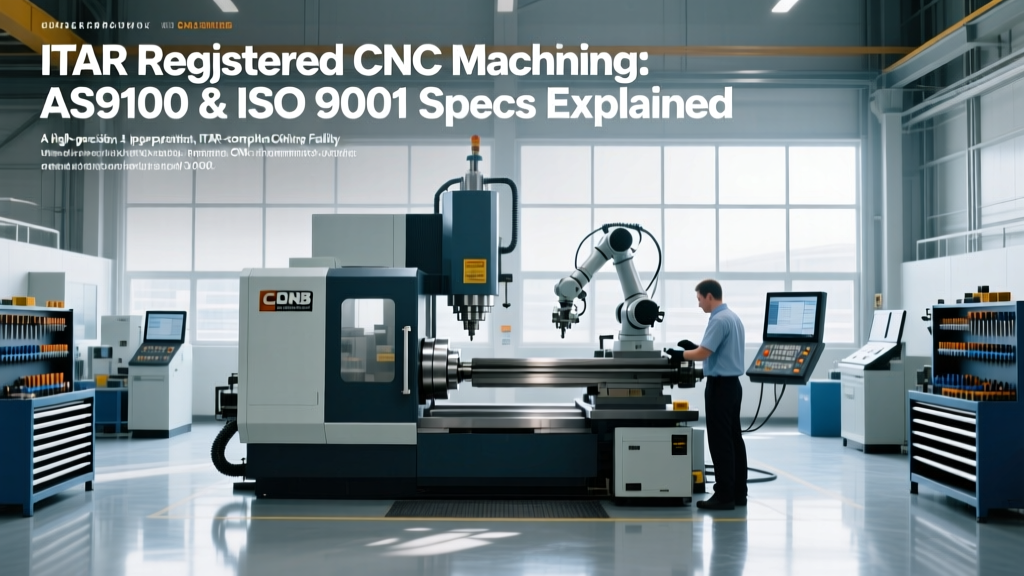
ITAR Registered CNC Machining: AS9100 & ISO 9001 Specs Explained
Explore how ITAR registered CNC machining facilities leverage AS9100 and ISO 9001 certifications to guarantee defense-grade precision and compliance.
When sourcing components for defense, aerospace, and munitions applications, procurement engineers frequently mandate the use of an ITAR registered CNC machining facility. However, a critical misconception in the supply chain is equating ITAR registration with machining quality. ITAR (International Traffic in Arms Regulations) is strictly a legal export-control framework governed by 22 CFR Parts 120-130. It dictates data sovereignty and personnel access; it does not measure spindle runout, surface finish, or CMM accuracy.
To guarantee the metallurgical integrity and dimensional precision required for defense articles, ITAR registration must be structurally integrated with rigorous Quality Management System (QMS) certifications—specifically ISO 9001:2015 and AS9100 Rev D. This guide details the technical specifications of these certifications and how they govern shop floor operations in defense machining.
Compliance Distinction: ITAR controls who can view the CAD model and where the physical part can be shipped. AS9100 Rev D and ISO 9001:2015 control how the part is machined, inspected, and validated. A shop can be ITAR registered without holding an ISO certification, but doing so introduces severe quality risks for mission-critical components.ISO 9001:2015 vs. AS9100 Rev D: Technical Specifications
While ISO 9001:2015 provides a baseline for general manufacturing quality, AS9100 Rev D (governed by the International Aerospace Quality Group) layers over 100 additional requirements specifically engineered for high-risk, low-to-medium volume aerospace and defense production.
| QMS Standard | Primary Focus | Key CNC Machining Clause | Shop Floor Application |
|---|---|---|---|
| ISO 9001:2015 | General process consistency and customer satisfaction. | Clause 8.5.1 (Control of production and service provision) | Standard SPC, basic tool calibration, general SOP adherence. |
| AS9100 Rev D | Risk mitigation, product safety, and absolute traceability. | Clause 8.1.3 (Product Safety) & 8.5.1.1 (Production Process Verification) | Mandatory FAI (AS9102), FMEA for setup, obsolescence management, Ti-6Al-4V MTR tracking. |
How AS9100 Rev D Dictates CNC Shop Floor Operations
In an ITAR registered CNC machining environment producing USML-listed (United States Munitions List) components, AS9100 Rev D enforces strict technical protocols that go far beyond standard job-shop practices.
First Article Inspection (FAI) and AS9102 Rev C
Under AS9100, any new part number, or any part produced after a significant process change (e.g., switching from a Haas VF-2 to a DMG Mori DMU 50 5-axis mill, or changing the CAM post-processor), requires a comprehensive First Article Inspection per AS9102 Rev C. This is not a simple visual check. It requires a 100% dimensional verification of every feature on the engineering drawing using calibrated CMMs (Coordinate Measuring Machines) like the Zeiss Contura or Renishaw Equator gauging systems. The resulting FAI report (Forms 1, 2, and 3) must be permanently linked to the part's serialization data.
Material Traceability and MTRs
Defense alloys such as Inconel 718, Ti-6Al-4V, and 17-4 PH stainless steel require absolute lot traceability. AS9100 Clause 8.5.2 mandates that the Material Test Report (MTR) provided by the mill must be verified against the shop's incoming inspection logs. If a CNC machined titanium bulkhead fails in the field, the QMS must allow auditors to trace the exact heat lot of the raw billet back to the original melting facility within hours. Scrap bins on the shop floor must be segregated by alloy type to prevent cross-contamination, a frequent failure point during Stage 2 audits.
Production Process Verification (Clause 8.5.1.1)
This clause requires machine shops to validate their CNC processes before full batch production. In practice, this means utilizing spindle probing cycles (e.g., Renishaw OMP60) to verify part datum shifts and tool wear compensation mid-cycle. If a shop relies solely on post-process manual inspection without in-process statistical verification, they will receive a non-conformance (NCR) during an AS9100 surveillance audit.
The ITAR Digital and Physical Perimeter in Machining
While AS9100 governs the physical machining, ITAR governs the security perimeter. The intersection of these two frameworks creates a highly controlled manufacturing environment.
- ERP Role-Based Access: Systems like Epicor or JobBOSS must be configured so that only U.S. persons (citizens or permanent residents) can access the digital work orders, CAD/CAM files, and setup sheets for ITAR-controlled parts.
- CAD/CAM Data Sovereignty: Toolpaths generated in Mastercam or Siemens NX for USML articles cannot be stored on cloud servers that route data through foreign nodes. Local, air-gapped, or strictly U.S.-hosted secure servers are mandatory.
- Physical Cell Segregation: 5-axis CNC cells machining classified or highly sensitive defense articles are often enclosed with badge-reader access. Only ITAR-cleared operators with specific AS9100 training sign-offs can enter the cell to perform tool changes or part loading.
Certification Timelines and Capital Requirements
Achieving and maintaining ITAR registration alongside AS9100 certification requires significant capital and administrative lead time. Procurement teams must account for these costs when evaluating supplier pricing models.
| Certification / Registration | Estimated Cost (50-Person Shop) | Timeline to Achieve | Renewal / Audit Cycle |
|---|---|---|---|
| ITAR Registration (DDTC) | $2,250 (Standard Fee) | 4 - 8 Weeks | Annual |
| ISO 9001:2015 Certification | $8,000 - $15,000 | 4 - 6 Months | 3-Year Cycle (Annual Surveillance) |
| AS9100 Rev D Certification | $18,000 - $35,000 | 9 - 14 Months | 3-Year Cycle (Annual Surveillance) |
Sourcing Framework: Evaluating an ITAR Registered CNC Partner
When vetting a machine shop for defense contracts, do not rely solely on the presence of an ITAR registration code. Use this technical decision framework to verify their actual capability:
- Request the AS9100 Certificate Scope: Ensure the certificate explicitly covers 'CNC Machining and Assembly of Aerospace/Defense Components.' Some shops hold AS9100 only for their distribution or kitting departments, not their manufacturing floor.
- Audit the FAI Archive: Ask for a redacted AS9102 Rev C First Article Inspection report for a complex 5-axis part. Verify that the CMM data correlates perfectly with the GD&T callouts on the drawing.
- Verify NCR (Non-Conformance Report) Workflows: A mature shop will have a robust, transparent NCR process. Ask how they handle a scrapped Inconel part—do they initiate a root-cause analysis (e.g., 5 Whys or Fishbone diagram) and update their FMEA, or do they simply remake the part and hide the scrap?
- Confirm ITAR Digital Controls: Ask the shop's IT administrator to demonstrate how a foreign national (e.g., an international student on an F-1 visa working in the engineering department) is technically blocked from accessing the secure server housing USML-controlled STEP files.
By demanding the intersection of ITAR legal compliance and AS9100 technical rigor, defense contractors ensure that the CNC machined components they source are not only legally compliant but engineered to survive the extreme tolerances of modern aerospace and military applications.