When to Outsource CNC Machining for the Mining Industry: A Repair Guide
Learn how to troubleshoot production bottlenecks and decide between in-house repair and outsourcing CNC machining for the mining industry to reduce downtime.
Diagnosing the In-House Machine Shop Bottleneck
Mining operations run on brutal, unforgiving schedules. When a 400-ton haul truck blows a spindle housing, or a continuous miner requires a replacement cutter drum assembly, the in-house maintenance shop is typically the first line of defense. However, treating your internal supply chain like a machine that requires troubleshooting is critical for operational survival. When in-house CNC machining for the mining industry fails, the symptoms rarely look like traditional machine breakdowns; instead, they manifest as scrapped parts, excessive tooling consumption, missed maintenance windows, and catastrophic equipment downtime.
This guide approaches the 'make vs. buy' decision through a troubleshooting lens. We will diagnose the specific failure modes of in-house mining repair shops and outline exactly when outsourcing to a specialized contract machine shop acts as the definitive repair for your production bottlenecks.
Operational Warning: Attempting to machine abrasive AR500 steel on a standard 3-axis VMC with a 10,000 RPM, low-torque spindle often results in severe chatter, premature carbide edge chipping, and out-of-tolerance bores that can compromise the structural integrity of load-bearing mining pins.Symptom 1: Tool Deflection and Chatter on Hardened Steels
Mining components are frequently fabricated from high-yield, abrasive steels like Hardox 450, AR400, or AR500 to withstand extreme impact and wear. If your in-house shop relies on aging vertical machining centers (VMCs) with standard BT40 spindles, you will inevitably experience tool deflection during heavy roughing passes.
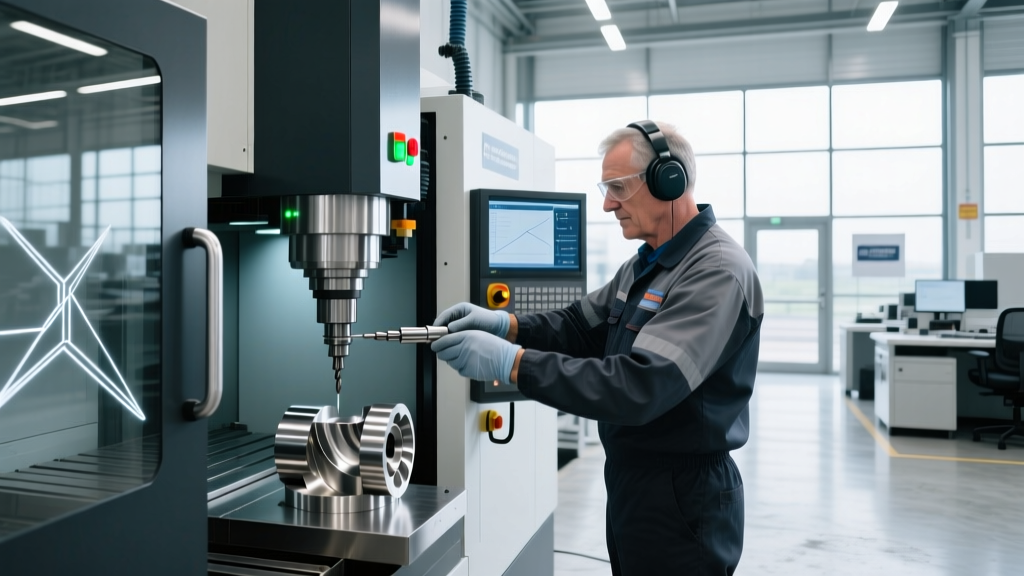
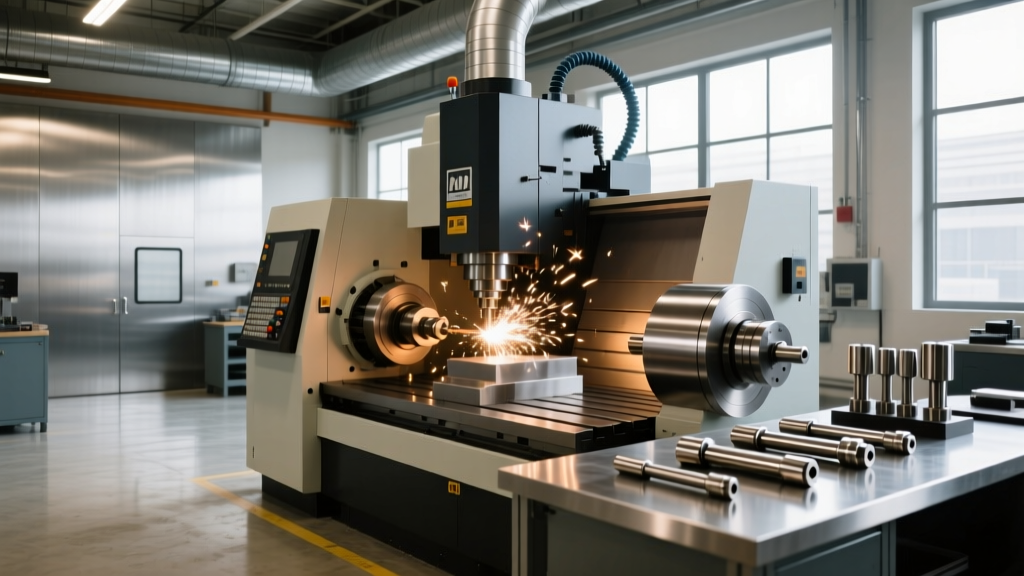
Using a standard 1/2-inch solid carbide endmill on AR500 steel at 300 SFM without high-pressure coolant leads to edge chipping within minutes. According to Sandvik Mining and Rock Solutions, optimizing cutting parameters for hardened mining steels requires rigid setups and advanced coolant delivery. Contract machine shops equipped with 5-axis horizontal machining centers (HMCs), such as the Makino a125Z, utilize 1,000 PSI through-spindle coolant and specialized trochoidal milling toolpaths. This extends tool life by up to 400% and holds critical bore tolerances to ±0.0005 inches on deep-hole pinions, eliminating the 'hidden tax' of constant tool replacement.
Symptom 2: Work Envelope Limitations and 'Shingling' Errors
A common failure point in surface mining is the cracking of dipper teeth adapters or boom pivot pins. These parts often exceed 60 inches in length and weigh over 2,000 lbs. If your in-house shop's largest machine is a standard 40" x 20" VMC, attempting to machine these parts via 'shingling' (machining in sections and repositioning the part) introduces cumulative runout and alignment errors.
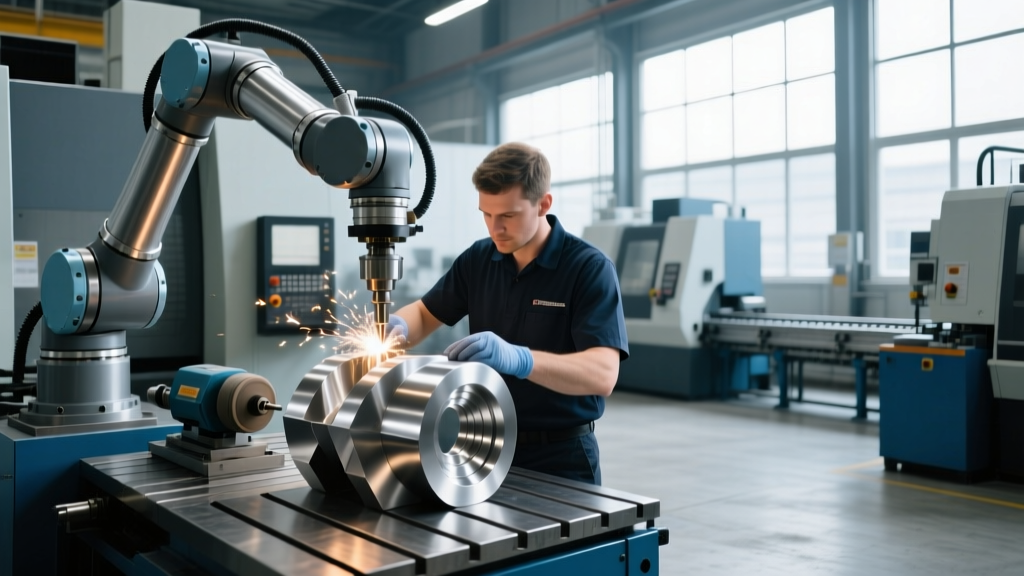
When a 60-inch dragline pin is machined in three separate setups, the coaxial runout between the bearing journals can easily exceed 0.010 inches. This misalignment causes uneven load distribution, leading to premature bearing failure in the field. Outsourcing to a facility with a 5-axis gantry mill (e.g., Zimmermann FZ30 or DMG Mori DMU 340 Gantry) allows the entire part to be machined in a single setup, guaranteeing concentricity and eliminating the root cause of the field failure.
Decision Matrix: In-House vs. Outsourced CNC Machining for the Mining Industry
Use this diagnostic matrix to determine whether your current machining workflow requires an outsourcing intervention.
| Operational Symptom | In-House Root Cause | Outsourcing Repair Protocol |
|---|---|---|
| Excessive scrap rates on large forgings | Thermal expansion during long cycle times; lack of in-cycle probing. | Contract shops use HMCs with Renishaw spindle probes to auto-update tool offsets for thermal drift mid-cycle. |
| Frequent spindle bearing failures | Overloading low-torque spindles with heavy roughing passes on hardened steel. | Outsource roughing to shops with high-torque, 15,000 RPM spindles designed for titanium and hardened alloys. |
| Bottlenecks at the manual deburring station | 3-axis machining leaves heavy burrs in intersecting deep holes. | 5-axis simultaneous machining allows for chamfering and deburring directly on the machine, saving 4-8 labor hours per part. |
| Missed maintenance windows due to part delays | Single-shift operations and unexpected machine breakdowns. | Leverage contract shops with 24/7 lights-out manufacturing capabilities and redundant machine cells. |
Financial Troubleshooting: Calculating the True Burden Rate
Many mine operators mistakenly believe in-house machining is cheaper because they only calculate the operator's hourly wage. To properly troubleshoot your production costs, you must calculate the fully burdened shop rate.
The True Cost of an In-House Mining Repair
- Machinist Salary & Benefits: A skilled CNC programmer/operator earning $85,000/year costs the company approximately $130,000/year with benefits and taxes (approx. $65/hr).
- Machine Depreciation: A modern 5-axis HMC (e.g., Doosan DVF 5000) costs roughly $550,000. Amortized over 10 years, that is $55,000/year ($27.50/hr based on 2,000 operating hours).
- Consumables & Overhead: Cutting tools, high-pressure coolant, floor space, and power add an estimated $35/hr.
Total True In-House Rate: $127.50 per hour.
The Outsourcing Value Proposition
A specialized contract machine shop may quote $165 per hour for 5-axis mining part machining. While the hourly rate is higher, their advanced toolpaths, rigid setups, and automated probing often reduce cycle times by 40% to 60%. Furthermore, if a $4,500 raw 4340 alloy steel forging is scrapped at the final boring operation due to an in-house thermal error, the total loss exceeds $10,000. Outsourcing transfers the scrap risk to the vendor, who possesses the metrology and machine rigidity to guarantee the part.
'According to research highlighted by McKinsey & Company's metals and mining insights, optimizing maintenance supply chains and reducing equipment downtime can improve overall mining productivity by up to 15%. Shifting complex, high-risk machining to specialized vendors is a primary lever for achieving this reliability.'
Step-by-Step: Vetting a Contract Shop for Mining Tolerances
Not all machine shops are equipped to handle the severe dynamic loads and metallurgical requirements of mining equipment. When outsourcing, use this checklist to audit potential partners:
- Material Traceability (MTRs): The shop must provide Mill Test Reports for every forging or plate used, verifying the chemical composition and yield strength of materials like Hardox or AR steel.
- Non-Destructive Testing (NDT) Capabilities: Look for in-house Magnetic Particle Inspection (MPI) and Ultrasonic Testing (UT) to detect subsurface flaws in forged mining pins before they are machined.
- Quality Certifications: ISO 9001:2015 is the baseline. For critical drilling and hoisting components, API Q1 certification is highly preferred.
- Advanced Metrology: Ensure the facility utilizes large-capacity Coordinate Measuring Machines (CMMs) like the Zeiss MMZ or portable laser trackers (FARO/Hexagon) to inspect oversized mining assemblies.
FAQ: Emergency Repair & Expedited Mining Parts
How fast can a contract shop turn around an emergency haul truck spindle housing?
Top-tier contract shops maintain 'hot lot' protocols for the mining industry. If raw material (like a pre-roughed 4340 forging) is in stock, expedited 5-axis machining and heat treatment can yield a finished, inspected part in 72 to 96 hours, compared to the 2-3 weeks typical of in-house shops juggling routine maintenance.
Can outsourced shops handle the reverse engineering of obsolete mining parts?
Yes. Specialized shops utilize 3D laser scanning (e.g., Creaform HandySCAN) to capture the exact geometry of worn or broken legacy components, such as continuous miner cutter picks or shovel dipper teeth. They recreate the CAD models, apply necessary engineering revisions to fix the original failure point, and machine the replacement part from modern, higher-grade alloys.
Is it cost-effective to outsource high-volume wear parts like bucket teeth?
For high-volume, repetitive wear parts, in-house machining or dedicated casting is usually more economical. Outsourcing CNC machining for the mining industry is best reserved for complex, low-volume, high-precision components (e.g., transmission housings, boom pivot pins, hydraulic cylinder blocks) where machine rigidity, 5-axis capability, and scrap-risk mitigation provide a clear return on investment.