Horizontal CNC Machining Services for Medical Device Compliance
Explore how horizontal CNC machining services ensure FDA and ISO 13485 compliance for complex medical device manufacturing and surgical tools.
The Regulatory Crucible: Why Medical Devices Demand Horizontal CNC
Medical device manufacturing operates under a zero-tolerance paradigm for defect rates. A single retained chip, a microscopic burr on a titanium spinal screw, or a surface finish deviation on an orthopedic implant can trigger catastrophic fatigue failure in vivo, leading to Class I FDA recalls. To mitigate these risks, original equipment manufacturers (OEMs) are increasingly migrating complex implant production away from standard vertical mills, opting instead for specialized horizontal cnc machining services that inherently support strict regulatory compliance.
The foundation of this compliance rests on the FDA’s Quality System Regulation, specifically 21 CFR Part 820, which mandates rigorous Production and Process Controls (P&PC). Under Section 820.70, manufacturers must validate processes where results cannot be fully verified by subsequent inspection. Horizontal machining centers (HMCs) provide the deterministic, repeatable environment required to pass these validation protocols, particularly when machining difficult-to-cut biomedical alloys.
⚠️ FDA Audit Warning: Manufacturing ControlsIn recent FDA Form 483 observations, over 35% of medical device manufacturing citations relate directly to inadequate process validation and failure to control environmental conditions (like coolant bioburden and chip contamination) during CNC machining. HMCs directly address these vulnerabilities through automated chip clearing and enclosed thermal management.
Material Traceability and the Chip Evacuation Imperative
Implantable devices predominantly utilize Ti-6Al-4V ELI (Grade 23 Titanium) and Cobalt-Chromium (CoCr) alloys. These materials are notorious for generating long, stringy, and highly abrasive chips during milling. In a Vertical Machining Center (VMC), gravity works against the process; chips fall back into the cutting zone or pool on the part bed. Recutting these chips causes tool deflection, accelerates insert wear, and ruins the critical surface finish (Ra) required for bone ingrowth or articulating joints.
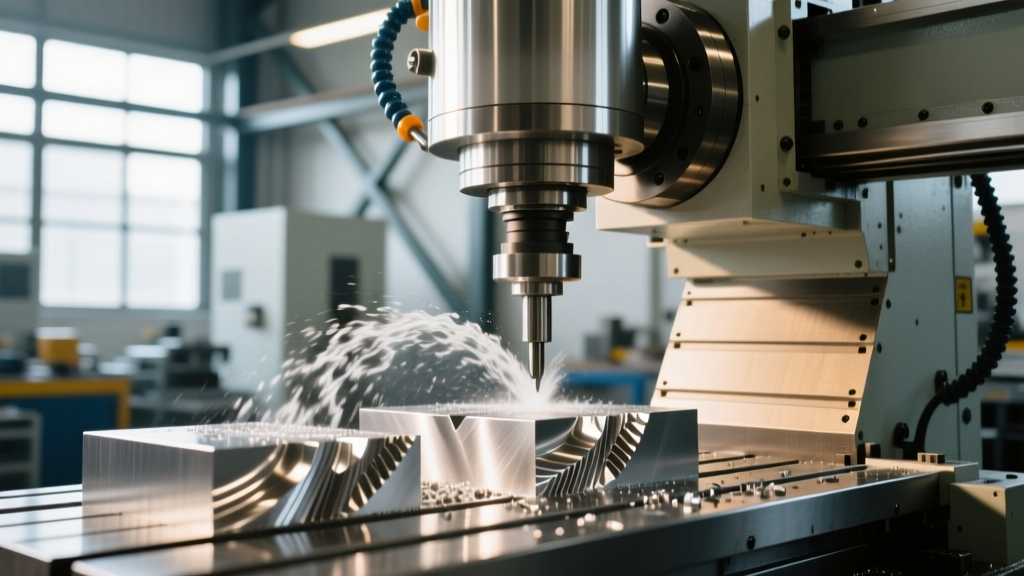
Horizontal cnc machining services leverage gravity to their advantage. The horizontal spindle orientation allows chips to fall directly away from the cutting zone and into the conveyor below. When paired with 1,000 PSI through-spindle coolant (TSC), HMCs ensure the cutting edge remains clear, maintaining a consistent surface roughness of Ra < 0.4 µm for porous ingrowth surfaces and Ra < 0.1 µm for articulating surfaces, without manual intervention.
Machine Selection: HMCs That Meet Cleanroom and Traceability Specs
Not every horizontal mill is suited for medical cleanroom environments. Machine shops offering compliant medical services invest in specific HMC architectures designed for thermal stability and multi-pallet automation. Models like the Makino a61nx or the DMG MORI NHX 4000 are industry staples in this sector due to their high-rigidity castings and advanced thermal compensation systems, which prevent dimensional drift during 72-hour unattended weekend runs.
| Feature | Vertical Machining Center (VMC) | Horizontal Machining Center (HMC) |
|---|---|---|
| Chip Evacuation | Poor (Requires manual clearing or air blasts) | Excellent (Gravity-fed, zero recutting) |
| Surface Finish (Ra) | Variable (0.4 - 0.8 µm on Ti-6Al-4V) | Highly Consistent (< 0.2 µm achievable) |
| Automation Readiness | Low (Robot tending required) | High (Integrated multi-pallet pools) |
| Hourly Machine Rate | $90 - $130 / hour | $160 - $240 / hour |
Navigating ISO 13485:2016 and Process Validation
Compliance in medical machining extends beyond the FDA. Contract manufacturers must adhere to ISO 13485:2016, the global standard for medical device quality management systems. Clause 7.5.6 specifically dictates the validation of processes for production and service provision. For CNC machining, this means the shop cannot simply run a first-article inspection (FAI) and begin production. They must execute a rigorous IQ/OQ/PQ (Installation, Operational, and Performance Qualification) protocol.
"In medical CNC machining, process validation isn't a paperwork exercise; it is the statistical proof that your horizontal machining center, tooling, coolant, and CAM strategy will produce 10,000 identical titanium knee tibial trays without a single Cpk deviation below 1.33."
— Director of Quality Assurance, Tier 1 Orthopedic Contract Manufacturer
Coolant Management and Bioburden Control
A frequently overlooked aspect of FDA compliance in machine shops is bioburden control via coolant management. Standard synthetic coolants can harbor bacteria and endotoxins, which can transfer to the porous surfaces of orthopedic implants. If an implant harbors endotoxins, it can trigger severe inflammatory responses in the patient, failing sterilization validation.
Top-tier horizontal cnc machining services utilize bio-stable, medical-grade synthetic fluids, such as Master Fluid Solutions TRIM MicroSol 585XT. Furthermore, compliant shops implement daily refractometer checks, weekly pH testing, and monthly microbiological dip-slides to ensure the coolant remains sterile and within the exact 6-8% concentration window required to prevent flash rust on 316L stainless steel surgical instruments.
Cost Analysis: Premium Pricing for Compliant Horizontal CNC Machining Services
Medical OEMs often experience sticker shock when transitioning from aerospace or automotive suppliers to specialized medical machine shops. The premium pricing for medical-grade horizontal cnc machining services—typically ranging from $180 to $240 per spindle hour—is not arbitrary. It reflects the massive overhead of regulatory compliance, traceability, and specialized metrology.
💡 Where Your Dollar Goes: Medical HMC Cost Breakdown
- 35% - Machine & Automation Depreciation: High-end HMCs with integrated pallet pools and 1,000 PSI TSC.
- 25% - QA & Metrology Overhead: Programming and operating 5-axis CMMs (e.g., Zeiss CONTURA) and optical comparators for 100% critical dimension inspection.
- 20% - Documentation & Traceability: Maintaining Certified Material Test Reports (CMTRs), lot traceability software, and device history records (DHR) per FDA 21 CFR 820.184.
- 15% - Cleanroom Deburring & Packaging: Manual edge-breaking under magnification and vacuum-sealing in ISO Class 7 cleanroom environments.
- 5% - Tooling & Consumables: Premium micro-grain carbide endmills and medical-grade synthetic coolants.
Supplier Qualification Checklist for Medical OEMs
When auditing a prospective machine shop for implantable device manufacturing, purchasing and engineering teams must look beyond ISO certificates. Use this targeted checklist to evaluate their true capability in horizontal cnc machining services for medical applications:
- Request the Design Control Matrix: Verify how the shop translates your CTQ (Critical to Quality) print callouts into specific CMM inspection programs and in-process probing routines.
- Audit the Chip Conveyor Maintenance Logs: Poorly maintained HMC chip conveyors lead to coolant tank contamination. Ask to see their weekly preventative maintenance (PM) schedules for fluid management.
- Verify Material Segregation Protocols: Ensure the shop has physical and systemic barriers to prevent cross-contamination between 316L Stainless Steel and Titanium work zones, which can cause galvanic corrosion in vivo.
- Review the Tool Life Management Strategy: Compliant shops do not run tools to failure. They use RFID tool tags or strict cycle-count macros in the HMC control to force tool changes at 80% of the validated tool life, ensuring surface finish consistency.
- Inspect the Cleanroom Transition: Observe how parts move from the CNC floor to the deburring/cleaning area. There must be a defined pass-through box or air-shower protocol to prevent shop-floor aerosolized oils from entering the final packaging zone.
By demanding rigorous adherence to these standards, medical OEMs ensure that their horizontal cnc machining partners deliver not just precision metal parts, but life-saving devices that withstand the harshest regulatory scrutiny and the demanding biological environment of the human body.