Railroad Fittings CNC Machining: 2026 High-Volume Equipment Guide
Discover the best high-volume CNC equipment for railroad fittings machining in 2026. Compare HMCs, multi-spindle lathes, and automation for mass production.
The Engineering Reality of High-Volume Railroad Fittings CNC Machining
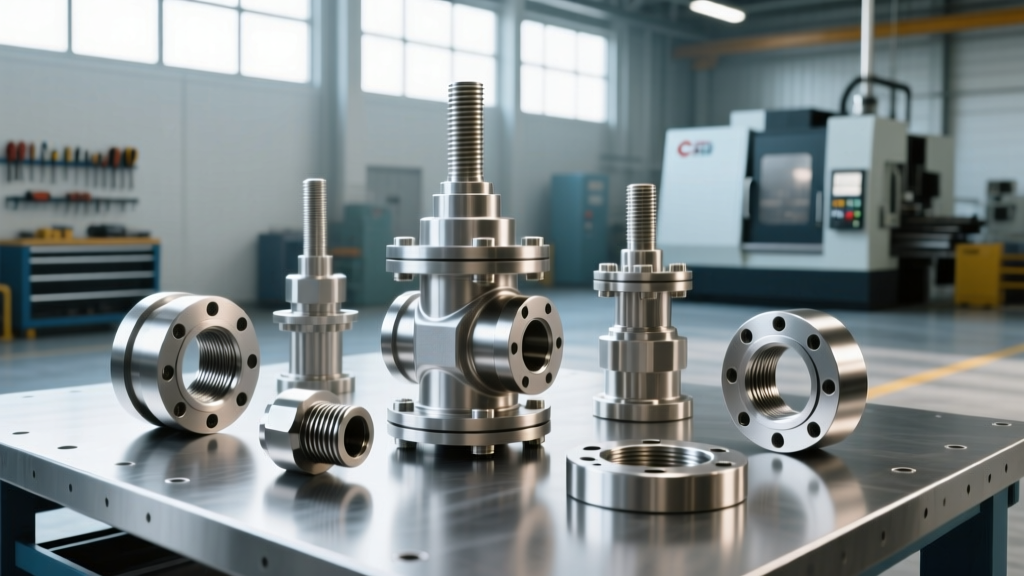
The transition from low-mix job shop work to high-volume contract manufacturing for the rail industry requires a fundamental rethinking of machine tool selection. Railroad fittings—including draft gear housings, coupler knuckles, brake beam brackets, and center plates—are subjected to extreme dynamic loads and harsh environmental degradation. Consequently, the Federal Railroad Administration (FRA) and the Association of American Railroads (AAR) enforce stringent dimensional tolerances and material traceability requirements (such as AAR M-201 and M-202 standards). Meeting these specifications at volumes exceeding 50,000 parts annually cannot be achieved using standard 3-axis vertical machining centers (VMCs).
⚠️ AAR Compliance Warning: High-volume production of coupler components requires strict adherence to AAR M-201 alignment tolerances (typically ±0.005 inches on critical mating surfaces). Cumulative tolerance stack-up from multiple fixture flips on a VMC will result in catastrophic batch rejections. Equipment selection must prioritize single-setup, multi-axis machining.Metallurgical Challenges: Why Standard Machines Fail
Before selecting equipment, shops must account for the specific metallurgy of rail components. The industry standard for heavy draft gear and coupler knuckles is Grade E cast steel or Austempered Ductile Iron (ADI). ADI offers a tensile strength exceeding 130 ksi but contains abrasive silicon carbides and hard pearlitic bands that rapidly degrade standard PVD-coated carbide inserts.
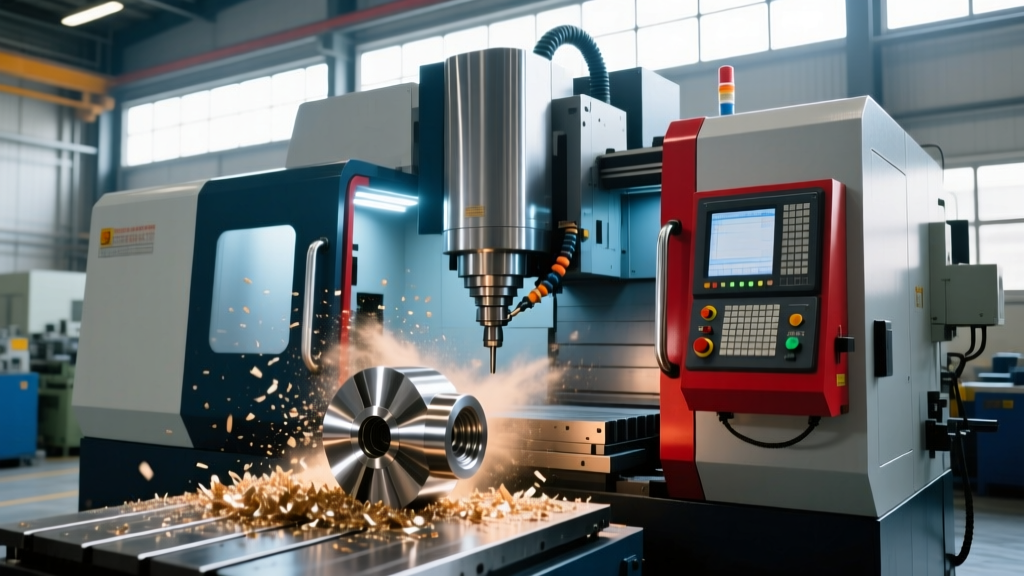
Furthermore, forged 4140 and 4340 steel components (like clevises and brake pins) produce long, stringy chips that tangle around toolholders and workpieces. In a high-volume, lights-out manufacturing environment, unmanaged chip evacuation is the primary cause of unplanned downtime. Therefore, the chosen CNC platform must support through-spindle high-pressure coolant (HPC) at a minimum of 70 bar (1,000 psi) and feature steeply sloped internal sheet metal to facilitate chip shedding.
Core Equipment Matrix for Mass Production
Selecting the right architecture depends on the specific fitting geometry. Below is a comparative matrix of the three dominant machine platforms used in 2026 for high-volume rail component manufacturing.
| Machine Platform | Ideal Fitting Type | Avg. Cycle Time Reduction | Estimated 2026 CapEx |
|---|---|---|---|
| 4-Axis HMC with Pallet Pool | Draft gears, knuckles, center plates | 40-50% vs. VMC | $650k - $950k (w/ automation) |
| 8-Spindle CNC Lathe | Brake pins, bushings, clevises | 75-85% vs. 2-axis lathe | $750k - $1.1M |
| 5-Axis Turn-Mill Center | Complex brake rigging, slack adjusters | 60% vs. multi-machine cell | $850k - $1.3M |
Horizontal Machining Centers (HMCs): The Backbone of Heavy Fittings
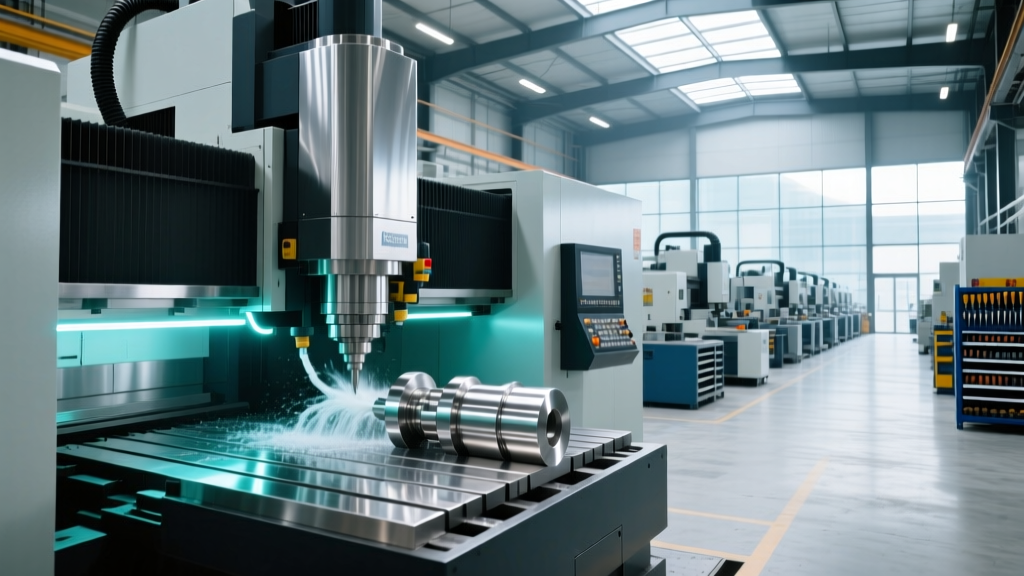
For prismatic and heavy cast components like draft gear housings, the 4-axis Horizontal Machining Center equipped with a linear pallet pool (LPP) is the undisputed industry standard. Machines like the Makino a61nx or the DMG MORI NHX 5000 dominate this space due to their thermal stability and aggressive metal removal rates (MRR).
Fixturing and Tombstone Strategy
The true ROI of an HMC in railroad fittings CNC machining lies in tombstone fixturing. A standard 500mm x 500mm tombstone can hold four to eight brake beam brackets simultaneously. By utilizing hydraulic self-clamping fixtures powered through the rotary table, shops eliminate manual clamping time and ensure uniform clamping force, preventing part distortion in thin-walled castings.
- Hydraulic Power Units: Must be integrated directly into the pallet to maintain pressure during the 12,000 RPM spindle engagement.
- RFID Tool Tracking: Essential for lights-out operations. The machine reads the RFID chip in the toolholder, automatically updating the offset and remaining tool life, preventing catastrophic crashes when an insert reaches its 40-part life limit on ADI materials.
Multi-Spindle Lathes: Dominating Symmetrical and Turned Fittings
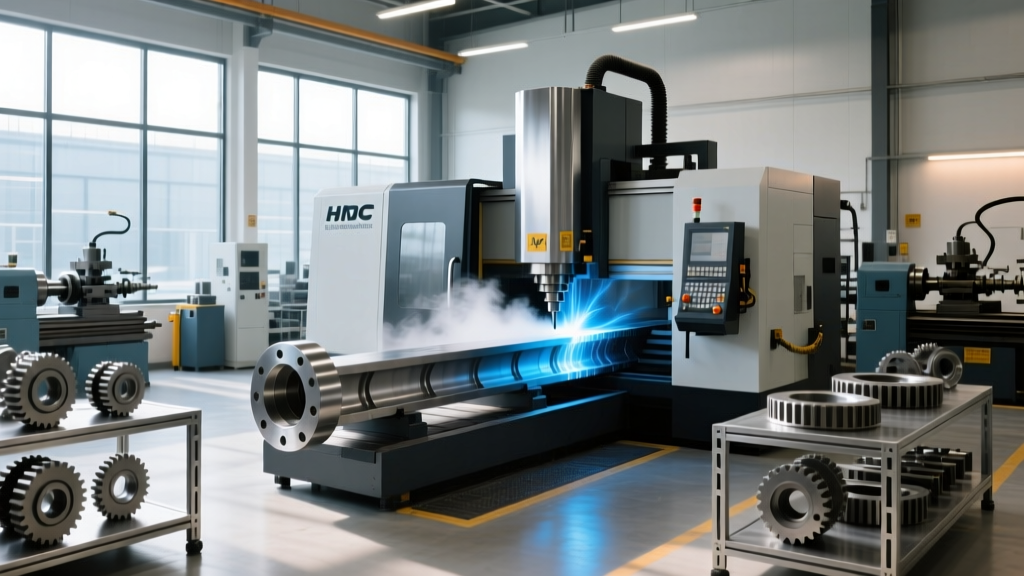
When producing high volumes of symmetrical fittings—such as brake cylinder clevises, journal bearing adapters, and draft gear pins—multi-spindle automatic lathes offer unmatched throughput. The INDEX MS32-8 (8-spindle) and Tornos MultiAlpha 8x20 are engineered specifically for this tier of production.
"The mathematics of multi-spindle machining dictate high-volume rail production. If a brake pin requires 90 seconds of total cutting time across turning, drilling, and threading, a single-spindle lathe produces 40 parts per hour. An 8-spindle machine indexes every 11.25 seconds, yielding 320 parts per hour from the same footprint, effectively reducing the cost-per-part from $4.50 to under $1.10."
— Production Engineering Analysis, Sandvik Coromant Railway Solutions
Synchronization and Back-Working
Modern multi-spindle machines utilize independent spindle speeds and C-axis positioning. This allows the machine to perform heavy roughing on spindle 1 at 1,500 RPM while simultaneously executing precision threading on spindle 4 at 3,500 RPM. The counter-spindle (pick-off) handles back-working operations, ensuring the part is completely finished before it drops into the conveyor chute, eliminating secondary operations entirely.
Automation Integration: Gantry vs. Robotic Tending
High-volume railroad fittings CNC machining requires uninterrupted material flow. Raw castings and forgings are heavy (often 40-150 lbs) and feature uneven surfaces that challenge standard robotic grippers.
💡 Automation Selection Framework:- Choose Gantry Loaders when handling raw castings (knuckles, draft gears) over 50 lbs. Gantries provide the vertical lift and rigidity required to seat heavy, rough-surfaced parts into hydraulic tombstone fixtures without misalignment.
- Choose 6-Axis Articulated Robots (e.g., FANUC M-710 series) when processing forged billets or bar-fed components where flexible wrist articulation is needed for deburring or post-machining inspection station transfers.
Tooling and Coolant: The Hidden Variables in Cycle Time
Capital equipment is only half the equation. The consumable strategy dictates whether a high-volume cell runs profitably or bleeds money through insert costs and downtime.
High-Pressure Coolant (HPC) Mandates
Standard 20-bar flood coolant is obsolete for high-volume rail machining. Machining forged 4340 steel requires minimum 70-bar (1,000 psi) HPC directed precisely at the cutting edge via the toolholder. This creates a hydraulic wedge that breaks stringy chips into manageable 'C' shapes, preventing bird-nesting inside the machine enclosure. Machines spec'd for rail production must feature 1000+ liter coolant tanks with high-capacity centrifugal separators to handle the massive volume of fine cast-iron graphite and steel swarf generated over a 24-hour shift.
Insert Substrate and Geometry Selection
For face milling Grade E cast steel, utilize heavy-duty insert geometries with reinforced cutting edges (such as the Sandvik CoroMill 345 or Walter Xtra.tec F4033). For ADI components, standard carbide will fail prematurely. Shops must invest in Cubic Boron Nitride (CBN) tipped inserts or specialized thick-film CVD coated grades designed specifically for hard-part milling, pushing tool life from 40 parts to over 300 parts per edge.
ROI and Cost-Per-Part Analysis
Justifying a $1.2 million capital expenditure for a palletized HMC cell or an 8-spindle lathe requires a clear view of the cost-per-part reduction. Consider a 100,000-part annual run of brake beam brackets:
- Legacy VMC Cell (3 Machines, 2 Operators/Shift): Cycle time 8.5 mins. Cost-per-part: $14.20. Annual labor and overhead: $1.42M.
- Automated HMC Cell (1 Machine, 1 Supervisor/Shift): Cycle time 3.2 mins (due to 4-axis indexing and optimized toolpaths). Cost-per-part: $6.80. Annual labor and overhead: $680k.
- Payback Period: At a gross margin improvement of $7.40 per part across 100,000 units, the annual savings total $740,000. The fully automated cell achieves ROI in approximately 18 to 22 months, after which the margin expansion directly impacts the shop's bottom line.
Final Equipment Selection Checklist
Before issuing a purchase order for high-volume railroad fittings CNC machining equipment, verify the following specifications with the machine tool builder:
- Coolant Pressure: Is the spindle and toolholder interface rated for continuous 70+ bar operation without seal degradation?
- Chip Conveyor Capacity: Does the hinge-belt conveyor feature a scrap-removal auger specifically designed for abrasive cast-iron fines?
- Thermal Compensation: Does the control feature real-time thermal displacement compensation to maintain ±0.005" tolerances across a 72-hour continuous weekend run?
- Software Integration: Can the machine's native API integrate directly with your shop's ERP/MES system for real-time OEE (Overall Equipment Effectiveness) tracking and automated tool-reordering?
Scaling into the rail supply chain is not merely about buying faster machines; it is about engineering a closed-loop, high-rigidity manufacturing system capable of holding tight tolerances in unforgiving materials, shift after shift, without human intervention.