High Volume CNC Machining Services for Architectural Facades
Explore technical specs, 5-axis toolpaths, and parametric CAM workflows driving high volume CNC machining services for architectural facade systems.
The Paradox of Scale in Architectural Metalwork
Architectural facades and curtain wall systems are traditionally viewed as bespoke, low-volume construction projects. However, the modern shift toward unitized curtain wall systems and parametric building envelopes has fundamentally changed manufacturing requirements. Today, mega-projects like commercial skyscrapers, airport terminals, and stadium enclosures require tens of thousands of structural nodes, mullion brackets, and ACM (Aluminum Composite Material) panels. This is where high volume CNC machining services intersect with architectural metalwork, transitioning the industry from manual stick-built assembly to automated, precision-driven mass customization.
Delivering high-volume facade components requires navigating strict architectural tolerances (typically ±0.5mm for panels and ±0.1mm for structural connectors) while managing the logistical bottleneck of machining large, unwieldy extrusions and complex 3D cast nodes. According to the Council on Tall Buildings and Urban Habitat (CTBUH), unitized facade systems now account for over 75% of high-rise envelopes globally, directly driving the demand for automated, high-throughput CNC fabrication.
Data Highlight: The Unitized AdvantageUnitized curtain walls manufactured via high-volume CNC processes reduce on-site installation time by up to 60% compared to traditional stick-built systems. By machining interlocking male/female aluminum extrusions to exact 5-axis tolerances, facades can be snapped together on-site, accommodating structural deflection and thermal expansion without field welding.
Core Technical Specifications for Facade CNC Operations
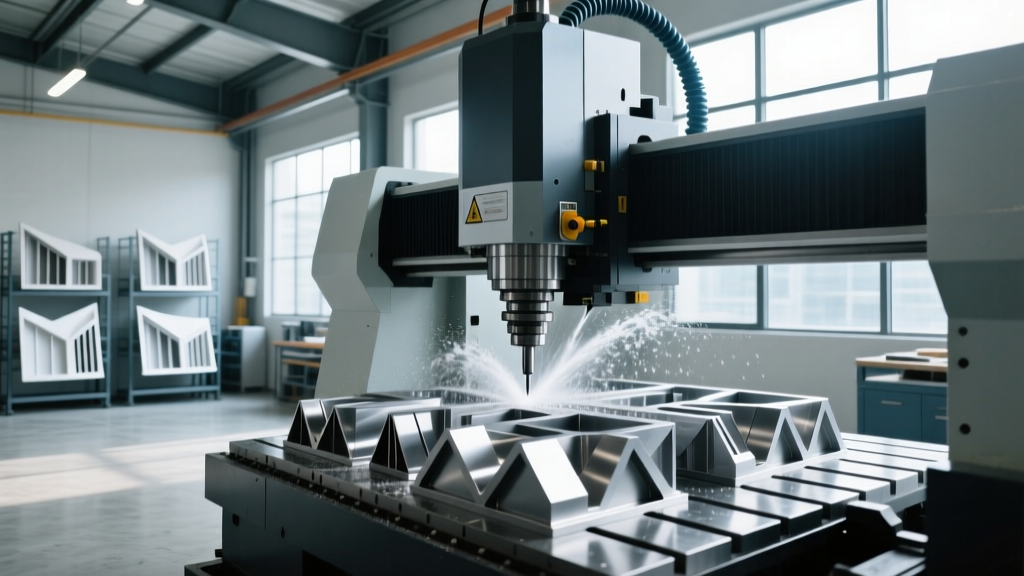
Machining architectural components requires specialized equipment that bridges the gap between heavy-duty structural cutting and high-speed aerospace routing. High volume CNC machining services typically deploy a hybrid machine park to handle both the massive work envelopes required for facade panels and the rapid cycle times needed for bracketry.
| Machine Type | Typical Model | Work Envelope (X-Y-Z) | Spindle Speed | Primary Application | Tolerance Capability |
|---|---|---|---|---|---|
| 5-Axis Gantry Router | Fidia GTF-30T | 3000 x 1500 x 1000 mm | 24,000 RPM | ACM Panel Routing, HPL Profiling | ± 0.25 mm |
| Horizontal Machining Center (HMC) | Makino a61nx | 730 x 730 x 889 mm | 14,000 RPM | Unitized Brackets, Cleats, Nodes | ± 0.05 mm |
| 5-Axis VMC (Large Format) | DMG MORI DMU 125 | 1250 x 1000 x 900 mm | 18,000 RPM | Complex 3D Structural Cast Nodes | ± 0.10 mm |
Parametric Toolpath Generation: The 'Mass Customization' Pipeline
In architectural metalwork, 'high volume' rarely means 50,000 identical parts. It means 10,000 unique parts generated from a single mathematical logic. A parametric facade might feature aluminum sunshades where every single bracket has a slightly different angle to optimize solar shading based on its exact GPS coordinate on the building's surface. High volume CNC machining services handle this through automated parametric CAM pipelines.
Step-by-Step Parametric CAM Workflow
- Geometry Generation (Rhino 3D + Grasshopper): The facade algorithm outputs thousands of unique 3D bracket geometries, each tagged with a unique ID and orientation vector.
- Automated Feature Recognition: Plugins like HAL Robotics or custom Python scripts analyze the 3D meshes, automatically identifying hole patterns, pocket depths, and edge profiles.
- Batch Toolpath Assignment: HyperMill or Mastercam API scripts apply predefined machining strategies (e.g., 3D adaptive clearing, 5-axis simultaneous contouring) to the entire batch without manual programmer intervention.
- Post-Processing & Nesting: The system generates individual G-code files or nests multiple small brackets onto a single 6063-T6 aluminum plate, utilizing tombstone fixtures on HMCs for uninterrupted lights-out machining.
Material Engineering & Tooling Strategies
The dominant material in architectural facades is 6063-T6 aluminum due to its excellent extrudability, high strength-to-weight ratio, and anodizing characteristics. However, machining high volumes of aluminum introduces severe tool wear and Built-Up Edge (BUE) challenges.
Warning: Galvanic Corrosion in Structural NodesWhen CNC machining aluminum facade brackets that will interface with carbon steel mullions or stainless steel (316L) tension cables, galvanic corrosion is a critical failure mode. High volume CNC services must machine precise recesses (typically 1.5mm deep) into the aluminum brackets to accept PTFE or EPDM isolation shims. Failure to maintain this ±0.05mm recess tolerance during high-speed production will result in direct metal-to-metal contact and catastrophic facade degradation in coastal environments.
Advanced Tooling for High-Throughput Aluminum
- DLC (Diamond-Like Carbon) Coated Endmills: Standard TiAlN coatings react chemically with aluminum at high cutting temperatures, accelerating BUE. DLC-coated solid carbide endmills provide a near-frictionless surface, extending tool life by 300% in high-volume 6063-T6 routing.
- Polished Flute Geometries: Mirror-polished carbide routers with high helix angles (45°+) ensure rapid chip evacuation, preventing chip welding in deep pocketing operations for unitized curtain wall interlocks.
- Through-Spindle Coolant (TSC) at 70 Bar: Essential for clearing chips from deep, small-diameter holes used for facade anchor bolts, preventing tap breakage during automated rigid tapping cycles.
Cost Breakdown: Unitized CNC vs. Traditional Fabrication
Transitioning to high volume CNC machining services requires significant upfront capital in CAM programming and custom fixturing, but the per-part economics shift dramatically at scale. The following matrix compares traditional manual fabrication (cutting, drilling, welding) against automated 5-axis CNC unitized production for a 5,000-panel commercial facade project.
| Cost Metric | Traditional Stick-Built Fabrication | High-Volume 5-Axis CNC Unitized |
|---|---|---|
| Setup & Programming | $4,500 (Minimal) | $28,000 (Parametric CAM + Fixtures) |
| Per-Part Machining Cost | $85.00 (Manual drill/weld) | $14.50 (Automated HMC Pallet) |
| Scrap / Rework Rate | 8.5% | 0.8% |
| On-Site Assembly Labor | $120.00 per panel | $35.00 per panel (Snap-fit) |
| Total Project Cost | $1,027,500 | $611,500 |
Quality Control & Metrology at Scale
According to standards set by the Architectural Aluminum Manufacturers Association (AAMA), facade components must endure extreme thermal cycling and wind-load deflection. A tolerance stack-up error of just 1.5mm across a continuous curtain wall run can cause weather-seal failure and water infiltration. High volume CNC machining services cannot rely on manual calipers for quality assurance.
Automated Metrology Integration
Modern machine shops integrate automated optical inspection (AOI) and laser tracking directly into the production floor. For large architectural extrusions (up to 6 meters in length), Faro Vantage Laser Trackers are used to scan the machined interlocking profiles immediately after the gantry router completes its cycle. The metrology software compares the point-cloud data against the original Grasshopper NURBS surface, automatically updating the CNC tool wear offsets in real-time via a closed-loop feedback network. This ensures that the 10,000th bracket machined maintains the exact same dimensional integrity as the first, compensating for ambient temperature shifts in the factory and progressive spindle thermal growth.
'In parametric facade engineering, the CNC machine is not just a cutting tool; it is the physical manifestation of the building's digital twin. If the G-code generation and the metrology feedback loops are not perfectly synchronized, the physical building simply will not assemble.' — Lead Facade Engineer, International Curtain Wall Consortium
Decision Framework: Selecting a CNC Partner for Facades
When sourcing high volume CNC machining services for architectural metalwork, generalist machine shops often fail due to a lack of understanding regarding architectural GD&T (Geometric Dimensioning and Tolerancing) and finishing requirements. Use this framework to evaluate potential partners:
- Anodizing & Finishing Logistics: Does the shop have in-house or tightly integrated anodizing lines? Machined 6063-T6 aluminum must be anodized (typically Class I, 25-micron thickness for exteriors) within 24 hours to prevent oxidation halos around machined edges.
- Parametric Data Handling: Request a sample run of 50 unique, algorithmically generated nodes. If the shop requires manual CAM programming for each node, they lack the API-driven infrastructure required for true high-volume architectural mass customization.
- Thermal Management: Ask about their coolant temperature control systems. Machining long aluminum mullions generates significant heat; shops without chilled coolant systems (maintained at 20°C ± 1°C) will deliver parts that measure correctly on the shop floor but warp when brought to standard room temperature.