Heavy CNC Machining for Rugged Electronics Enclosures & Compliance
Explore how heavy CNC machining ensures tight-tolerance compliance for rugged electronics enclosures, meeting IP68, NEMA 4X, and EMI shielding standards.
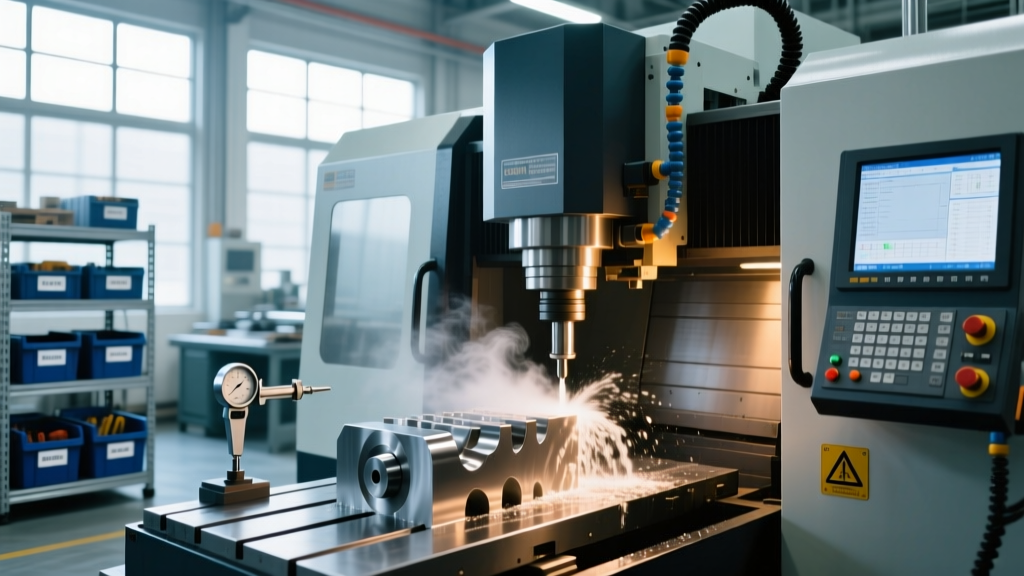
When engineering large-format electronics enclosures for extreme environments—such as deep-sea ROV control nodes, military radar housings, or heavy-duty mining server racks—traditional sheet metal fabrication fails to meet modern compliance requirements. Achieving true IP68 ingress protection and MIL-STD-461 EMI shielding on enclosures exceeding 30 inches in any dimension requires monolithic billet machining. This is where heavy CNC machining becomes critical, bridging the gap between massive material removal rates and the microscopic tolerances required for environmental sealing.
⚠️ Compliance Warning: The Welded Seam LiabilityFabricated and welded aluminum enclosures inherently suffer from heat-affected zones (HAZ) that warp mating surfaces. A warp deviation as small as 0.004 inches across a 40-inch flange will compromise conductive elastomer gaskets, resulting in catastrophic EMI leakage and immediate failure during NEMA 4X hose-down testing. Monolithic heavy CNC machining eliminates weld distortion entirely.
Why Heavy CNC Machining Outperforms Fabrication for Compliance
Heavy CNC machining utilizes large-format 5-axis gantry mills (such as the Zimmermann FZ30 or DMG Mori DMU 340 Gantry) to carve enclosures from solid blocks of aerospace-grade aluminum or titanium. While the raw material and machine-time costs are higher upfront, the total cost of ownership and compliance certification drops significantly by eliminating post-weld stress relieving, non-destructive testing (NDT) of weld seams, and manual flange truing.
| Metric | Monolithic Heavy CNC Machining | Welded / Fabricated Assembly |
|---|---|---|
| Flange Flatness (40" span) | ±0.001" (Guaranteed) | ±0.015" - ±0.030" (Requires post-machining) |
| EMI Shielding Integrity | Continuous grain structure, 100dB+ attenuation | Vulnerable at TIG/MIG weld seams |
| IP68 / NEMA 6P Rating | Passes submersion without secondary sealants | Requires RTV silicones or epoxy potting |
| Lead Time to First Article | 3–5 weeks | 6–9 weeks (includes welding, NDT, rework) |
Navigating Critical Safety & Compliance Standards
Heavy-duty enclosures must survive brutal physical and electromagnetic environments. Machine shops must program toolpaths that guarantee specific surface finishes and geometric dimensioning and tolerancing (GD&T) callouts to satisfy these regulatory frameworks.
NEMA 4X and IP68 Ingress Protection
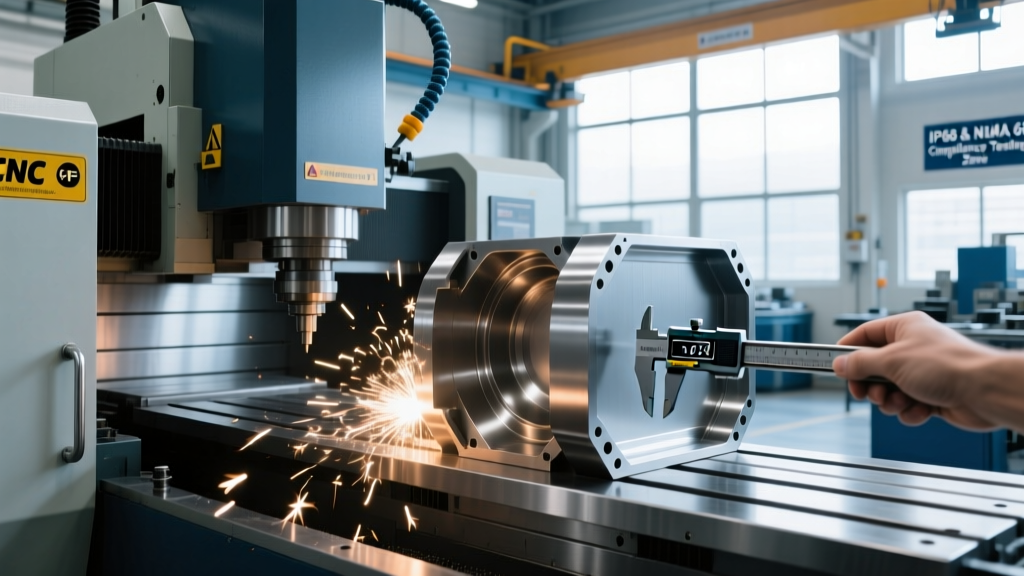
According to OSHA electrical enclosure regulations and broader industry standards, NEMA 4X requires enclosures to withstand high-pressure hose-directed water and resist corrosion. To achieve this on a 50-inch radar housing, the CNC-machined O-ring gland must maintain a depth tolerance of ±0.002 inches and a surface finish of Ra 32 µin. If the heavy gantry mill chatters during the finishing pass, the microscopic tool marks will wick water past the O-ring under hydrostatic pressure.
MIL-STD-810H Shock and Vibration
For defense applications, enclosures must survive the rigorous testing outlined in MIL-STD-810H for environmental engineering considerations. Heavy CNC machining allows engineers to integrate thick-walled ribbing and monolithic shock-mount bosses directly into the enclosure floor. Unlike bolted or welded standoffs, which can fatigue and snap under Method 514.8 vibration testing, monolithic bosses machined from 5083-H116 aluminum distribute harmonic loads across the entire billet structure.
MIL-STD-461 EMI/RFI Shielding
The FCC's Electromagnetic Compatibility division and military equivalents require strict containment of radio frequency interference. Rugged enclosures utilize conductive elastomer gaskets (such as Parker Chomerics CHO-SEAL 1285). These gaskets require the CNC-machined mating flanges to have a hardness of at least 70 Shore A and a strict flatness profile to ensure continuous electrical grounding around the entire 12-foot perimeter of a large server cabinet.
📊 Data Highlight: Gasket Compression Tolerances
For standard silver-aluminum filled silicone gaskets used in heavy industrial enclosures:
- Optimal Compression: 15% to 20% of original gasket cross-section.
- Required Flange Flatness: 0.002" per linear foot.
- Surface Finish Requirement: Ra 32 µin to Ra 63 µin (too smooth prevents friction grip; too rough cuts the elastomer).
- Fastener Spacing: Maximum 4.0" center-to-center to prevent flange bowing between bolts.
Material Selection for Heavy-Duty Enclosure Machining
Selecting the correct billet material is the first step in compliance engineering. Heavy CNC machining centers can handle extreme hardness, but the material must align with the environmental threat model.
- 6061-T6 Aluminum: The baseline for commercial rugged enclosures. Excellent machinability, good EMI shielding, and cost-effective. Fails in high-chloride (marine) environments without heavy anodizing.
- 5083-H116 Aluminum: The standard for marine and offshore oil & gas electronics. Contains higher magnesium content for extreme corrosion resistance. Requires specialized carbide tooling and slower feed rates during heavy roughing passes to prevent built-up edge (BUE).
- Grade 5 Titanium (Ti-6Al-4V): Reserved for aerospace and deep-submergence vehicles. Offers the highest strength-to-weight ratio and is entirely non-magnetic (critical for sonar and MRI-adjacent equipment). Heavy machining of titanium demands high-torque spindles, high-pressure through-tool coolant (1000+ PSI), and rigid tapping cycles.
Step-by-Step: Designing for 5-Axis Heavy Gantry Machining
Design for Manufacturability (DFM) for large-format CNC machining requires a different approach than small precision parts. Follow this framework to optimize your enclosure design:
- Establish the Raw Billet Envelope: Standard aluminum plate thicknesses max out around 8 to 10 inches. If your enclosure requires a 12-inch deep cavity, you will need custom forged billets, which add 4 weeks to lead time. Design the enclosure depth to stay within 9.5 inches to utilize off-the-shelf premium cast tooling plate (e.g., MIC-6).
- Implement Internal Corner Radii: Never design sharp internal corners on deep pockets. A heavy CNC endmill cannot machine a sharp 90-degree internal angle. Specify a minimum internal radius equal to the tool radius plus 0.050 inches (e.g., 0.550" radius for a 1.0" diameter cutter) to allow for smooth trochoidal milling toolpaths.
- Uniform Wall Thicknesses: While monolithic blocks don't suffer from injection molding sink marks, drastic variations in wall thickness can cause internal stress release during heavy roughing, leading to micro-warping. Keep vertical walls and floor thicknesses as uniform as possible, ideally maintaining a minimum of 0.250" for structural rigidity.
- Specify Thread Milling over Tapping: For large format enclosures requiring dozens of #10-32 or 1/4-20 threaded holes for EMI covers, specify thread milling. Heavy gantry machines can helical interpolate threads perfectly, eliminating the risk of broken taps in massive, expensive billets.
Cost and Lead Time Realities in 2026
Budgeting for heavy CNC machining requires understanding the economics of large-format machine time. In 2026, 5-axis heavy gantry mills typically run between $160 and $240 per hour, depending on the region and facility overhead.
For a 40" x 30" x 8" 5083 Aluminum radar enclosure, expect raw material costs to hover around $3,500 to $4,200. Machining time for heavy roughing (removing up to 60% of the material mass) and precision finishing will range from 35 to 50 hours. Total first-article costs generally land between $9,000 and $14,000 per unit. However, at production volumes of 50+ units, the per-part cost drops by 30-40% as CAM engineers optimize toolpaths and transition to custom PCD (polycrystalline diamond) tooling for extended edge life.
Frequently Asked Questions
Can heavy CNC machines hold tight tolerances across a 5-foot span?
Yes, but it requires thermal stability management. High-end gantry mills utilize active thermal compensation and chilled ball screws. A quality machine shop will rough-cut the enclosure, allow the part to rest for 24 hours to relieve induced stresses, and then perform the semi-finishing and finishing passes in a climate-controlled room (held at 68°F / 20°C) to guarantee ±0.001" flatness across 60 inches.
How do you prevent galvanic corrosion between the aluminum enclosure and stainless steel EMI fasteners?
Machine shops must specify and apply isolation compounds or anodize the enclosure to a minimum of MIL-A-8625 Type II, Class 2 (0.0007" thick) with a proper chromate or eco-friendly trivalent seal. Additionally, using A286 stainless steel or titanium fasteners instead of standard 304/316 SS reduces the galvanic potential difference in marine environments.
Is it possible to integrate liquid cooling channels into a monolithic heavy-machined enclosure?
Absolutely. 5-axis heavy CNC machining allows for the integration of complex, conformal cooling channels directly into the enclosure floor. By using deep-hole drilling and 5-axis contouring, shops can machine serpentine channels that sit just 0.100" below the component mounting surface, providing vastly superior thermal transfer compared to bolted-on cold plates, while maintaining the external IP68 seal.