2026 Trends: CNC Machining Medical Parts & Defense Dual-Use Tech
Explore how 2026 innovations in CNC machining medical parts are transforming defense manufacturing with shared tolerances, materials, and Swiss-type tech.
The Dual-Use Paradigm: Why Defense Needs Medical Precision
In 2026, the miniaturization of loitering munitions, drone guidance arrays, and seeker heads has forced defense contractors to look outside traditional aerospace supply chains. The solution? Machine shops specializing in cnc machining medical parts. The micro-precision required for next-generation defense micro-actuators now perfectly mirrors the tolerances demanded by orthopedic implants and surgical robotics. This crossover is creating a highly lucrative dual-use manufacturing sector where medical expertise directly translates to defense superiority.
2026 Data Highlight: Tolerance ConvergenceIn 2020, defense aerospace standard tolerances hovered around ±0.0005 in. By 2026, guidance fin actuators and optical targeting housings require ±0.0002 in. (5µm) — the exact baseline for Class III medical implants. Shops that mastered medical micro-machining are currently winning 68% of new micro-munition RFPs due to their existing process capabilities.
Material and Tolerance Matrix: Medical vs. Defense
While both sectors utilize advanced alloys, the specific grades and surface finish requirements are merging. Below is a comparison of how specifications overlap in modern contract machining.
| Feature | Medical (Implants/Tools) | Defense (Guidance/Munitions) | 2026 Converged Standard |
|---|---|---|---|
| Tolerance | ±0.0002 in. (5µm) | ±0.0005 in. (12µm) | ±0.0002 in. across critical interfaces |
| Primary Titanium | Ti-6Al-4V ELI (Grade 23) | Ti-6Al-4V (Grade 5) | ELI grade adopted for fatigue-critical drone parts |
| Surface Finish | 8 Ra µin (mirror polish) | 32 Ra µin (as-machined) | 16 Ra µin for aerodynamics and fatigue life |
| Traceability | FDA UDI (Laser Etch) | DoD IUID (Dot Peen/Laser) | Unified MTConnect data logging + Laser 2D Matrix |
Swiss-Type Lathes: From Bone Screws to Micro-Servos
The machinery that dominates cnc machining medical parts — specifically Swiss-type automatic lathes — has become the backbone of micro-munition production. Machines like the Tsugino B038-V and Citizen L20000 series utilize a guide bushing to support the material within 1mm of the cutting tool. This eliminates deflection, a critical factor when turning long, slender titanium bone screws or, in the defense sector, umbilical connector pins for missile systems.
High-Pressure Coolant Strategies
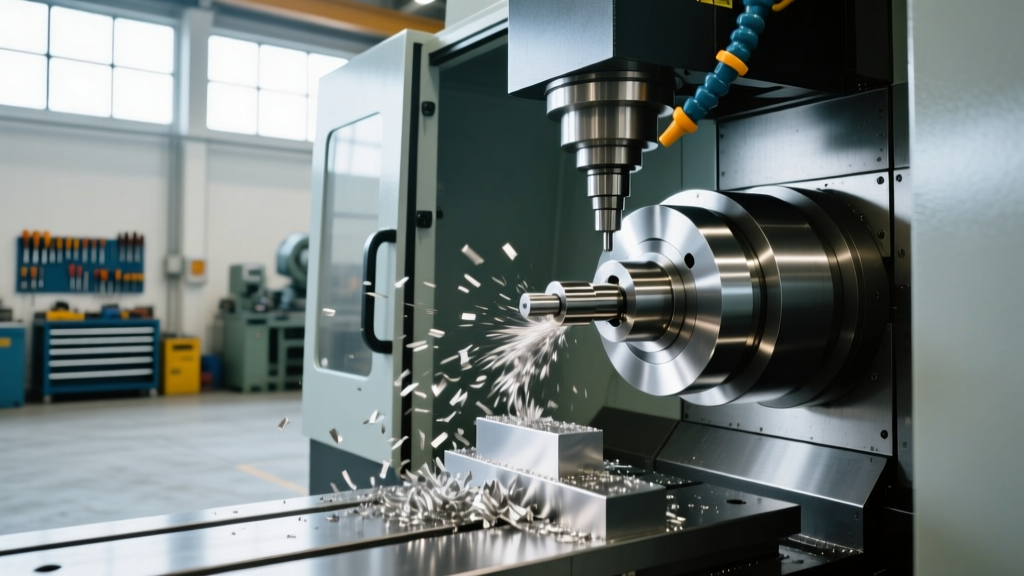
When machining deep-hole features in Grade 23 Titanium, medical shops have long relied on 1,500 PSI through-tool coolant to break chips and prevent work hardening. Defense contractors are now adopting this exact setup. Using a 0.080 in. deep-hole drill at 45 SFM (Surface Feet per Minute) with 1,500 PSI coolant reduces cycle times on defense connector housings by 34% compared to traditional flood coolant peck-drilling cycles.
The Nitinol Challenge: Stents vs. Shape-Memory Actuators
Nitinol (Nickel-Titanium) is famous for its superelasticity and shape-memory properties. In the medical field, it is the standard material for vascular stents and heart valve frames. In defense, Nitinol is increasingly used for deployable satellite arrays and thermal-activated micro-actuators in confined payloads.
⚠️ Warning: Thermal Phase ShiftingMachining Nitinol generates intense localized heat. If the cutting zone exceeds 150°C, the material's austenite-to-martensite phase transformation is permanently altered, ruining the shape-memory effect. Medical shops use uncoated carbide or PCD (Polycrystalline Diamond) tooling with aggressive flood cooling. Defense shops transitioning to Nitinol must abandon dry machining or MQL (Minimum Quantity Lubrication) immediately.
Optimized Cutting Parameters for Nitinol (55-Ni / 45-Ti)
- Cutting Speed (SFM): 40 - 60 SFM (Strictly maintained to avoid heat buildup)
- Feed Rate: 0.002 - 0.004 IPR (Inches per Revolution) to ensure the tool cuts beneath the work-hardened layer
- Tooling: Sharp, uncoated micro-grain carbide with a positive rake angle
- Coolant: High-volume flood (minimum 15 GPM) with water-soluble synthetic fluid
5-Axis Mill-Turn: Robotic Arms and Seeker Heads
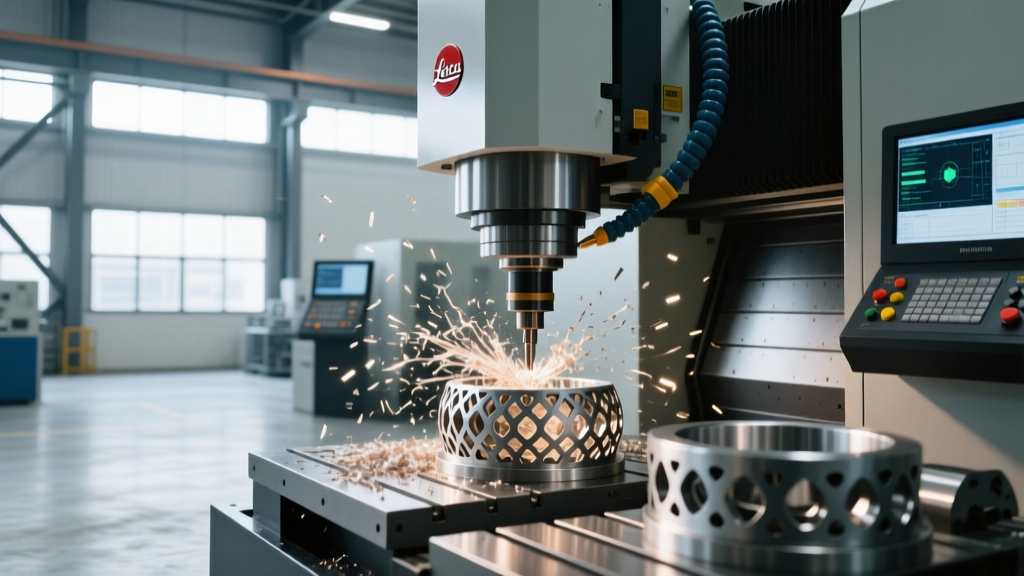
Complex defense components, such as infrared seeker heads and radar waveguide housings, require simultaneous 5-axis machining to maintain geometric tolerances across compound curves. This is the exact same technology used for machining robotic surgical arms and custom cranial implants. The DMG MORI NTX 1000 and Mazak INTEGREX i-200 are industry staples for these operations.
Toolpath Optimization for Thin-Wall Structures
Both surgical retractors and drone optical housings suffer from thin-wall chatter. In 2026, advanced CAM software like Mastercam and hyperMILL utilize dynamic motion toolpaths that maintain a constant tool engagement angle. By limiting radial engagement to 10% of the tool diameter while increasing axial depth of cut, shops can machine 0.040 in. thick titanium walls without inducing harmonic vibration. This technique, perfected in the medical sector for lightweight implant frameworks, is now critical for reducing the SWaP (Size, Weight, and Power) footprint of loitering munitions.
Traceability: Bridging FDA UDI and DoD IUID
A major barrier to entry for defense contracts is the stringent Item Unique Identification (IUID) requirement. However, shops already performing cnc machining medical parts possess a massive advantage. The medical sector operates under the FDA's Unique Device Identification (UDI) system, which mandates rigorous lot tracking, biocompatibility certs, and laser-etched 2D barcodes.
According to data from the NIST Manufacturing Extension Partnership, machine shops that integrate MTConnect protocols to automate the data collection for FDA audits can pivot to DoD IUID compliance in under 90 days. The digital thread required to prove a titanium spinal cage was machined with a specific tool on a specific date is identical to the documentation required by the DoD Manufacturing Technology Program for flight-critical drone components.
Surface Finishing: Citric Passivation vs. Hard Anodizing
The post-machining finishing processes for medical and defense parts represent one of the few areas where the sectors diverge, yet cross-training operators yields massive efficiency gains.
- Medical (Citric Passivation): Stainless steel and titanium medical tools must undergo citric acid passivation (per ASTM A967) to remove free iron and enhance the natural oxide layer without altering part dimensions. This is critical for biocompatibility and preventing in-vivo corrosion.
- Defense (Hard Anodizing & Alodine): Aluminum defense housings typically require Type III Hard Anodizing (MIL-A-8625) for extreme wear resistance, or Alodine (chemical film) for electrical conductivity and paint adhesion.
Shops that maintain in-house citric passivation lines for medical parts can easily adapt those tanks and rinsing protocols for defense aluminum treatments, eliminating the 2-3 week lead times associated with outsourcing surface finishing to third-party vendors.
Decision Framework: Cross-Certifying Your Machine Shop
For shop owners looking to leverage their medical expertise into defense contracts, a strategic approach to certification and floor layout is required.
- Audit Quality Systems (ISO 13485 vs. AS9100D): ISO 13485 focuses heavily on process validation and biocompatibility. AS9100 Rev D focuses on configuration management and risk mitigation. Implement a unified QMS that satisfies both, utilizing shared First Article Inspection (FAI) templates.
- Establish an ITAR Cage: Unlike medical parts, defense components often fall under ITAR (International Traffic in Arms Regulations). You must physically and digitally partition your CNC network. Use air-gapped servers for defense G-code and restrict facility access via RFID badge logging.
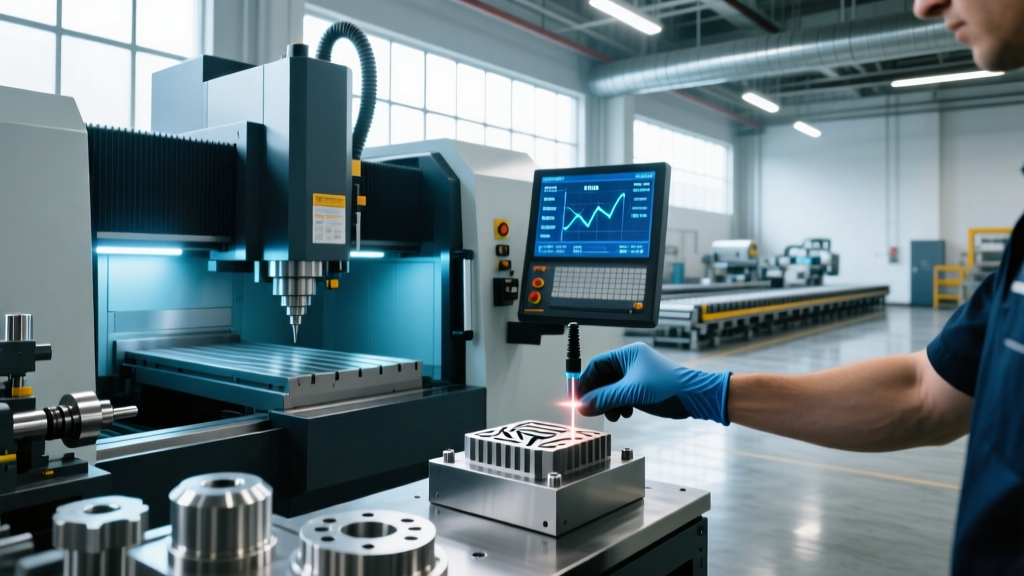
- Invest in Automated Metrology: Medical shops rely on optical comparators and white-light scanners for complex organic shapes (like knee joints). Defense shops traditionally use hard gauges. Upgrading to a Renishaw Equator 300 gauging system allows you to automate the inspection of both medical implants and defense micro-fins directly on the shop floor, reducing CMM bottlenecking by up to 80%.
The Bottom Line
The technological ceiling for cnc machining medical parts has effectively become the floor for advanced defense manufacturing. By leveraging Swiss-type precision, Nitinol machining protocols, and automated traceability, medical machine shops are uniquely positioned to dominate the 2026 micro-defense supply chain.