CNC Machining for Medical vs Aerospace: Operator Training
Master operator training for CNC machining for medical and aerospace components. Learn tolerance management, probing routines, and material best practices.
The Tolerance Paradigm: Training Operators for High-Reliability Sectors
Transitioning an operator from general commercial job-shop work to high-reliability manufacturing requires a fundamental shift in mindset. When managing CNC machining for medical implants and aerospace turbine components, the cost of a scrapped part is not merely the raw material and machine time; it encompasses the catastrophic risk of field failure, regulatory audits, and supply chain disruptions. In 2026, the integration of 5-axis simultaneous machining and closed-loop metrology demands that operators act as process engineers rather than simple button-pushers.
This guide outlines the advanced training protocols and best practices required to run precision aerospace and medical components on multi-axis platforms like the DMG MORI DMU 50 3rd Gen or Haas UMC-500SS.
Comparative Machining Parameters: Medical vs. Aerospace
While both sectors demand extreme precision, the operational focus differs based on the end-use environment. Medical components prioritize biocompatibility and surface integrity to prevent bacterial harboring, while aerospace components prioritize fatigue resistance and thermal stability.
| Parameter | Medical (Orthopedic Implants) | Aerospace (Turbine/Structural) | Operator Focus Area |
|---|---|---|---|
| Primary Materials | Ti-6Al-4V ELI, CoCr, PEEK | Inconel 718, Ti-6Al-4V, 15-5PH | Toolpath chip-thinning management |
| Standard Tolerances | ±0.0002" (5 µm) on mating bores | ±0.0005" (12 µm) true position | Thermal growth compensation |
| Surface Finish (Ra) | ≤ 0.4 µm (Mirror polish req.) | ≤ 0.8 µm (Fatigue life critical) | Cutting edge wear monitoring |
| Traceability Standard | ISO 13485 / FDA 21 CFR Part 820 | AS9100 Rev D / AS9102 FAI | Tool life and offset logging |
Core Training Module 1: Predictive Tool Wear Compensation
In aerospace and medical machining, reactive tool changing leads to scrapped parts. Operators must be trained in predictive macro-variable programming to adjust offsets before a tool breaches the tolerance band.
Implementing G10 Data Setting Commands
Operators should utilize G10 L2 (work coordinate shifts) and G10 L10/L11 (tool length and radius compensation) to automate wear adjustments. For example, when roughing Inconel 718 aerospace brackets, notch wear at the depth-of-cut line is predictable. Training must cover how to map tool life in the machine's control (e.g., Fanuc 31i-B5) to trigger a sister tool replacement at 85% of the calculated life, preventing catastrophic insert failure during the finish pass.
Core Training Module 2: Advanced Probing and In-Process Metrology
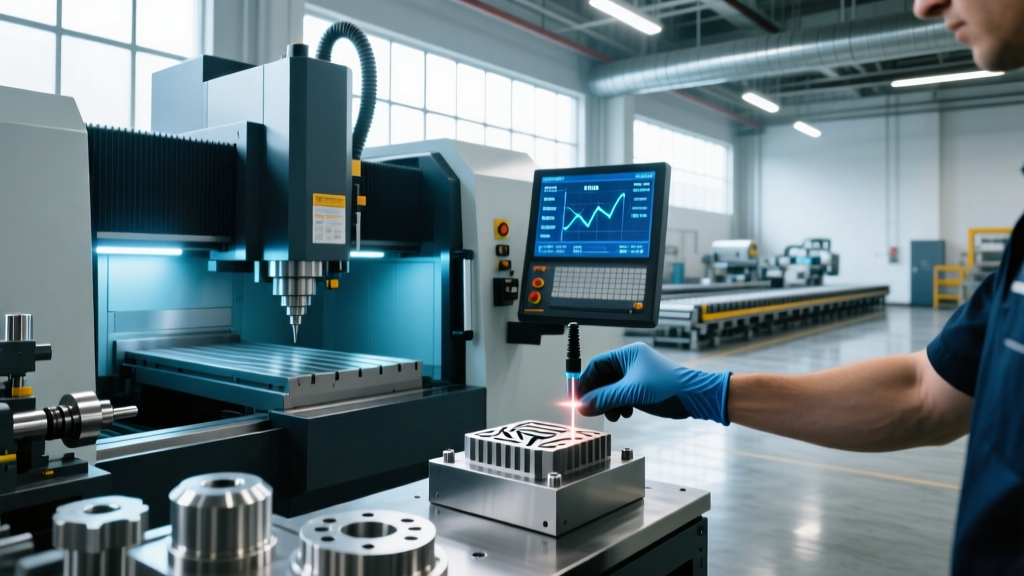
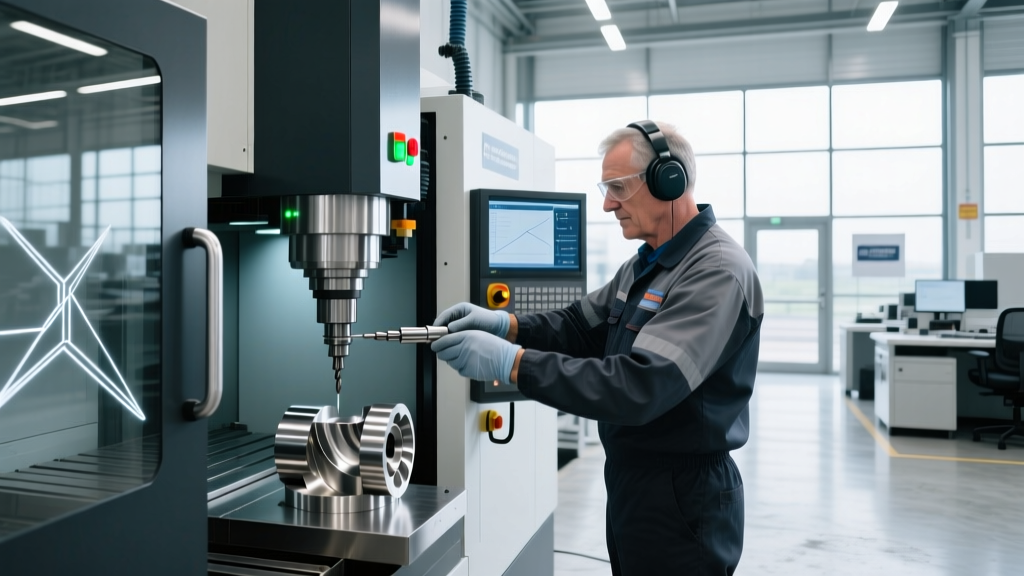
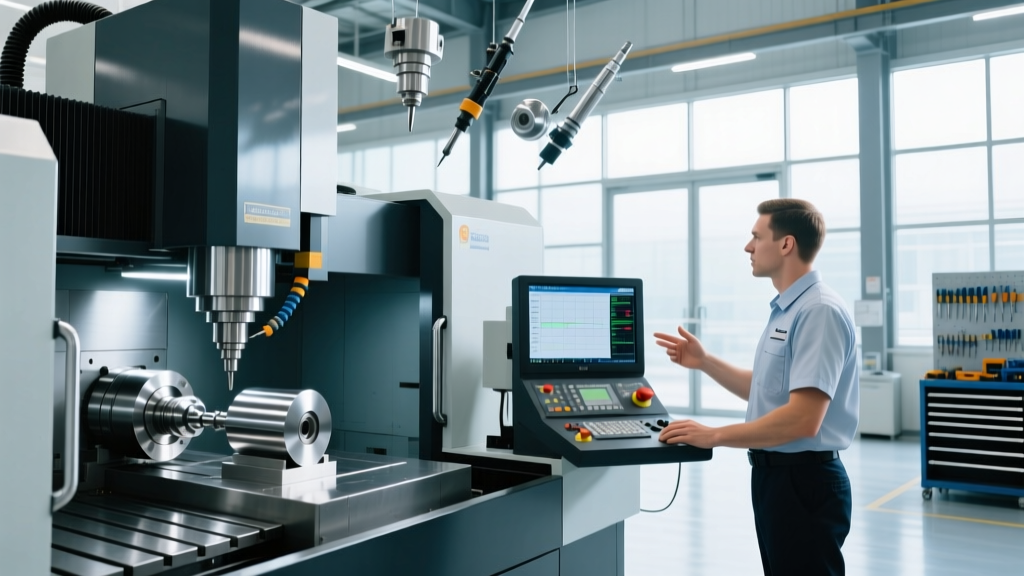
First Article Inspection (FAI) is insufficient for high-volume precision runs. Operators must master in-process probing using systems like the Renishaw OMP600 or Blum Novotest TC60 to verify part geometry without unclamping.
- Kinematic Calibration: Before the shift, operators must run a 3D artifact ball-bar test to verify trunnion table kinematics. A 5-axis machine's RTCP (Rotary Tool Center Point) can drift by 0.0003" due to ambient shop temperature changes.
- Thermal Soak Routines: Train operators to execute a 15-minute warm-up macro that cycles the spindle to 12,000 RPM and sweeps the axes to full travel. This stabilizes the ball screw thermal expansion.
- Bore Probing Sequences: For medical hip-stem tapers, operators must program a 4-point probing cycle (G65 P9023) rather than a standard 2-point cycle to detect out-of-roundness caused by clamping distortion.
- Feedback Loop Integration: Operators must understand how to link probe results directly to the active tool offset register, allowing the machine to self-correct for tool deflection during heavy side-milling of titanium.
Material-Specific Operator Best Practices
General-purpose cutting parameters will destroy tooling and ruin surface integrity in these sectors. Operators require material-specific cheat sheets at every workstation.
Aerospace: Inconel 718 and Titanium Ti-6Al-4V
- Speeds and Feeds: Maintain cutting speeds between 15-25 SFM for Inconel 718. Exceeding 30 SFM causes rapid diffusion wear on the rake face.
- Chip Control: Train operators to listen to the cut. A high-pitched squeal indicates work hardening. The feed rate must be high enough to cut beneath the work-hardened layer left by the previous pass (minimum 0.004 IPT).
- Coolant Pressure: Utilize through-tool coolant at a minimum of 1,000 PSI to break the stringy chips characteristic of aerospace titanium, preventing chip re-welding on the cutting edge.
Medical: PEEK and Cobalt Chrome (CoCr)
- PEEK Machining: Use sharp, uncoated carbide or polycrystalline diamond (PCD) tooling. Operators must ensure air-blast or flood coolant is perfectly filtered; embedded micro-chips in PEEK will cause the part to fail biocompatibility testing.
- Cobalt Chrome: CoCr is notoriously difficult to machine due to its high hardness (up to 45 HRC). Operators must employ trochoidal milling toolpaths to maintain constant tool engagement and avoid shock-loading the insert.
Coolant Management and Contamination Control
Coolant is a cutting tool, not just a lubricant. Operator training must include daily fluid management protocols.
| Metric | Medical Target | Aerospace Target | Operator Action |
|---|---|---|---|
| Filtration Level | 5 to 10 Microns | 20 to 30 Microns | Check filter pressure gauges every 4 hours |
| Concentration | 8% - 10% | 6% - 8% | Use a digital refractometer daily at 7:00 AM |
| Tramp Oil | < 1% surface coverage | < 3% surface coverage | Run centrifugal skimmers continuously |
For medical parts, operators must verify that the coolant does not contain sulfur or chlorine additives that could cause localized pitting or fail cytotoxicity testing. Aerospace operators must focus on tramp oil removal to prevent part staining, which can mask fluorescent penetrant inspection (FPI) cracks during post-machining NDT (Non-Destructive Testing).
Certification, Documentation, and the Operator's Role
In high-reliability machining, if it is not documented, it did not happen. Operators are the first line of defense in quality management systems.
Navigating AS9100 and ISO 13485 Requirements
Under AS9100 Rev D, aerospace operators must be trained to execute First Article Inspections (FAI) per the AS9102 standard. This involves ballooning the engineering drawing and correlating every dimension to a specific measurement tool and operator ID. Operators must understand how to properly fill out AS9102 Form 3, ensuring that the serial number of the caliper or micrometer used is logged and within its calibration due date.
Similarly, in CNC machining for medical devices, operators must maintain Device History Records (DHR). Every tool change, offset adjustment, and environmental anomaly (like a shop AC failure causing thermal drift) must be logged. Training should emphasize that altering a CNC program at the machine control without routing it through the engineering change order (ECO) process is a direct violation of quality system regulations.
"The most expensive machine in your shop is the one that produces scrap that makes it to the customer. In aerospace and medical, operator training is not an overhead expense; it is a risk mitigation strategy that directly protects the company's operating license." — Director of Quality Assurance, Tier 1 Aerospace Supplier.
Summary: Building a Culture of Precision
Training operators for CNC precision machining in the medical and aerospace sectors requires moving beyond basic G-code programming. It demands a deep understanding of metallurgy, thermal dynamics, in-process metrology, and stringent regulatory documentation. By implementing structured training modules focused on predictive tool wear, advanced probing routines, and rigorous coolant management, machine shops can achieve the zero-defect rates required by these unforgiving industries. Equip your operators with the data, the authority to stop the machine when anomalies occur, and the continuous education necessary to master the complexities of modern 5-axis manufacturing.