Multi-Axis CNC Equipment Guide for CNC Machining Industries
Expert buying guide for selecting 5-axis and multi-axis CNC machines for complex geometries across advanced CNC machining industries and job shops.
The Kinematic Shift in Advanced CNC Machining Industries
Across advanced CNC machining industries, the transition from 3+2 positional milling to full simultaneous 5-axis machining is no longer a luxury reserved for aerospace primes; it is a baseline requirement for competitive job shops tackling complex geometries. Medical titanium implants, aerospace impellers, and integral turbine blisks demand continuous tool-vector manipulation to maintain optimal chip thickness and avoid catastrophic chatter on undercut walls.
Selecting the right multi-axis equipment requires moving beyond basic axis-count comparisons. Buyers must evaluate kinematic configurations, Rotary Tool Center Point (RTCP) control architecture, and the hidden costs of high-frequency tooling. This guide provides a technical framework for capital equipment investment in the multi-axis space.
Decision Framework: When to Upgrade to Simultaneous 5-Axis- Stay 3+2 Positional: If 90% of your work involves prismatic parts with angled holes or simple multi-sided features where the tool locks in place before cutting.
- Upgrade to Simultaneous 5-Axis: If your CAD models feature compound curvatures, deep cavities requiring short tool extensions, or thin-walled aerospace structures demanding constant tool-lead-angle adjustments to manage cutting forces.
Trunnion vs. Swivel Head: Configuration Selection Matrix
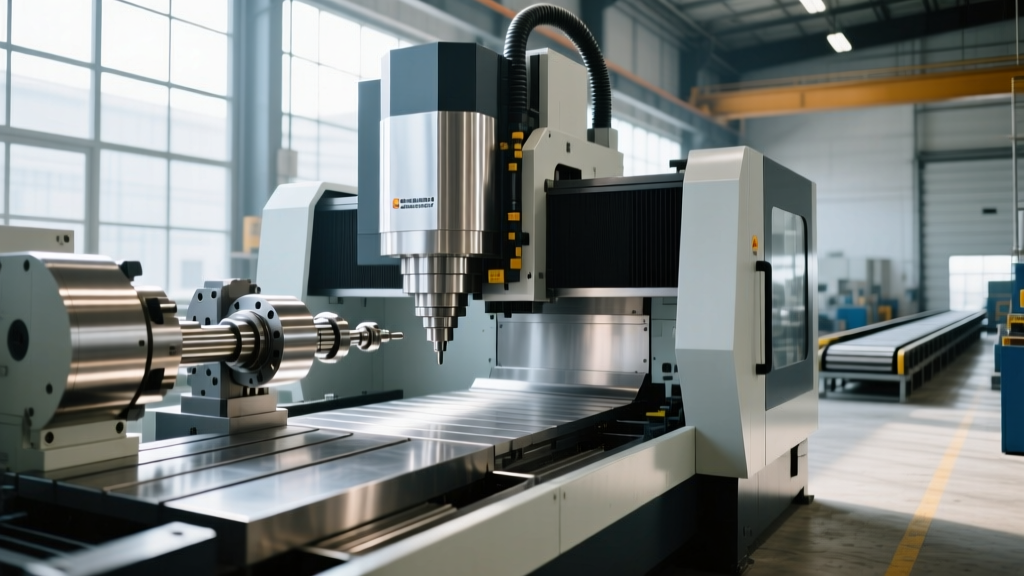
The physical layout of the rotary axes dictates the machine's payload capacity, rigidity, and ideal part geometry. Misaligning the kinematic style with your part profile is the most common capital expenditure error in modern machine shops.
| Kinematic Style | Axis Designation | Max Payload Capacity | Best Suited For | Primary Limitation |
|---|---|---|---|---|
| Trunnion Table | A-axis (Tilt) + C-axis (Rotate) | Low to Medium (300 - 800 lbs) | Small, complex medical/aerospace parts; high-speed contouring. | Table deflection under heavy loads; limits X/Y travel when tilted. |
| Swivel Head (Gantry) | B-axis (Tilt) + C-axis (Rotate) | High (2,000 - 10,000+ lbs) | Large aerospace structural components, molds, heavy dies. | Reduced Z-axis rigidity at extreme B-axis tilt angles; higher footprint. |
| Traveling Column / Tilt Rotary | B-axis (Head) + C-axis (Table) | Medium (1,000 - 2,500 lbs) | Mixed production environments; general job shop flexibility. | Complex chip evacuation; higher initial calibration costs. |
2026 Market Contenders: Pricing and Capability Deep-Dive
When evaluating equipment for complex geometries, base price is merely the entry fee. The true cost of ownership lies in the spindle interface, control package, and automation readiness. Below is an analysis of three dominant platforms currently defining the market.
1. Haas UMC-750SS (The Job Shop Workhorse)
Estimated Base Price: $225,000 - $245,000
Kinematics: Trunnion Table (A/C)
Spindle: 12,000 RPM Inline Direct-Drive, 40-Taper (HSK-A63 option available)
The UMC-750SS remains the gateway drug for CNC machining industries moving into 5-axis. Its integrated Renishaw OMP600 probe and Haas Intuitive Probing System (IPS) drastically reduce the setup time for complex angled datums. However, buyers targeting high-speed titanium milling should upgrade to the HSK-A63 spindle interface. The standard CAT40 tooling lacks the dual-contact face-and-taper rigidity required to prevent Z-axis pullout during aggressive 5-axis simultaneous contouring at 10,000+ RPM.
2. DMG MORI DMU 50 3rd Generation (The Precision Standard)
Estimated Base Price: $260,000 - $310,000
Kinematics: Swivel Head (B) + Rotary Table (C)
Spindle: 15,000 RPM HSK-A63 (20,000 RPM option)
For micro-machining and tight-tolerance medical geometries (e.g., orthopedic knee joints), the DMU 50 is the benchmark. Its CELOS control with Siemens Sinumerik ONE architecture offers superior look-ahead processing. The machine's cooling concept—which actively cools the spindle, torque motors, and ball screws—limits thermal growth to under 5 microns over an 8-hour shift, a critical metric for holding ±0.0002" profile tolerances on complex curves.
3. Mazak Variaxis i-800 NEO (The Heavy Aerospace Anchor)
Estimated Base Price: $380,000 - $450,000
Kinematics: Tilt/Rotary Table (A/C)
Spindle: 12,000 RPM (High-Torque 10,000 RPM option)
The Variaxis i-800 NEO is engineered for high-metal-removal-rate (MRR) aerospace structures. Unlike lighter trunnion tables, its heavily ribbed A/C table supports up to 1,760 lbs, allowing shops to mount massive hydraulic tombstones. The MAZATROL SmoothAi control excels in conversational 5-axis programming, though most aerospace primes will still rely on CAM-generated G-code utilizing inverse time feedrates (G93) for complex surfacing.
Control Architecture: RTCP and Look-Ahead Processing
The mechanical rigidity of a 5-axis machine is useless if the control cannot calculate the kinematic chain in real-time. Advanced manufacturing research from NIST highlights that Rotary Tool Center Point (RTCP) calibration is the single most critical software feature for complex geometries.
Technical Warning: The G93 vs. G94 TrapWhen programming simultaneous 5-axis toolpaths, the relationship between linear and rotary movement constantly changes. If your CAM post-processor outputs standard Feed per Minute (G94), the rotary axes will lag or overshoot during tight corners, gouging the part. Ensure your equipment control supports and your CAM software outputs Inverse Time Feedrate (G93), which forces the control to synchronize all five axes to reach the end of the block simultaneously, regardless of the physical distance each axis must travel.
Modern controls like the Heidenhain TNC7 and Fanuc 31i-B5 utilize specialized look-ahead algorithms (often processing 1,000 to 2,000 blocks ahead) to smooth out micro-stutters in the toolpath. When requesting machine bids, demand the 'High-Speed Machining' or 'NURBS interpolation' software options; these are frequently hidden in the $15,000–$25,000 accessory list but are mandatory for aerospace contouring.
Hidden Costs and Edge-Case Failure Modes
Capital equipment buyers frequently underestimate the ancillary investments required to keep a 5-axis machine cutting complex geometries profitably.
- Tooling and Workholding ($30,000 - $50,000): Standard vises interfere with 5-axis spindle heads. You must invest in zero-point clamping systems (e.g., System 3R or Schunk) and high-precision HSK shrink-fit toolholders (HAIMER or REGO-FIX) to maintain a TIR (Total Indicated Runout) of less than 3 microns.
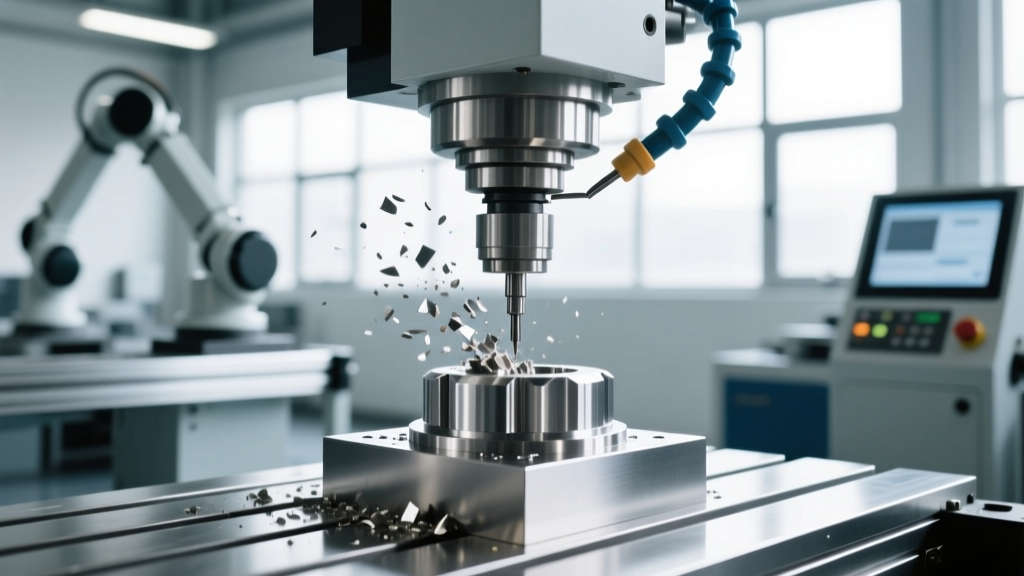
- Through-Spindle Coolant (TSC) Pressure: Complex geometries often involve deep, undercut cavities where standard flood coolant cannot reach the cutting zone. Upgrading to a 1,000 PSI TSC package ($8,000+ option) is non-negotiable for evacuating chips in deep-pocket titanium milling, preventing recut chips and subsequent tool breakage.
- Kinematic Drift and Calibration: Over time, the physical centerlines of the rotary axes shift due to thermal cycling and minor crashes. Machines equipped with automated kinematic calibration cycles (using a spindle probe and a calibration sphere) can self-correct RTCP parameters in 4 minutes. Machines lacking this feature require manual laser-tracker calibration, costing $2,500+ per visit and resulting in 12 hours of downtime.
The Cut-Sample Evaluation Protocol
Never purchase a multi-axis machine based solely on a brochure or a generic demo part. According to milling best practices outlined by Sandvik Coromant, verifying machine dynamics requires a customized cut sample that stresses the specific kinematic weak points of the machine.
Step 1: The Cone Test. Machine a 30-degree truncated cone using simultaneous 5-axis circular interpolation. Measure the surface finish and roundness. Any mismatch in the X/Y/Z and A/C axis servo tuning will manifest as visible 'witness lines' or cusps at the quadrant transitions.
Step 2: The Deep Cavity Undercut. Program a toolpath that requires the B or A axis to tilt to its maximum working limit (e.g., -15 degrees) while executing a finishing pass with a long-reach ball nose endmill. This tests the machine's Z-axis rigidity and spindle nose deflection under side-load.
Step 3: RTCP Verification. Machine a complex aerospace rib structure, then pause the program mid-cut. Retract the tool, shut off the machine, power it back on, re-home, and resume the cut exactly where it left off. If the control's RTCP memory and kinematic calibration are robust, the tool will re-enter the cut without leaving a dwell mark or gouging the part.
For deeper theoretical frameworks on 5-axis kinematic chains and error mapping, refer to the MIT OpenCourseWare materials on advanced manufacturing and design. Ultimately, selecting the right multi-axis equipment is an exercise in matching the machine's kinematic envelope and control architecture to the specific geometric tolerances of your target market.