How CNC Machining History Shaped Modern Architectural Metalwork Alternatives
Discover how cnc machining history shaped modern 5-axis architectural facades, comparing CNC milling against robotic welding and metal 3D printing.
The Evolution from Punched Tape to Parametric Facades
Parametric architecture demands complex, non-repeating geometries that push the limits of traditional fabrication. To understand the capabilities of modern 5-axis milling for architectural nodes and facade brackets, one must look at cnc machining history. The journey from John Parsons’ 1949 punched-card experiments to the MIT Servomechanisms Lab’s first 3-axis mill in 1952 laid the groundwork for today’s simultaneous multi-axis kinematics. In 2026, AI-driven toolpath optimization allows fabricators to translate complex NURBS surfaces directly from Rhino/Grasshopper into G-code, eliminating the manual programming bottlenecks that defined the early 2000s.
Historical Context: The Shift to Architectural Scale
Early CNC machines were constrained by 2.5D geometries and rigid aerospace tolerances. The architectural metalwork industry largely ignored CNC until the late 2010s, relying instead on manual TIG welding and waterjet-cut flat patterns. The introduction of affordable, large-format 5-axis gantry mills (capable of handling 3m x 1.5m billets) shifted the paradigm. Today, understanding cnc machining history provides context for why modern structural nodes are milled from solid billets rather than assembled from welded plates, reducing on-site fitting time by up to 78%.
Comparison Matrix: Architectural Node Fabrication Alternatives
When engineering structural connections for glass curtain walls or tensile membrane facades, project managers must choose between subtractive (CNC), additive (3D printing), and formative/joining (Robotic Welding) processes. Below is a technical comparison of the three primary alternatives for producing complex, load-bearing architectural nodes.
| Fabrication Method | Tolerance (ISO 10791-7) | Cost per Node (Avg) | Lead Time (50 Nodes) | Max Envelope |
|---|---|---|---|---|
| 5-Axis CNC Milling | ±0.05 mm | $1,100 - $2,400 | 3 - 4 Weeks | 3000 x 1500 x 800 mm |
| Robotic TIG + Waterjet | ±1.5 mm (post-grind) | $650 - $1,200 | 5 - 7 Weeks | Unlimited (modular) |
| Metal Binder Jetting (MBJ) | ±0.2 mm (post-sinter) | $800 - $1,800 | 6 - 8 Weeks | 800 x 500 x 400 mm |
Deep Dive: 5-Axis CNC Milling for Facade Brackets
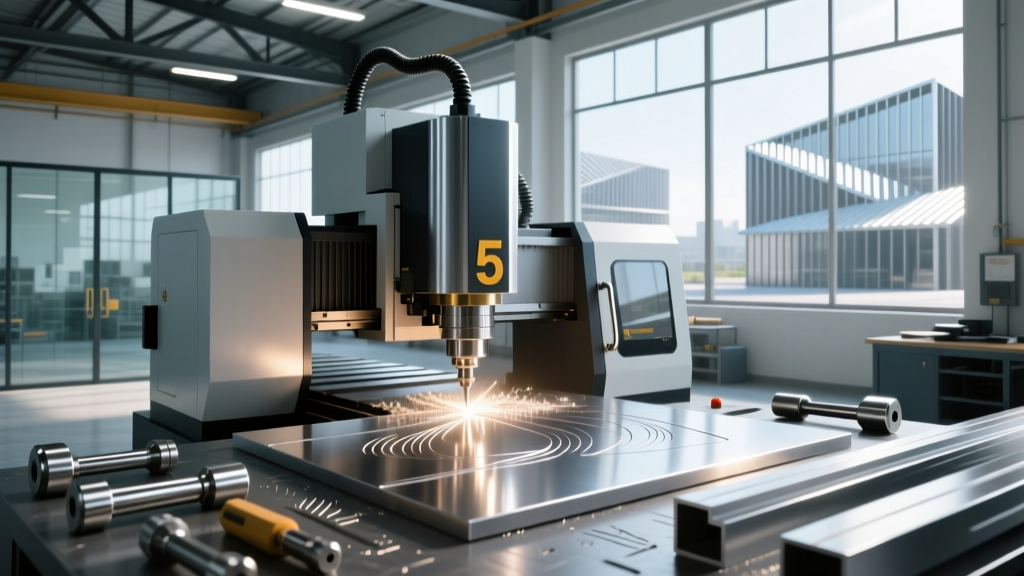
For high-end commercial facades where structural integrity and aesthetic perfection are non-negotiable, 5-axis CNC milling remains the gold standard. Machines like the Zimmermann FZ33 Compact or the Breton Flymill 5X are specifically configured for large-format architectural components, featuring high-torque HSK-A100 spindles capable of removing massive volumes of aluminum or stainless steel.
Material Selection and Cutting Parameters
While 6061-T6 aluminum is the default for general machining, architectural facades in coastal or high-humidity environments require 5083-H32 marine-grade aluminum. 5083 offers superior stress-corrosion cracking resistance and maintains higher yield strength after welding (if secondary attachments are required).
- Tooling: 20mm solid carbide 3-flute endmill with AlCrN coating (optimized for sticky aluminum alloys).
- Spindle Speed: 14,000 RPM (utilizing through-spindle coolant to prevent chip welding).
- Feed Rate: 4,200 mm/min.
- Axial Depth of Cut (Ap): 10mm (roughing), 0.5mm (finishing).
- Radial Depth of Cut (Ae): 2mm (trochoidal roughing to maintain constant tool engagement).
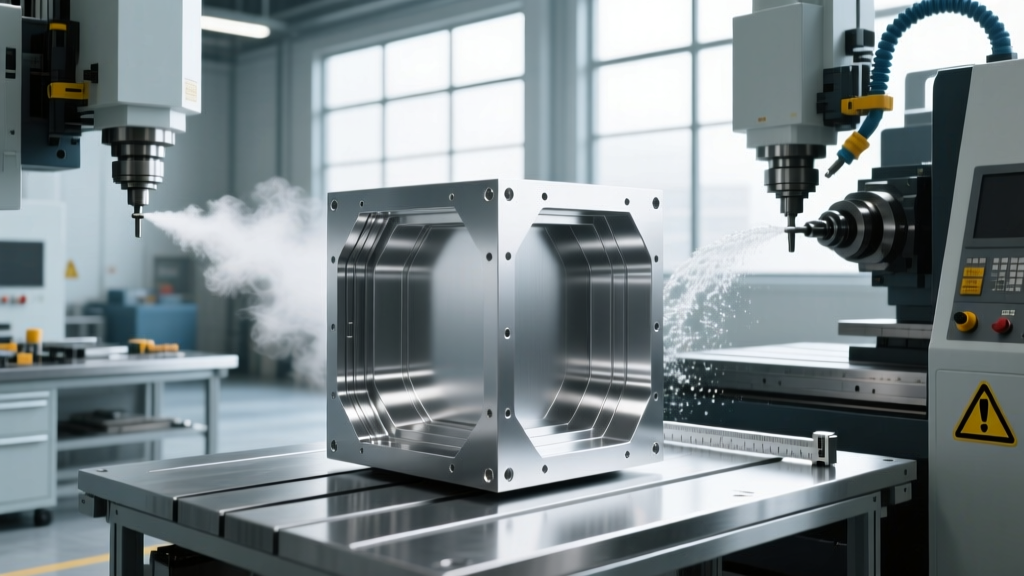
When machining 316L stainless steel for exterior tension nodes, the low thermal conductivity of the alloy traps heat in the cutting zone. This causes localized thermal expansion, leading to out-of-tolerance bore diameters once the part cools. Always use high-pressure flood coolant (minimum 70 bar) and implement a 4-hour thermal stabilization pause before executing the final finishing toolpaths.
Cost Breakdown: The True Price of a Milled Node
Architects often assume CNC milling is prohibitively expensive. However, when factoring in the elimination of post-weld X-ray inspections and manual grinding, the economics shift. A typical parametric facade node (approx. 250mm x 250mm x 150mm) milled from a solid 5083 billet breaks down as follows:
- Raw Material: $85 (Saw-cut billet with 5mm machining allowance).
- Machine Time: 7.5 hours @ $165/hr = $1,237 (Includes setup, probing, and 5-axis simultaneous finishing).
- Post-Processing: $140 (Hard anodizing Type III for UV and weather resistance).
- Total Landed Cost: ~$1,462 per node.
Failure Modes and Edge Cases in Architectural CNC
Even with advanced CAM software, architectural metalwork presents unique failure modes that standard aerospace or automotive machining protocols do not address.
1. Chatter on Thin-Walled Parametric Webs
Parametric designs often feature organic, sweeping webs that thin out to 3mm or 4mm at the edges. Standard climb milling induces harmonic chatter, ruining the surface finish and compromising fatigue life. Solution: Utilize dynamic milling toolpaths that maintain a constant radial engagement, and leave 1.5mm of stock for a final spring-pass using a variable-pitch endmill to disrupt harmonic frequencies.
2. Vacuum Chuck Failure on Contoured Panels
For large, curved facade panels (e.g., 2m x 1m aluminum composite or solid alloy sheets), mechanical clamping obstructs the toolpath. Vacuum chucks are the alternative, but standard flat vacuum tables fail on contoured 3D surfaces. Solution: Machine a custom high-density polyurethane fixture board that perfectly mirrors the Z-depth contour of the panel's backside, embedding localized vacuum pods to secure the workpiece without inducing pre-load stress.
"The translation of architectural intent into machinable geometry is where most facade projects fail. A beautiful Grasshopper script means nothing if the tool cannot physically reach the undercut without colliding with the part holder. Design for Manufacturing (DfM) must be integrated at the conceptual phase, not after the design is frozen."
— Lead Fabrication Engineer, Specialized Architectural Metals
Decision Framework: Selecting the Right Alternative
Choosing between 5-axis CNC, robotic welding, and 3D printing depends on project scale, material requirements, and geometric complexity. Use this framework to specify the correct fabrication route:
Choose 5-Axis CNC Milling When:
- The project requires aerospace-grade tolerances (±0.05mm) for structural pin connections.
- Nodes are highly complex, featuring deep undercuts and organic 3D contours.
- Materials are high-strength aluminum (5083/7075) or solid stainless billets.
- Production volume is between 10 and 500 unique nodes.
Choose Robotic Welding + Waterjet When:
- The nodes are primarily prismatic or constructed from intersecting flat/curved plates.
- Material thickness exceeds 100mm, making solid billet milling cost-prohibitive.
- Production volume exceeds 1,000 nodes, justifying the creation of complex welding jigs.
- Surface finish requirements allow for visible weld beads and manual grinding marks.
Choose Metal Binder Jetting When:
- The geometry features internal lattice structures or conformal cooling channels impossible to mill.
- The nodes are relatively small (under 400mm in any dimension).
- The material must be a specialized alloy (e.g., Inconel 718) that is too difficult to machine conventionally.
- Lead times of 8+ weeks are acceptable for sintering and post-processing.
Integration with Modern Architectural Workflows
The true power of modern CNC in architecture lies in software integration. The historical gap between CAD design and CAM programming has been bridged by direct plugin ecosystems. Today, parametric models generated in Rhino 3D are fed directly into Mastercam or Autodesk PowerMill via API connections. The software automatically identifies collision zones, calculates optimal tool axis vectors for 5-axis simultaneous milling, and generates machine-specific G-code. This seamless pipeline ensures that the intricate, mathematically driven facades envisioned by architects are physically realized with micrometer precision, honoring the decades of innovation that define cnc machining history.