CNC Machining China Factory: Prototyping vs Production Training
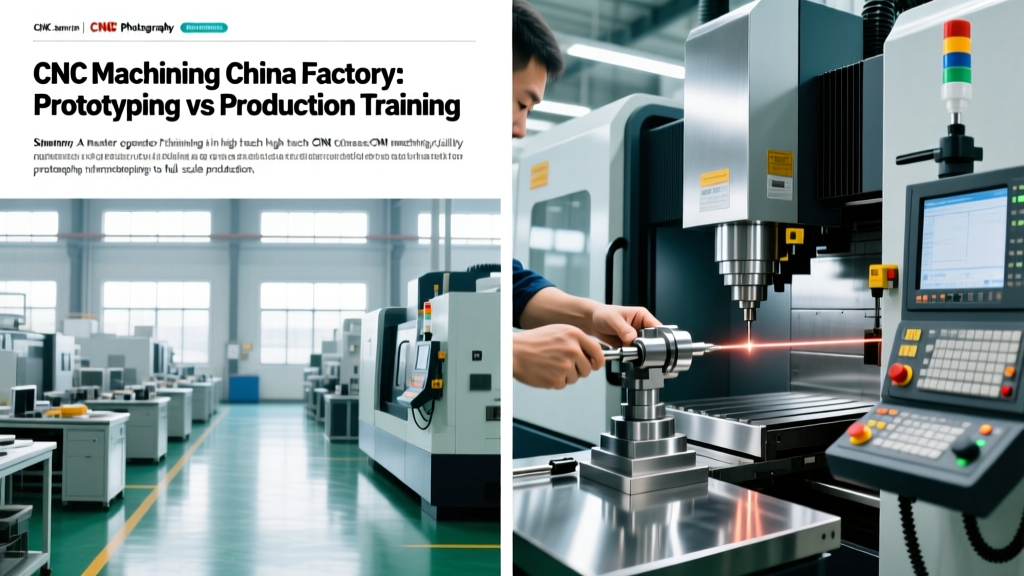
Master operator training for a CNC machining China factory. Learn best practices for transitioning setups from rapid prototyping to high-volume production.
Bridging the Gap Between Prototype Flexibility and Production Rigidity
Transitioning a shop floor from rapid prototyping to high-volume production requires more than just running the same G-code 10,000 times. The operational realities of these two paradigms are fundamentally opposed. When managing a high-output cnc machining china factory, where margins are dictated by cycle-time reductions measured in tenths of a second, operator training must bridge the gap between the flexibility of prototyping and the rigid efficiency of production.
Prototyping prioritizes feature completion, geometric flexibility, and fast turnaround. Production prioritizes cycle time, tool life predictability, and automated chip clearing. Operators trained exclusively in prototype environments often struggle when thrust into production roles, leading to premature tool failure, unmanageable chip nests, and compounding dimensional drift. This guide outlines the specific technical training modules required to transition operators between these two distinct machining disciplines.
The Operational Mindset Shift
- Prototype Mindset: 'Get the part off the machine.' Tolerances are generally ±0.002". Manual deburring is acceptable. Tool wear is monitored visually between cycles.
- Production Mindset: 'Optimize the process.' Tolerances tighten to ±0.0005". Deburring must be minimized via toolpath design. Tool wear is compensated automatically via in-process probing and macro variables.
Toolpath and Tooling: From 'Good Enough' to Optimized
In a prototype environment, an operator might use a standard 3-flute carbide endmill to rough out a pocket in 6061-T6 aluminum using conventional offset toolpaths. The cycle time might be 4 minutes, and if the tool wears out after 15 parts, it is simply swapped. According to the Sandvik Coromant Milling Knowledge Hub, this approach is financially ruinous in high-volume production.
Training Module: Constant Tool Engagement
Production operators must be trained to verify and utilize CAM strategies that maintain constant tool engagement, such as trochoidal milling or adaptive clearing. When roughing 7075-T6 aluminum on a machine like the Haas VF-2SS, an adaptive toolpath allows the operator to run a 1/2" endmill at 12,000 RPM and 300 IPM with a 70% radial depth of cut (DOC) and 2x diameter axial DOC. This clears material 40% faster than traditional step-overs while keeping cutting forces uniform, extending tool life from 20 parts to over 150 parts.
Operators must also be trained on insert-based tooling for production. Swapping a solid carbide rougher for a Sandvik CoroMill 390 indexable cutter reduces tool replacement costs from $85 per solid endmill to $12 per indexable corner, a critical margin saver when machining 50,000+ components.
Workholding and Fixture Transitioning
Workholding is where the transition from prototype to production is most physically evident on the shop floor. Prototype setups rely heavily on standard Kurt DX6 vises and custom soft jaws machined in-house. While soft jaws offer immense geometric flexibility and can be prepared in 20 minutes, they lack the repeatability and clamping force required for untended production runs.
| Setup Parameter | Rapid Prototyping | High-Volume Production |
|---|---|---|
| Primary Workholding | Standard Vise + Aluminum Soft Jaws | Pneumatic/Hydraulic Custom Fixtures |
| Setup Time | 15 - 45 minutes | 4 - 8 hours (initial build) |
| Changeover Time | 10 minutes | < 60 seconds (pallet systems) |
| Clamping Force | Manual torque (variable) | Regulated pneumatic (consistent) |
| Operator Loading | Manual placement & alignment | Drop-in locators, foolproof (Poka-Yoke) |
Training Module: Poka-Yoke (Mistake-Proofing) Fixtures
Production operators must be trained to design and load parts into fixtures utilizing Poka-Yoke principles. In a high-efficiency cnc machining china factory, an operator loading a part backward into a pneumatic fixture can crash a $40,000 spindle in seconds. Training must cover the integration of air-seating sensors. These sensors detect if a chip is trapped between the part and the hard jaw by monitoring air pressure drops. If the part is not seated perfectly, the machine's PLC prevents the cycle start. Operators must learn to wire these 24V DC sensors into the Fanuc or Haas control I/O pages.
In-Process Metrology and Macro Programming
Relying on an operator to stop the machine, open the doors, blow off the part, and measure a bore with a dial bore gauge is a prototyping habit that destroys production cycle times. The National Institute of Standards and Technology (NIST) emphasizes the integration of smart manufacturing and automated metrology to reduce human-induced variation.
"In production machining, the spindle should only stop for tool changes and part loading. If the spindle stops for measurement, the process is fundamentally flawed."
Training Module: Renishaw Probing and Macro Variables
Operators must be trained to program and troubleshoot in-process probing routines using tools like the Renishaw OMP60. Instead of manual measurement, the operator programs a probing cycle immediately after a finishing pass.
- Probe the Feature: The machine probes a finished bore diameter.
- Calculate Deviation: The control compares the probed size to the nominal target.
- Update Wear Offset: Using custom macro variables (e.g.,
#101 = #101 + [#135 - #100]), the control automatically updates the tool wear offset in the background. - Compensate Next Part: The next part is machined with the updated offset, keeping the dimension perfectly centered within the ±0.0002" tolerance band without human intervention.
Operators must be taught how to set tolerance limits within the macro. If the probed dimension deviates by more than 0.0005" (indicating a chipped insert rather than normal wear), the macro should trigger an alarm and halt the machine, preventing the production of 500 scrap parts before the operator notices.
Chip Evacuation and Coolant Pressures
Stringy chips in ductile materials like 304 stainless steel or 6061 aluminum are a nuisance in prototyping; in production, they are a catastrophic failure point. Birds-nesting around the tool or workpiece will crash a production run and ruin surface finishes.
According to guidelines from the Society of Manufacturing Engineers (SME), modern production environments require high-pressure coolant systems to manage chip evacuation. Operators must be trained to utilize through-spindle coolant (TSC) at pressures exceeding 1,000 PSI.
- Prototype Setup: Standard flood coolant at 150 PSI. Operator manually clears chips with an air gun between cycles.
- Production Setup: 1,000 PSI TSC directed through the cutting edge of the drill or endmill. The high-pressure jet fractures the chip at the shear zone, creating small, manageable 'C' or '6' shaped chips that wash away automatically. Operators must be trained to select the correct drill geometry (e.g., 140-degree split point with polished flutes) to pair with high-pressure coolant.
Standard Operating Procedures (SOPs) for Scale
The final pillar of operator training is the discipline of documentation and First Article Inspection (FAI). In prototyping, the CAD model is the sole source of truth. In production, the controlled drawing and the SOP dictate the process.
Production Readiness Checklist for Operators
- Tool Life Management: Are tool life limits set in the control's tool management page? (e.g., Alarm at 95% life, Sister Tool swap at 100%).
- Warm-Up Cycle: Has the spindle and axes thermal growth cycle been executed? (Critical for holding ±0.0003" tolerances on 5-axis machines like the Haas UMC-750).
- Chip Conveyor Verification: Is the conveyor belt speed synchronized with the material removal rate (MRR) to prevent hopper overflow?
- First-Off & Last-Off Protocol: Are the first and last parts of the shift isolated and tagged for CMM verification?
Training operators to navigate the shift from a CNC machining China factory's prototyping lab to its production floor requires a complete rewiring of their approach to time, tooling, and tolerance. By mastering adaptive toolpaths, automated probing macros, pneumatic fixturing, and high-pressure coolant dynamics, operators transform from manual machinists into process engineers capable of sustaining high-yield, untended manufacturing runs.