GCode for CNC Milling Machine Workflows: 2026 AI & Macro Trends
Explore how AI, parametric Macro B, and conversational controls are transforming GCode for CNC milling machine programming in 2026.
The Shift from CAM to Parametric Logic
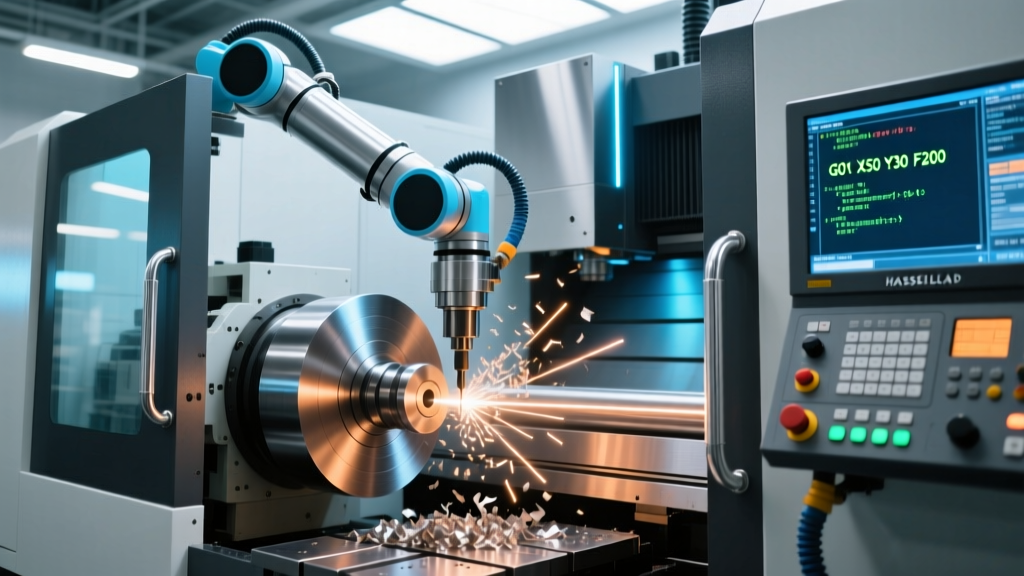
The era of relying solely on CAM software to output thousands of lines of linear GCode for CNC milling machine operations is ending. In 2026, the most efficient machine shops have transitioned from static, post-processed toolpaths to dynamic, parametric programming. When generating GCode for CNC milling machine workflows today, the objective is no longer just to move the cutter from point A to point B; it is to embed decision-making logic directly into the control cabinet.
Modern CNC controls, such as the FANUC 31i-B5 and Siemens Sinumerik ONE, possess the processing power to calculate micro-moves, adjust feedrates based on real-time spindle load, and compensate for thermal expansion on the fly. This shift requires programmers to write GCode that acts as a set of parameters and rules, rather than a rigid sequence of coordinates.
2026 Industry Data Highlight:According to recent smart manufacturing adoption reports, 68% of Tier 1 aerospace suppliers now utilize parametric macro-driven GCode combined with in-machine probing, reducing setup times by an average of 41% compared to traditional CAM-only workflows.
Parametric Macro B: The Backbone of Modern Milling GCode
Macro B programming remains the most critical skill for advanced CNC milling. While conversational programming is useful for simple 2.5D parts, complex 5-axis contours and adaptive probing routines demand the variable-driven architecture of Macro B. By utilizing local variables (#1 to #33) and system variables (#1000+), programmers can create subroutines that adapt to raw material variations.
Real-World Edge Case: Adaptive Toolpath Correction
Consider a scenario where you are machining a titanium Ti-6Al-4V aerospace structural rib. Raw material forgings often have slight dimensional variations. Instead of manually indicating the part and updating the work offset, modern GCode integrates a Renishaw OMP60 probe routine directly into the program header.
Here is a functional snippet demonstrating how GCode dynamically updates the G54 work offset based on probe feedback:
G65 P9023 Z-10. D1. (Renishaw probe call to surface)
IF [#141 LT 0.005] GOTO 10 (Check Z deviation threshold)
G10 L2 P1 Z[#5223 + #141] (Update G54 Z offset dynamically)
N10
M00 (Optional stop for operator verification if deviation > 0.005)
This approach eliminates human error in offset calculation. The GCode literally rewrites the machine's coordinate system before the first cutting tool is engaged.
AI Copilots in the CNC Control Cabinet
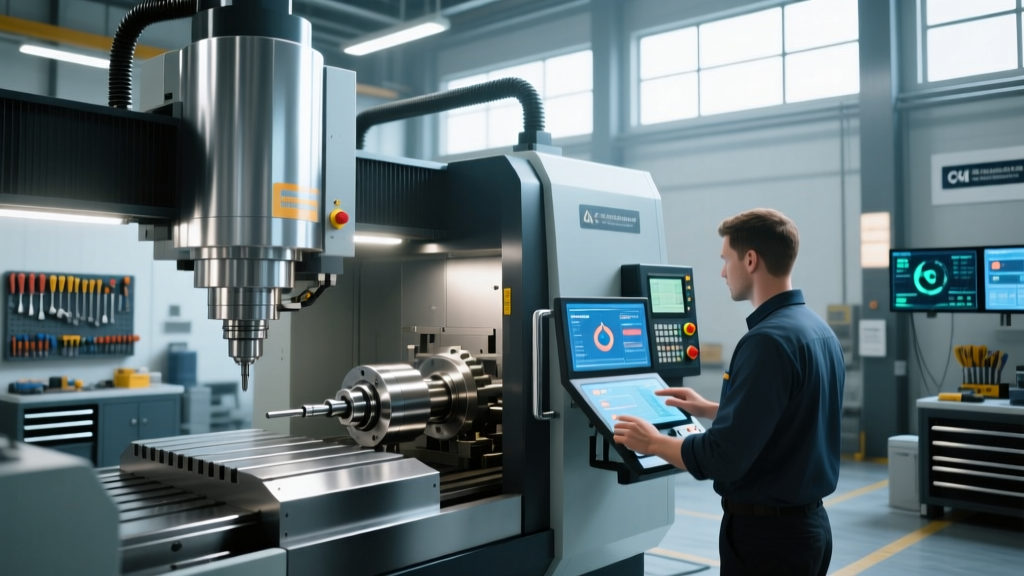
The most significant disruption in 2026 is the integration of Artificial Intelligence directly into the CNC control's GCode interpreter. AI is not replacing the programmer; it is optimizing the GCode at the point of execution.
- AI Thermal Displacement Compensation: FANUC's latest AI models monitor spindle load, ambient shop temperature, and coolant flow rates. The control automatically adjusts the Z-axis tool length offset (H-code) in real-time using
G10 L11commands executed in the background, preventing Z-depth drift during long roughing cycles. - Conversational to GCode Translation: Siemens Sinumerik ONE now features an AI copilot that allows operators to input natural language commands via the control panel (e.g., 'Face mill top surface, leave 0.5mm stock'). The control instantly generates and simulates the underlying GCode, bypassing the need for a dedicated CAM station for secondary operations.
- Chatter Detection and Feedrate Override: Instead of programming a static
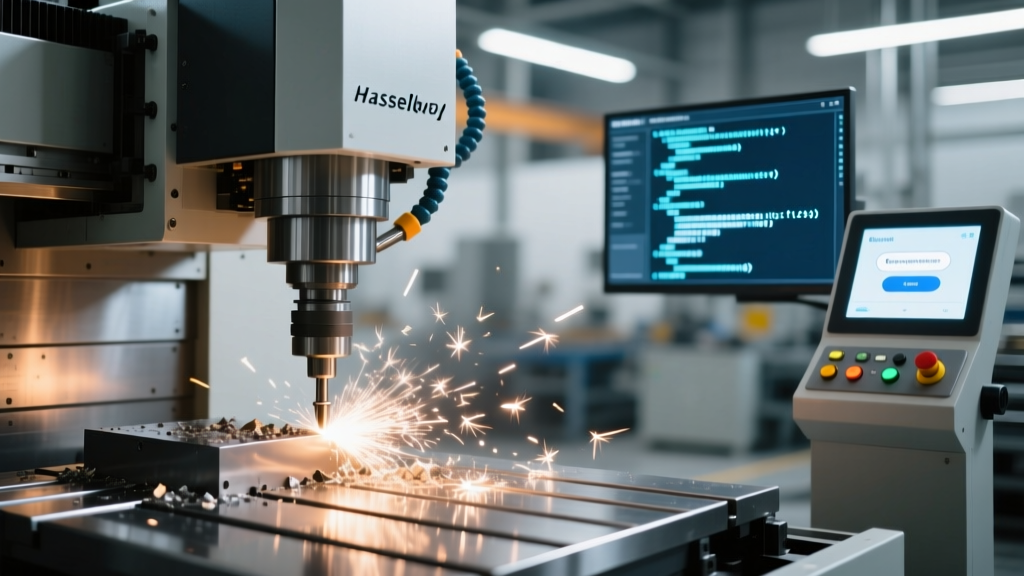
F800feedrate, AI-driven controls analyze accelerometer data. If chatter is detected in a deep pocket, the control dynamically scales the feedrate down toF650until the harmonic vibration subsides, then ramps back up.
Legacy CAM vs. AI-Parametric GCode: A Structural Comparison
| Feature | Legacy CAM Post-Processing | 2026 AI-Parametric GCode |
|---|---|---|
| File Size | 10MB - 50MB (Thousands of G01/G02 lines) | 50KB - 200KB (Macro calls & spline interpolation) |
| Tool Wear Handling | Manual offset adjustment by operator | Automated via in-cycle probing & G10 data setting |
| Thermal Drift | Ignored (relies on shop climate control) | AI background compensation via sensor fusion |
| Setup Time | 45 - 90 minutes (Manual indicating) | 5 - 15 minutes (Automated macro probing) |
Security and Validation: Preventing AI-Induced Crashes
With the rise of generative AI tools assisting in code creation, a new failure mode has emerged in 2026: AI hallucinations in GCode. Large Language Models (LLMs) can occasionally generate syntactically correct but physically disastrous M-codes or non-standard canned cycles that a specific machine control cannot interpret safely.
'Generative AI is an excellent tool for drafting Macro B logic and calculating trigonometric variables, but it lacks spatial awareness of the machine's kinematic limits. Every line of AI-assisted GCode must pass through a digital twin simulation before touching the shop floor.'
— Dr. Elena Rostova, Lead Researcher at the NIST Smart Manufacturing Division
Mandatory Verification Workflows
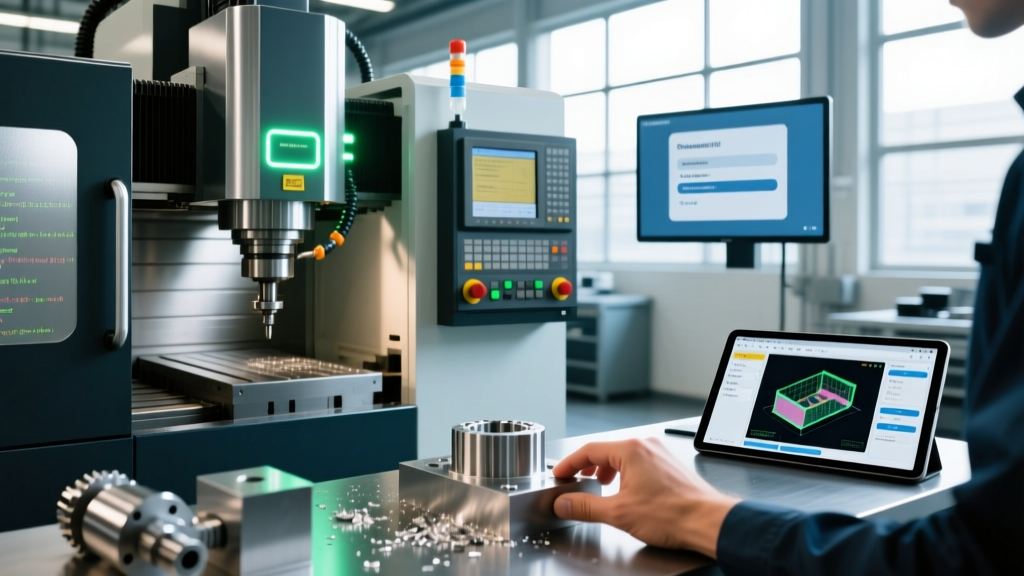
To mitigate the risk of spindle crashes caused by unverified code, top-tier machine shops have made CNC simulation software a non-negotiable step in the workflow. CGTech's VERICUT remains the industry standard, utilizing the machine's actual control emulator to read the GCode exactly as the FANUC or Siemens cabinet would. In 2026, VERICUT's AI module can automatically detect inefficient tool engagement angles and rewrite the GCode feedrates before the program is sent to the DNC network.
Cost Analysis of Upgrading to AI-Ready Controls
Transitioning to a parametric, AI-assisted GCode workflow requires hardware and software investments. Shop owners must weigh the upfront costs against the reduction in scrap and setup time.
2026 Implementation Cost Matrix
- Siemens Sinumerik ONE Virtual Commissioning License: ~$4,500/year. Allows programmers to run the digital twin and test parametric GCode on a PC before deployment.
- Haas NGC (Next Generation Control) AI Option Package: ~$2,995 one-time hardware/software unlock. Includes advanced tool monitoring and thermal compensation algorithms.
- VERICUT CNC Simulation Base License: ~$12,500 per seat. Essential for validating 5-axis AI-generated toolpaths and preventing catastrophic collisions.
- Renishaw Equator Gauging System Integration: ~$18,000. Works in tandem with in-machine probing GCode to automate off-machine tool offset updates.
ROI Timeline: Most high-mix, low-volume job shops report breaking even on these software and control upgrades within 7 to 9 months purely through reduced setup times and eliminated first-part scrap.
Actionable Next Steps for CNC Programmers
To stay competitive in 2026, CNC programmers must evolve beyond generating static toolpaths. Begin by auditing your current post-processors to ensure they support Macro B variable passing. Invest time in mastering system variables (like #3000 for custom alarms and #3004 for feed hold control). Finally, establish a strict digital validation protocol for any GCode generated or modified by AI assistants, ensuring that the code is not just mathematically correct, but kinematically safe for your specific milling machine.