Evaluating the Laser CNC Machine in Cutter Head Systems
Explore how a laser CNC machine in cutter head systems operates. We break down CO2 vs fiber beam dynamics, focal lengths, and assist gas specs.
The Anatomy of a Laser CNC Cutter Head
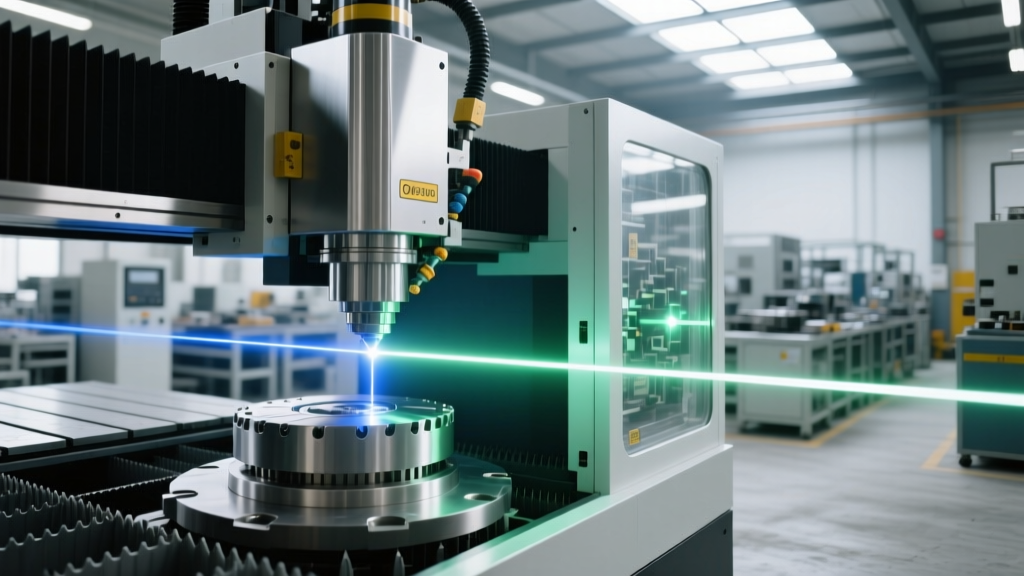
When integrating a laser CNC machine in cutter head configurations, engineers must balance photon energy delivery, fluid dynamics, and real-time capacitive tracking. The cutting head is not merely a passive conduit for the laser beam; it is a highly calibrated optical and mechanical assembly. In modern 10kW to 30kW fiber laser systems, the cutter head must withstand immense thermal loads while maintaining focal tolerances of ±0.05mm.
Core Cutter Head Specifications (2026 Standard Fiber Systems)
- Wavelength Compatibility: 1.064 µm (Fiber/Disk) vs. 10.6 µm (CO2)
- Maximum Power Handling: Up to 40 kW (with specialized water-cooled collimators)
- Z-Axis Update Rate: > 1,000 Hz for capacitive height sensing
- Cross-Jet Air Pressure: 4 to 6 bar (prevents debris ingress to optics)
The primary components include the collimator (which straightens the divergent beam from the fiber optic cable), the focusing lens (typically fused silica for fiber lasers or ZnSe for CO2 systems), and the nozzle body. According to Precitec, modern cutting heads also incorporate protective windows with anti-reflective coatings that must be replaced if spatter compromises their transmission rate beyond 2%.
Beam Delivery: Collimation and Focusing Optics
The transition from the raw beam to a high-density cutting spot is governed by the focal length of the lens. The focal length determines both the spot size at the material surface and the Rayleigh length (the depth of focus where the beam area remains within twice its minimum). A shorter focal length yields a smaller kerf and higher energy density but sacrifices the depth of focus, making it unsuitable for thick plates where beam divergence would cause excessive kerf taper.
Focal Length Selection Matrix
| Focal Length | Target Material Thickness | Spot Size (Approx) | Rayleigh Length |
|---|---|---|---|
| 5.0 inch (127mm) | 0.5mm – 3.0mm (Thin Sheet) | 0.08mm – 0.12mm | Short (High precision) |
| 7.5 inch (190mm) | 3.0mm – 12.0mm (Medium Plate) | 0.15mm – 0.20mm | Medium (Balanced) |
| 10.0 inch (254mm) | 12.0mm – 30.0mm+ (Thick Plate) | 0.25mm – 0.35mm | Long (Minimal taper) |
Selecting the incorrect focal length is a primary cause of dross formation. As detailed in TRUMPF's laser cutting fundamentals, utilizing a 5-inch lens on 15mm mild steel will result in the focal point burying too deep into the kerf, causing the assist gas to lose coherence and fail to eject the molten slag.
Assist Gas Fluid Dynamics and Pressures
The cutter head nozzle directs assist gas coaxially with the laser beam. The gas serves three functions: it ejects molten material from the kerf, it shields the cut edge from oxidation (in the case of inert gases), or it actively participates in an exothermic reaction to boost cutting energy.
- Oxygen (O2): Used primarily for mild steel. The oxygen reacts exothermically with the molten iron, contributing up to 60% of the total cutting energy. Because the reaction is highly energetic, gas pressures are kept intentionally low—typically between 0.5 and 2.5 bar. High pressure would cool the reaction zone and extinguish the cut.
- Nitrogen (N2): Used for stainless steel and aluminum to achieve an oxide-free, clean edge. Nitrogen acts purely as a mechanical ejector and cooling agent. Modern high-power fiber lasers require massive nitrogen volumes at high pressures, ranging from 12 to 30 bar, to physically blow the highly reflective molten aluminum out of the kerf before it re-solidifies.
- Argon (Ar): Reserved for reactive metals like titanium. Argon prevents embrittlement and alpha-case formation in the heat-affected zone (HAZ). Pressures typically mirror nitrogen setups (10 to 20 bar), though operational costs are significantly higher due to the price of bulk liquid argon.
Nozzle Design and Standoff Distances
The physical geometry of the copper nozzle dictates gas flow characteristics. Single-wall (conical) nozzles are used with inert gases (Nitrogen/Argon) to accelerate the gas flow to supersonic speeds, maximizing ejection force. Double-wall nozzles feature an internal and external cone, designed specifically for low-pressure Oxygen cutting; they create a wider, more laminar gas envelope that envelops the cut edge without disrupting the delicate exothermic reaction.
Engineering Warning: Never use a double-wall nozzle with high-pressure nitrogen. The internal geometry will cause turbulent backflow at pressures above 6 bar, leading to severe edge striations and potential lens contamination from molten splash-back.
The standoff distance—the gap between the nozzle tip and the material surface—is rigorously maintained between 0.5mm and 1.5mm. This is managed by a capacitive height sensor integrated directly into the cutter head.
Capacitive Height Sensing Mechanics
Sheet metal is rarely perfectly flat; thermal distortion during cutting and raw material tolerances can introduce warping. The cutter head utilizes the copper nozzle as one plate of a capacitor and the workpiece as the other. An oscillator circuit measures the capacitance, which changes inversely with the distance to the metal. This analog signal is digitized and fed to the Z-axis servo drive.
In 2026, advanced CNC controllers sample this capacitive data at frequencies exceeding 2,000 Hz. If the Z-axis servo motor cannot react fast enough to a sudden upward warp in the sheet, the collision detection algorithm will trigger an emergency stop within 4 milliseconds to prevent a catastrophic crash that could shatter the $15,000 focusing lens assembly.
Troubleshooting Common Cutter Head Failures
Even with precise calibration, mechanical and optical degradation occurs. Below is a diagnostic matrix for common anomalies originating at the cutter head.
| Symptom | Root Cause at Cutter Head | Mechanical Fix |
|---|---|---|
| Asymmetrical kerf width / directional dross | Beam misalignment in the nozzle orifice; beam is clipping the inner copper wall. | Perform a tape shot test; adjust the X/Y motorized centering screws on the collimator housing. |
| Sudden loss of pierce capability | Protective window contamination or micro-fracture from spatter blowback. | Inspect window under UV light; replace if transmission drops below 98%. Check cross-jet air pressure. |
| Erratic Z-axis floating / nozzle crashing | Ceramic insulator ring fractured or coated in conductive metallic dust. | Clean ceramic ring with isopropyl alcohol; replace if capacitance calibration fails to hold zero. |
| Heavy spatter on top edge (mild steel) | Focal point set too high; oxygen pressure exceeding exothermic threshold. | Lower Z-axis focus offset by 0.5mm increments; reduce O2 pressure to 1.2 bar. |
Component Lifecycle and Replacement Economics
Maintaining a laser CNC machine in cutter configurations requires strict adherence to component lifecycles. A high-end auto-focus cutting head (such as those manufactured by Precitec or RayTools) represents a capital investment of $12,000 to $25,000. However, the operational consumables dictate the true cost per hour.
Protective quartz windows cost between $30 and $80 each and should be swapped every 40 to 80 hours of active cutting time, depending on the pierce frequency of the nesting program. Copper nozzles, priced at $8 to $25 depending on the orifice diameter and whether they are standard or high-speed (micro-cone) variants, typically last 10 to 15 hours before the orifice degrades from thermal expansion and spatter adhesion. Operating with a degraded nozzle orifice alters the supersonic gas flow profile, resulting in a 15% to 20% reduction in maximum cutting speed and severe edge roughness.
For comprehensive safety protocols regarding optical alignment and Class 4 laser hazards during cutter head maintenance, operators must strictly adhere to the guidelines published by the Laser Institute of America. Proper lockout/tagout procedures and the use of wavelength-specific alignment goggles (OD 7+ at 1.064 µm) are non-negotiable when the cutter head enclosure is opened for optical servicing.