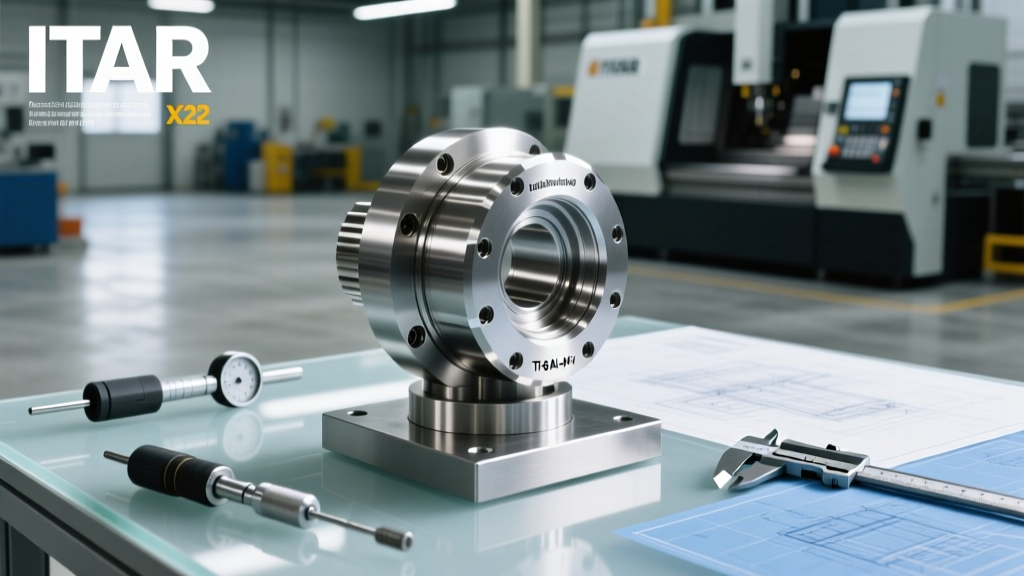
Cost Analysis for Defense CNC Machined Components: 2026 Budget Guide
Learn how to budget for defense CNC machined components in 2026. Breakdown of ITAR compliance, aerospace alloy costs, and tight tolerance machining expenses.
The Economics of Defense Manufacturing
Procurement officers and defense contractors face a complex matrix of variables when pricing defense CNC machined components. Unlike commercial manufacturing, where unit economics and high-volume amortization dictate margins, defense machining requires absorbing heavy compliance overhead, exotic material waste, and non-linear tolerance costs into every RFQ. As supply chain constraints evolve in 2026, budgeting accurately for military and aerospace hardware requires moving beyond simple "time-plus-material" models and adopting a fully burdened cost analysis framework.
The price delta between a commercial CNC part and a mil-spec equivalent is rarely just the material cost. It is the compounding effect of AS9100D quality management systems, ITAR facility controls, and the severe machining penalties associated with aerospace-grade superalloys. Understanding these specific cost levers is critical for accurate budget planning and avoiding catastrophic margin erosion on fixed-price defense contracts.
Key Budgeting Insight: A commercial machine shop operating at $65/hour will typically quote defense work at $95 to $130/hour. This 45-100% premium is not arbitrary profit; it is the direct amortization of NADCAP certification, CMM inspection time, ITAR-compliant IT infrastructure, and documented material traceability.Material Matrix: Alloys, Machinability, and Cost Multipliers
Material selection is the primary cost driver for defense CNC machined components. Defense applications routinely demand materials that exhibit high strength-to-weight ratios, thermal resistance, and fatigue endurance. However, the physical properties that make these alloys ideal for missile guidance housings or rotorcraft transmission casings make them notoriously hostile to cutting tools.
| Material (Mil-Spec) | Raw Material Cost (per lb) | Machinability Rating | Tooling Wear Multiplier | Primary Defense Application |
|---|---|---|---|---|
| 6061-T6 Aluminum | $3.50 - $5.00 | 200% (Baseline) | 1.0x | Non-structural housings, test fixtures |
| 7075-T6 Aluminum | $5.50 - $8.00 | 120% | 1.3x | Aerospace structural ribs, weapon receivers |
| 17-4 PH Stainless | $9.00 - $14.00 | 50% | 2.5x | Naval hardware, landing gear components |
| Ti-6Al-4V (Grade 5) | $25.00 - $35.00 | 22% | 4.0x | Turbine blades, airframe structural nodes |
| Inconel 718 | $40.00 - $60.00 | 15% | 6.5x | Exhaust manifolds, high-temp engine mounts |
The Hidden Cost of Titanium and Inconel
When budgeting for Ti-6Al-4V or Inconel 718, raw material cost is only the beginning. These alloys work-harden rapidly and possess low thermal conductivity. During CNC milling, the heat generated at the cutting zone does not dissipate into the chip; instead, it transfers directly into the cutting tool. This necessitates specialized through-tool coolant systems, rigid tapping cycles, and premium carbide or ceramic endmills. A shop must factor in a 4x to 6.5x increase in consumable tooling costs and a 70% reduction in material removal rates (MRR) compared to standard aluminum machining.
The Non-Linear Tolerance Cost Curve
A common budgeting error in defense procurement is assuming a linear relationship between tolerance tightening and part cost. In reality, the cost curve is exponential. Standard commercial CNC machining reliably holds ±0.005" (±0.127mm). Pushing into aerospace territory at ±0.001" (±0.025mm) requires slower feed rates, secondary finishing passes, and increased operator attention, typically adding 30% to the machining cost.
However, optical, targeting, and precision weaponry components often demand tolerances of ±0.0002" (±0.005mm) or tighter. At this threshold, standard 3-axis or 5-axis CNC machining is no longer sufficient on its own.
- Thermal Compensation: The shop floor must be climate-controlled to 68°F (20°C) ±1° to prevent thermal expansion of the metal and the machine castings.
- Spindle Growth: High-end machines with active spindle thermal displacement compensation are required, which command higher hourly rates.
- Post-Machining Processes: Achieving sub-0.0005" tolerances often requires secondary jig grinding or lapping, adding $150-$300 per hour in specialized labor.
- Inspection Overhead: Parts must be verified using a Coordinate Measuring Machine (CMM) in a temperature-controlled metrology lab. CMM programming and run-time can easily equal 25% of the total CNC machining time.
Critical Warning for RFQs: Never blanket-callout a drawing with ±0.0005" tolerances unless functionally mandatory. Restricting tight tolerances only to critical datum surfaces and mating bores can reduce overall component machining costs by up to 40%.
Compliance and Certification Overhead Allocation
Manufacturing defense CNC machined components requires adherence to strict regulatory frameworks. The DoD Office of Industrial Base Analysis and Sustainment heavily monitors supply chain security, meaning machine shops must invest significantly in compliance infrastructure. These costs do not appear as line items on a quote but are baked into the shop's overhead rate.
ITAR Compliance Costs
The International Traffic in Arms Regulations (ITAR) mandates that technical data and physical components for defense articles remain strictly under the control of U.S. persons. For a CNC facility, this requires:
- Segregated, air-gapped, or heavily encrypted IT servers for CAD/CAM files.
- Physical badge access controls and visual barriers on the shop floor.
- Strict HR vetting processes to ensure no foreign nationals access the manufacturing floor.
- Annual ITAR registration fees and specialized legal counsel.
These administrative and facility burdens typically add 12% to 18% to a defense contractor's baseline overhead rate compared to a purely commercial job shop.
NADCAP and AS9100D Certification
While AS9100D governs the overarching quality management system, NADCAP (National Aerospace and Defense Contractors Accreditation Program) is required for special processes like heat treating, anodizing, and non-destructive testing (NDT). Maintaining NADCAP accreditation requires rigorous internal audits, dedicated quality personnel, and continuous documentation. When evaluating supplier quotes, procurement officers must recognize that a NADCAP-certified supplier's higher hourly rate reflects this mandatory, audited reliability.
Design for Manufacturability (DFMA) in Defense Applications
Engineers designing defense components often prioritize performance over manufacturability, leading to exorbitant CNC costs. Implementing DFMA principles specifically tailored for defense alloys can yield massive budget savings without compromising mil-spec performance. According to supply chain optimization frameworks highlighted by NIST's Manufacturing Extension Partnership, early-stage design interventions can reduce production costs by up to 30%.
Actionable DFMA Checklist for Defense Parts
- Standardize Internal Corner Radii: Avoid 1/8" internal radii in deep titanium pockets. This forces the use of long, fragile endmills that must take light passes, increasing machine time by 300%. Design for 1/2" or 3/8" radii to allow rigid tooling and aggressive material removal.
- Minimize Deep Cavity Milling: In 7075-T6 and Titanium, deep pockets require specialized extended-reach tooling. Consider designing the part as two separate forgings or billets that are friction-stir welded or mechanically fastened after shallow CNC profiling.
- Optimize Stock-to-Part Ratios: Machining a 50lb Titanium billet down to a 4lb finished structural node wastes 92% of the material, which cannot be recycled at full value. Utilize near-net-shape forgings or additive manufacturing (DED) pre-forms, finishing only the critical mating surfaces via CNC.
- Eliminate Custom Thread Sizes: Use standard Mil-Spec (MS) or National Aerospace Standard (NAS) thread sizes. Custom threads require bespoke thread-milling or tapping operations, adding setup time and inspection complexity.
2026 Budgeting Framework for Procurement Officers
To accurately forecast budgets for defense CNC machined components, procurement teams should abandon historical commercial pricing models and adopt the following fully-burdened estimation framework for 2026:
| Cost Category | Calculation Method | Defense Premium Factor |
|---|---|---|
| Raw Material | Part Volume + 20% Machining Allowance + Scrap Value | 1.5x - 4.0x (Alloy dependent) |
| CNC Machine Time | Estimated Cycle Time + 15% Setup/Teardown | 1.4x (Due to lower MRR in superalloys) |
| Consumable Tooling | Factored at 8-12% of Machine Time cost | 3.0x (Carbide wear in Inconel/Titanium) |
| Quality & Inspection | First Article Inspection (FAI) + CMM Runtime | Add 25-40% of total machine time cost |
| Compliance Overhead | ITAR, AS9100D, NADCAP Amortization | Add 18% to baseline shop rate |
By applying this matrix, defense contractors can establish realistic baseline budgets before issuing RFQs, reducing the likelihood of supplier default and ensuring that critical mil-spec hardware is sourced from financially stable, compliant machine shops. Accurate budgeting is not just an accounting exercise; it is a fundamental pillar of national defense supply chain resilience.