Breaking CNC Machining News: Direct-Drive 5-Axis Tech
Explore the latest CNC machining news on direct-drive 5-axis kinematics. We break down torque motor specs, thermal management, and ISO calibration.
The 2026 Shift in 5-Axis Kinematics
The most significant development dominating current CNC machining news is the industry-wide transition from mechanical transmission systems to direct-drive kinematics in 5-axis machining centers. For decades, 5-axis trunnion tables and rotary axes relied on worm gear drives and pre-tensioned ball screws. While reliable, these mechanical linkages introduce inherent physical limitations: backlash, elastic wind-up, and friction-induced thermal growth. As aerospace and medical micro-machining tolerances have tightened to the sub-micron level, the mechanical transmission has become the primary bottleneck in machine tool accuracy.
According to research tracked by NIST Advanced Manufacturing programs, the elimination of mechanical drivetrain components is the most effective method for reducing volumetric error in multi-axis cutting. In 2026, direct-drive linear motors on the X, Y, and Z axes, paired with direct-drive torque motors on the A and C rotary axes, have moved from niche, high-cost prototypes to the standard configuration for premium 5-axis vertical machining centers (VMCs).
How Direct-Drive Torque Motors Work in Trunnion Tables
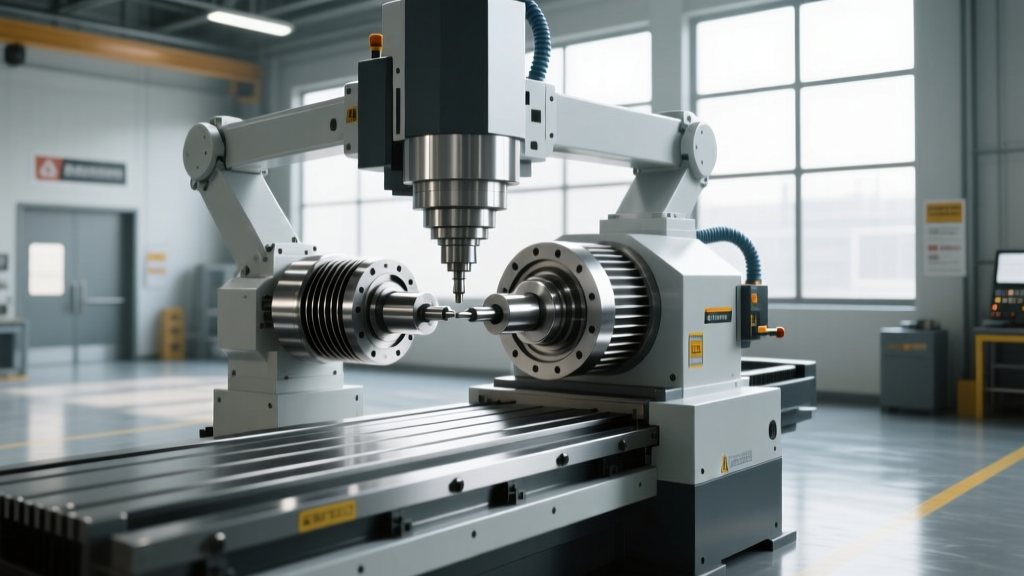
A direct-drive torque motor integrates the rotor directly onto the rotating axis (the trunnion or spindle head) and mounts the stator to the stationary machine casting. There are no gears, belts, or couplings between the electromagnetic field and the cutting tool. When the CNC control commands a rotational move, the stator's electromagnetic field instantly acts upon the rotor's permanent magnets, generating torque without mechanical lag.
Eliminating the Backlash Gap
In a traditional worm gear drive, a slight clearance (backlash) must exist between the gear teeth to prevent binding and allow for lubrication. Over time, wear increases this gap, requiring manual adjustment or software compensation. Direct-drive torque motors operate with zero mechanical backlash. The only limitation to positional accuracy is the resolution of the rotary encoder and the stiffness of the machine casting. This allows for simultaneous 5-axis contouring where the tool maintains exact tangential contact with complex aerospace blisks or medical implants without the micro-stutters caused by gear teeth meshing.
| Specification | Worm Gear / Ball Screw | Direct-Drive Torque / Linear |
|---|---|---|
| Backlash | 3 to 5 arc-minutes (new) | Zero (Encoder-limited) |
| Rotary Acceleration | 15 to 30 rad/s² | 100 to 250 rad/s² |
| Linear Acceleration (X/Y/Z) | 0.5G to 0.8G (5-8 m/s²) | 1.5G to 2.5G (15-25 m/s²) |
| Maintenance Interval | 2,000 - 5,000 hours (lubrication) | Lifetime (non-contact) |
| Approximate Machine Cost | $150,000 - $250,000 | $450,000 - $750,000+ |
Thermal Management: The Achilles Heel of Direct Drive
While direct-drive motors eliminate mechanical friction, they generate immense electrical heat within the stator windings. If left unmanaged, this heat transfers into the machine casting, causing asymmetric thermal expansion that destroys volumetric accuracy. This is the primary reason early direct-drive machines struggled in non-climate-controlled environments.
Modern 2026 direct-drive 5-axis machines solve this via dual-circuit liquid cooling jackets integrated directly into the stator housing. To maintain geometric accuracy compliant with the ISO 230-2:2020 standard for geometric accuracy, the cooling system must meet strict specifications:
- Coolant Temperature Stability: The external chiller unit must maintain the coolant at 20°C with a variance of no more than ±0.1°C.
- Flow Rate Requirements: Torque motors on heavy trunnion tables typically require a minimum flow rate of 12 to 18 liters per minute to effectively extract the 2kW to 5kW of continuous heat generated during heavy roughing cycles.
- Thermal Isolation: Advanced models use ceramic thermal barriers between the motor rotor and the trunnion bearings to prevent heat migration into the workpiece.
"A direct-drive motor is only as accurate as its thermal management system. Without ±0.1°C chiller stability, a 24-bit encoder is just measuring thermal expansion with extreme precision."
Encoder Resolution and the Feedback Loop
The mechanical elimination of backlash is useless if the CNC control cannot measure the axis position with corresponding exactness. The current standard in high-end 5-axis news involves 24-bit absolute rotary encoders (such as the Heidenhain ROC series or Siemens equivalent) mounted directly on the rotary axis, bypassing the motor bearings entirely to avoid measuring bearing play.
To understand the information gain of a 24-bit system, consider the mathematics of the feedback loop:
- A 24-bit encoder provides 16,777,216 discrete counts per single revolution (360 degrees).
- On a standard 500mm diameter trunnion table, the circumference at the outer edge is approximately 1,570mm.
- Dividing 1,570mm by 16.7 million counts yields a linear resolution of 0.093 microns (93 nanometers) per count at the extreme edge of the work envelope.
This nanometer-level feedback is fed into the CNC control's position loop, which typically operates at a cycle time of 250 microseconds (4,000 Hz), while the current loop controlling the motor torque operates at 1 kHz to 2 kHz. This ultra-high-frequency closed-loop system allows the machine to instantly correct for cutting forces that attempt to push the tool off the programmed vector.
Step-by-Step: Calibrating Direct-Drive Axes to ISO 230-2
Because direct-drive machines lack mechanical stops and gear meshing, calibration relies entirely on laser interferometry and volumetric error compensation. When commissioning a new direct-drive 5-axis machine, technicians must follow a rigorous sequence:
- Thermal Soak: Run a standardized warm-up cycle for 120 minutes, engaging all linear and rotary axes at 50% rapid traverse to stabilize the liquid cooling loop and casting temperature.
- Linear Axis Mapping: Mount a laser interferometer on the table. Step the X, Y, and Z axes in 50mm increments across their full travel, measuring bidirectional positioning accuracy and calculating the reverse pitch (backlash equivalent, which should read < 1 micron).
- Rotary Axis Eccentricity: Mount a precision calibration sphere on the trunnion table. Use a touch probe to map the sphere's center at 15-degree increments through the full 360-degree rotation of the C-axis and the ±120-degree tilt of the A-axis.
- Volumetric Compensation: Input the mapped deviation data into the CNC controller's spatial error compensation (SEC) matrix. The control will now dynamically adjust all five axes simultaneously in real-time to correct for any remaining geometric misalignments.
Buyer’s Framework: Procuring Direct-Drive Technology
Upgrading to a direct-drive 5-axis VMC represents a massive capital expenditure, often exceeding $500,000 for a fully equipped cell with automation and high-pressure coolant. Shop owners must evaluate the ROI based on specific production metrics rather than general industry hype.
When to Invest: Direct-drive is mandatory if your shop machines titanium or Inconel aerospace structural components requiring 5-axis simultaneous finishing passes where surface finish must remain under 0.8 Ra, or if you produce medical orthopedic implants with complex organic curves where micro-stutters from gear backlash cause scrap rates above 2%.
When to Avoid: If your primary workload consists of 3+2 axis machining of aluminum enclosures or steel prismatic parts where the tool is locked in position during the cut, the acceleration benefits of direct-drive linear motors are negated. In these scenarios, a high-quality, pre-tensioned ball screw machine with a worm-gear trunnion will deliver identical part quality at less than half the capital cost.
The latest CNC machining news confirms that direct-drive technology is no longer experimental; it is the established benchmark for precision. However, achieving its theoretical accuracy requires strict adherence to thermal management protocols, high-resolution encoder maintenance, and rigorous ISO-compliant calibration routines.