CNC Machine Tools News: 5-Axis Aerospace Titanium Case Study
Explore the latest CNC machine tools news with our deep dive into 5-axis titanium milling for aerospace. Discover real-world metrics, costs, and setups.
The Application Challenge: Ti-6Al-4V Structural Components
Tracking the latest cnc machine tools news reveals a distinct operational shift among Tier 2 aerospace suppliers: the aggressive transition from 3-axis vertical machining centers to 5-axis trunnion platforms for titanium structural parts. Ti-6Al-4V (Grade 5 Titanium) remains the dominant alloy for landing gear brackets, wing ribs, and engine pylons due to its 40% weight savings over steel. However, its thermal conductivity is roughly one-sixth that of carbon steel, meaning 80% of the heat generated during cutting remains concentrated at the tool's cutting edge rather than dissipating into the chip.
This thermal bottleneck forces shops to make a critical decision: either accept low material removal rates (MRR) and extended cycle times, or invest in high-torque 5-axis platforms capable of aggressive trochoidal roughing. This case study examines a mid-sized Ohio-based aerospace supplier that overhauled its titanium milling cell in late 2025, yielding measurable production gains now being realized in 2026.
Case Study Snapshot
- Component: Main Landing Gear Bracket (Ti-6Al-4V)
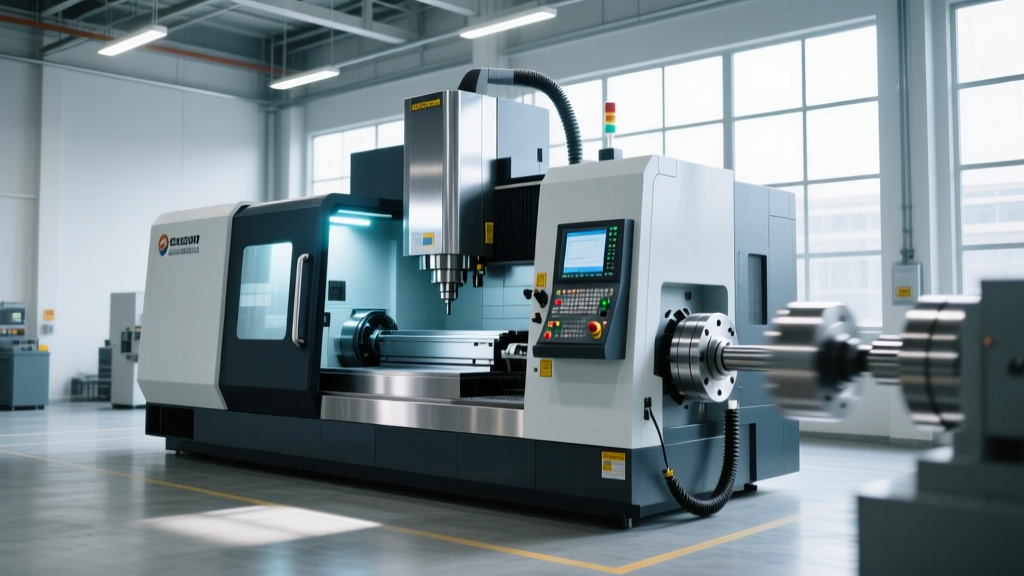
- Machine: DMG MORI DMU 50 3rd Generation (5-Axis)
- Cycle Time Reduction: 240 minutes to 145 minutes (-39%)
- Tool Life Improvement: 42 parts per edge to 68 parts per edge
Machine Selection and Configuration Economics
The supplier selected the DMG MORI DMU 50 3rd Generation specifically for its dynamic rigidity and spindle torque curve. A common mistake in 5-axis titanium machining is prioritizing high RPM (e.g., 20,000+ RPM spindles designed for aluminum aerospace structural parts). Titanium requires high torque at lower speeds to maintain chip thickness without stalling the spindle.
Spindle and Coolant Specifications
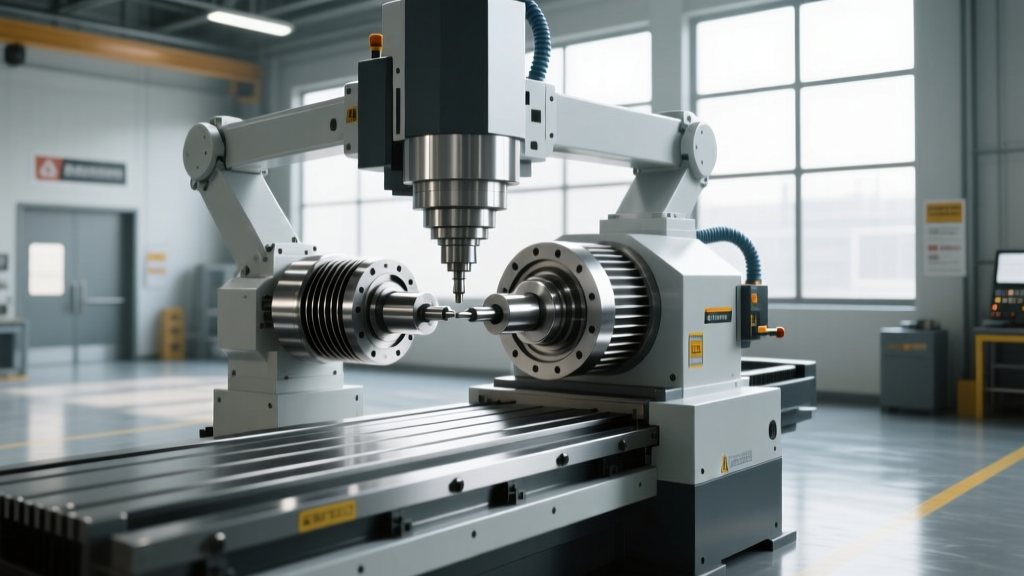
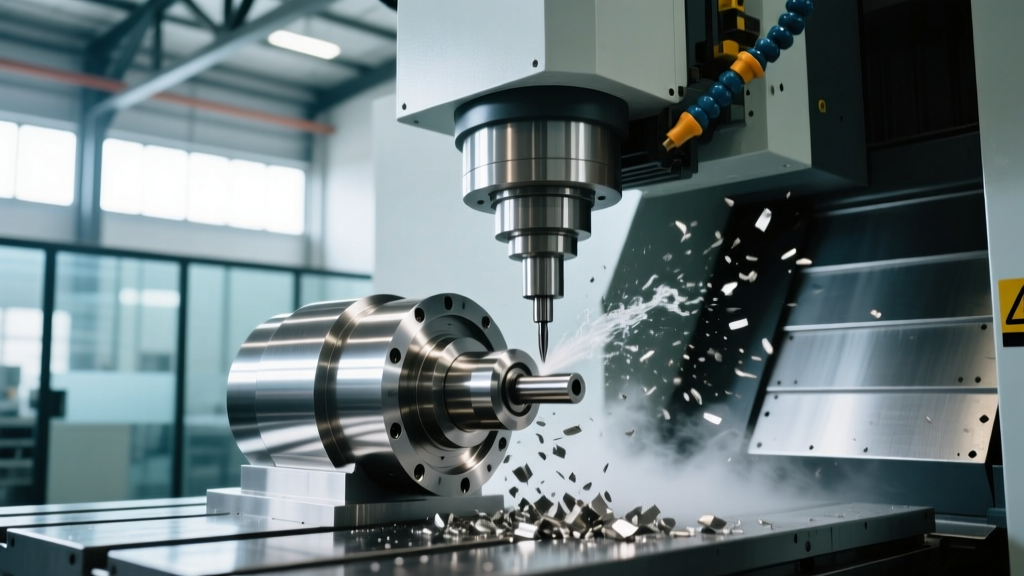
The shop configured the DMU 50 with the 10,000 RPM powerSKYL spindle option. This specific spindle delivers 202 Nm of torque at a 40% duty cycle, which is essential for driving 1/2-inch diameter end mills through heavy roughing passes in titanium. To manage the extreme thermal load, the machine was equipped with a 1,000 PSI (69 bar) through-spindle coolant (TSC) pump. Standard 300 PSI flood coolant is insufficient for deep-cavity titanium milling; at 1,000 PSI, the coolant penetrates the cutting zone, rapidly cools the edge, and forces chip evacuation to prevent secondary cutting (recutting chips), which is the primary cause of premature tool failure in this alloy.
As of Q1 2026, the capital expenditure for this exact configuration—including the high-pressure coolant system, automated chip conveyor, and Heidenhain TNC7 control—sits between $415,000 and $435,000, depending on probe and tool-setting laser options.
Tooling Strategy and Toolpath Mechanics
For roughing, the engineering team moved away from traditional zig-zag pocketing and adopted dynamic trochoidal milling. By maintaining a constant radial depth of cut (RDOC) at 6% of the tool diameter, the cutting forces remain uniform, eliminating the shock loads that cause micro-chipping on carbide edges.
The shop standardized on Kennametal's HARVI III 5-flute end mills with an AlTiN (Aluminum Titanium Nitride) PVD coating. The variable helix and variable pitch geometry of the HARVI III breaks up harmonic vibrations (chatter), which is critical when machining the thin 2mm walls typical of aerospace brackets. According to Sandvik Coromant's material-specific milling guidelines, maintaining a continuous chip thickness and avoiding dwell times are paramount to preventing work hardening in titanium; the dynamic toolpaths achieve exactly this.
Machining Parameters Matrix
| Operation | Tool | Speed (SFM) | Feed (IPT) | DOC (Axial) | RDOC (Radial) |
|---|---|---|---|---|---|
| Roughing (Trochoidal) | 1/2" 5-Flute End Mill | 160 | 0.0035 | 0.750" (1.5xD) | 0.030" (6%) |
| Semi-Finishing | 3/8" 5-Flute End Mill | 200 | 0.0025 | 0.500" | 0.015" (4%) |
| Finishing (Walls) | 1/4" 7-Flute End Mill | 240 | 0.0018 | 0.250" | 0.005" (2%) |
Failure Modes and Edge Cases in Ti-6Al-4V
Transitioning to high-efficiency 5-axis titanium milling introduces specific failure modes that standard CNC operators often misdiagnose. Understanding these edge cases is critical for maintaining the 145-minute cycle time.
- Thermal Cracking (Edge Chipping): If the 1,000 PSI coolant pump experiences a pressure drop or if the nozzle alignment drifts away from the cutting zone, the tool edge experiences rapid thermal cycling (heating to 800°C+ and quenching instantly). This causes microscopic thermal cracks perpendicular to the cutting edge, leading to catastrophic edge chipping within 15 minutes. Fix: Install inline coolant pressure sensors with machine-halt macros.
- Built-Up Edge (BUE): Titanium has a high chemical affinity for carbide. If the surface speed (SFM) drops too low (below 120 SFM), the material welds to the tool. When the BUE breaks off, it takes a piece of the carbide substrate with it. Fix: Never program dwell times at the bottom of pockets; maintain continuous tool engagement.
- Workpiece Springback: Ti-6Al-4V has a low modulus of elasticity. When finishing thin walls (under 3mm), the material deflects away from the cutter, resulting in tapered walls that fail CMM inspection. Fix: Utilize a spring-pass finishing strategy with a final 0.001" radial stock allowance and a reduced feed rate of 12 IPM to allow the material to relax into the cut.
Production Economics and ROI Analysis
The financial justification for the 5-axis cell relies on the compounding savings in labor, scrap reduction, and tooling longevity. Under the previous 3-axis VMC setup, the landing gear bracket required three separate setups, accumulating 45 minutes of manual fixturing and indicating time per part. The 5-axis trunnion table reduced this to a single setup using a zero-point clamping system, cutting non-cut time to 12 minutes.
Per-Part Cost Breakdown (2026 Estimates)
Previous 3-Axis VMC Process:
- Machine Time: $160.00 (4.0 hrs @ $40/hr)
- Tooling Cost: $54.00 (Frequent edge chipping required 3 roughing tools per part)
- Labor/Setup: $37.50 (45 mins @ $50/hr)
- Total Cost Per Part: $251.50
Current 5-Axis DMU 50 Process:
- Machine Time: $108.75 (2.41 hrs @ $45/hr 5-axis rate)
- Tooling Cost: $22.00 (Optimized trochoidal paths extended tool life by 62%)
- Labor/Setup: $10.00 (12 mins @ $50/hr)
- Total Cost Per Part: $140.75
Net Savings: $110.75 per part. At a monthly volume of 120 brackets, the shop realizes an additional $13,290 in gross margin monthly, paying off the $415,000 machine investment in approximately 31 months, excluding scrap reduction benefits.
Strategic Takeaways for Shop Floors
The data from this implementation underscores that purchasing a 5-axis machine is only 20% of the equation. The remaining 80% of the ROI is captured through rigorous attention to low-speed torque specifications, high-pressure coolant integration, and dynamic toolpath programming. Shops reviewing current market offerings must look past rapid traverse rates and spindle RPM, focusing instead on Nm torque curves at 4,000 RPM and the structural damping characteristics of the trunnion table when planning their next titanium machining capital expenditure.