CNC Machine Tool Industry News Today: Mill-Turn vs 5-Axis VMCs
Analyzing CNC machine tool industry news today to compare 2026 mill-turn centers and 5-axis VMCs. Real pricing, specs, and ROI frameworks for job shops.
The Current Landscape: What CNC Machine Tool Industry News Today Tells Us
When shop owners and manufacturing engineers scan CNC machine tool industry news today, the dominant narrative for 2026 centers on a massive capital shift toward multi-tasking architectures. Driven by aerospace reshoring initiatives, strict ITAR compliance requirements, and a 14% surge in complex valve and actuator orders, the debate between investing in Mill-Turn Centers versus 5-Axis Vertical Machining Centers (VMCs) has never been more critical. According to the latest consumption data tracked by the US Cutting Tool Institute (USCTI), multi-axis machine orders have outpaced standard 3-axis VMCs for the fourth consecutive quarter, signaling a permanent shift in how mid-sized job shops approach part consolidation.
2026 Market Pulse: Multi-Tasking vs. Multi-Axis
- Mill-Turn Market Share: Up 18% YoY, heavily driven by medical implant and fluid power sectors requiring high L/D (Length-to-Diameter) ratio parts.
- 5-Axis VMC Market Share: Stable at 22% of total new machine sales, dominated by monolithic structural aerospace components and aluminum mold bases.
- Lead Times: Domestic delivery for equipped 5-axis VMCs averages 14-18 weeks; Mill-Turn centers are currently seeing 24-32 week lead times due to B-axis spindle head supply constraints.
Head-to-Head Matrix: Mill-Turn Centers vs. 5-Axis VMCs
To make an informed capital expenditure decision, shops must look past the marketing brochures and evaluate the hard specifications, real-world equipped pricing, and physical limitations of the leading platforms in 2026.
| Machine Architecture | Benchmark Model | 2026 Equipped Price Range | Max Turning Diameter | Primary Failure Mode / Limitation |
|---|---|---|---|---|
| Mill-Turn Center | DMG MORI NTX 2000 | $720,000 - $890,000 | 25.6 in (650 mm) | Y-axis thermal displacement during heavy off-center milling. |
| Mill-Turn Center | Mazak Integrex i-200S | $610,000 - $740,000 | 21.7 in (550 mm) | Lower torque limits on the milling spindle for hard-metal roughing. |
| 5-Axis VMC | Haas UMC-750SS | $235,000 - $275,000 | N/A (Trunnion Table) | A-axis brake slippage under high-torque roughing of Inconel/Titanium. |
| 5-Axis VMC | Hermle C42U | $850,000 - $1.2M | N/A (Modified Gantry) | High maintenance cost for collision-damage on the trunnion bearings. |
The Mill-Turn Alternative: Deep Dive on B-Axis Architectures
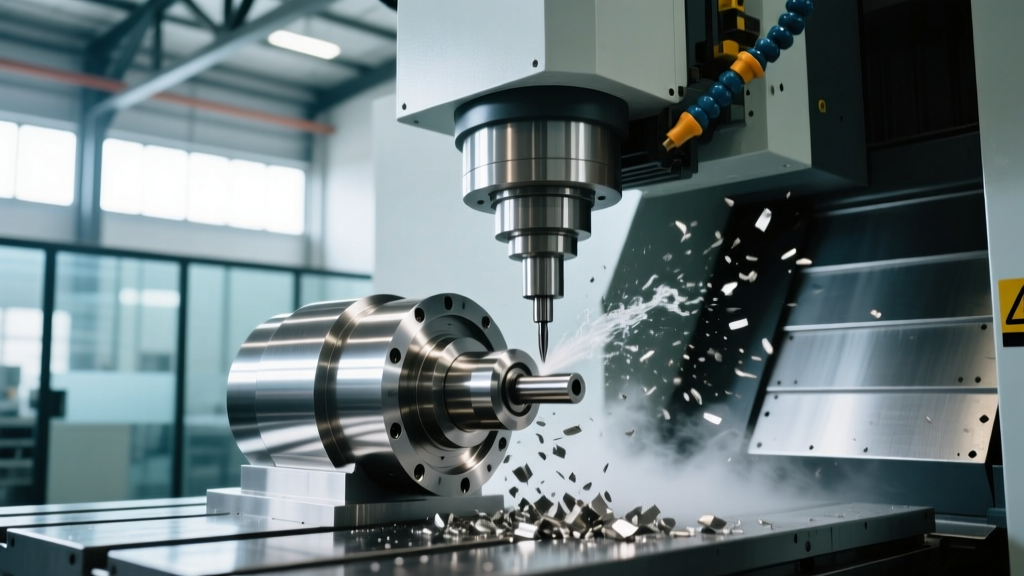
Mill-turn centers are essentially CNC lathes with a fully integrated 5-axis milling head. The defining feature is the B-axis spindle head, which allows the milling cutter to approach the workpiece at any angle while the part is held in the main chuck or sub-spindle. This architecture is non-negotiable for parts like hydraulic manifolds, landing gear actuators, and medical bone screws where the L/D ratio exceeds 4:1.
DMG MORI NTX 2000 vs. Mazak Integrex i-200S
The NTX 2000 features a 20,000 RPM B-axis spindle with a built-in motor, delivering exceptional surface finishes on aerospace aluminum and titanium. However, the primary edge case shops face is thermal growth. When executing heavy Y-axis milling operations, the asymmetrical mass of the B-axis head can cause microscopic thermal displacement if the machine’s internal chiller unit is not strictly calibrated to a 20°C (68°F) ambient shop environment. Conversely, the Mazak Integrex i-200S utilizes a highly rigid box-way construction that excels in heavy interrupted cuts on stainless steel, but its 12,000 RPM milling spindle limits cycle time efficiency on complex 3D contoured aluminum mold inserts.
- + Mill-Turn Advantage: Complete part-off capability. A complex valve body requiring turning, cross-drilling, and 5-axis contouring is finished in a single setup, eliminating 4-6 hours of inter-departmental queuing and secondary fixturing.
- - Mill-Turn Drawback: Programming complexity. Generating collision-free G-code for a machine with dual spindles, a lower turret, and a B-axis milling head requires advanced CAM modules and highly skilled operators.
The 5-Axis VMC Alternative: Trunnion Table Dynamics
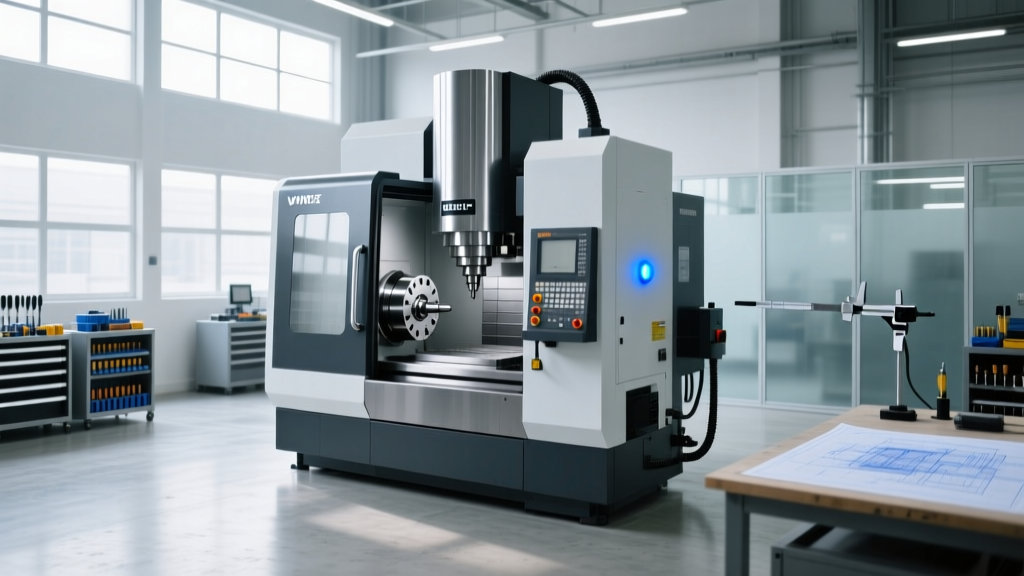
For shops producing monolithic structural components, impellers, and titanium airframe brackets, the 5-axis VMC remains the undisputed workhorse. These machines utilize a trunnion table (A and C axes) to tilt and rotate the part while a fixed 3-axis vertical spindle performs the cutting.
Haas UMC-750SS vs. Hermle C42U
The Haas UMC-750SS dominates the mid-tier market. Equipped with an HSK-63A taper and a 12,000 RPM inline direct-drive spindle, it offers an unbeatable entry price point. However, shops must account for trunnion table sag. When loading a 1,000 lb titanium blank onto the A-axis cradle, the gravitational load can induce a 0.0008-inch deflection at the extreme tilt angles, requiring in-process probing routines to compensate. The Society of Manufacturing Engineers (SME) frequently highlights that ignoring this kinematic deflection is the leading cause of scrapped aerospace structural ribs on mid-tier 5-axis machines.
The Hermle C42U, by contrast, utilizes a modified gantry design where the table is fully supported on both sides, virtually eliminating sag and allowing for aggressive 5-axis simultaneous roughing of Inconel 718. The trade-off is a base price that exceeds $850,000 before high-pressure coolant and automation integrations are added.
"The decision between a mill-turn and a 5-axis VMC rarely comes down to the machine's price tag. It comes down to the cost of the fixture. If you are spending $15,000 on custom hydraulic tombstones and spending 4 hours setting up a part on a 5-axis VMC, you have already justified the ROI of a mill-turn center for your next capital purchase."
— Senior Manufacturing Engineer, Tier-1 Aerospace Supplier
Decision Framework: Matching Architecture to Part Geometry
Do not rely on sales representatives to dictate your machine architecture. Use this strict geometric and metallurgical decision tree to determine the correct investment for your 2026 order book:
- Is the part primarily cylindrical with an L/D ratio greater than 3:1?
Yes → Mill-Turn Center. A 5-axis VMC cannot securely hold long shafts without severe chatter and tailstock interference. - Does the part require heavy material removal from a solid block (monolithic)?
Yes → 5-Axis VMC. Mill-turn chucks lack the clamping force and Z-axis rigidity required to hold a 500 lb aluminum billet during aggressive roughing passes. - Is the primary material Titanium or Inconel requiring high-torque milling?
Yes → Mill-Turn (with high-torque B-axis option) or Premium 5-Axis (Hermle/Grob). Avoid standard mid-tier 5-axis VMCs; the trunnion brakes will slip under the cutting forces. - Is the annual volume under 50 pieces with high mix/low volume characteristics?
Yes → 5-Axis VMC. The flexibility of standard vise fixturing on a VMC trunnion table drastically reduces setup time for one-off prototypes compared to programming custom chuck jaws for a mill-turn.
⚠️ Warning: The Hidden Costs of Multi-Tasking CAM
When budgeting for a mill-turn center, shops frequently underestimate the software and tooling ecosystem. A standard 5-axis VMC requires a 5-axis CAM seat (e.g., Mastercam, approx. $6,500). A full mill-turn center requires a specialized Mill-Turn CAM module (e.g., hyperMILL or Mastercam Mill-Turn, approx. $12,500 - $18,000) capable of generating synchronized G-code for the lower turret and B-axis spindle. Furthermore, mill-turn machines heavily utilize quick-change tooling systems like Sandvik Coromant Capto C6. Budget an additional $25,000 to $40,000 just to populate the initial Capto tooling inventory, as standard CAT40 or BT40 holders cannot be used in the B-axis milling spindle.
Final Verdict for 2026 Capital Expenditure
The CNC machine tool industry news today makes it clear that the era of the standalone 3-axis VMC and manual CNC lathe is rapidly closing for competitive job shops. If your shop's revenue relies on complex, rotational, fluid-power, or medical components, the Mill-Turn center is the mandatory alternative to reduce setup times and eliminate secondary operations. However, if your bread and butter consists of aerospace structural ribs, impellers, and 5-sided aluminum housings, the 5-Axis VMC remains the most cost-effective, high-rigidity alternative. Align your machine architecture strictly to your part geometry, and ensure your CAM software budget scales proportionally with the kinematic complexity of the hardware you choose.