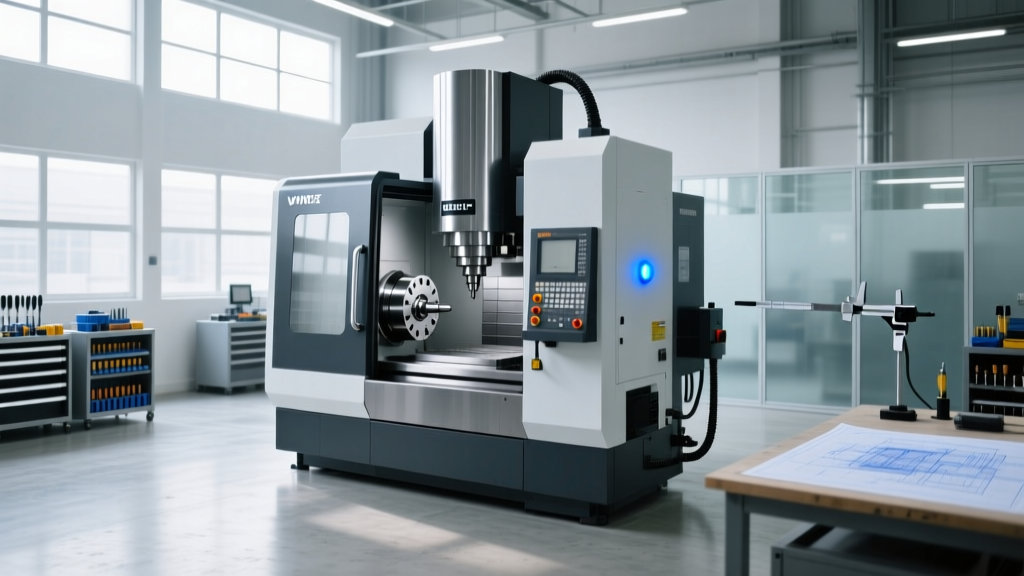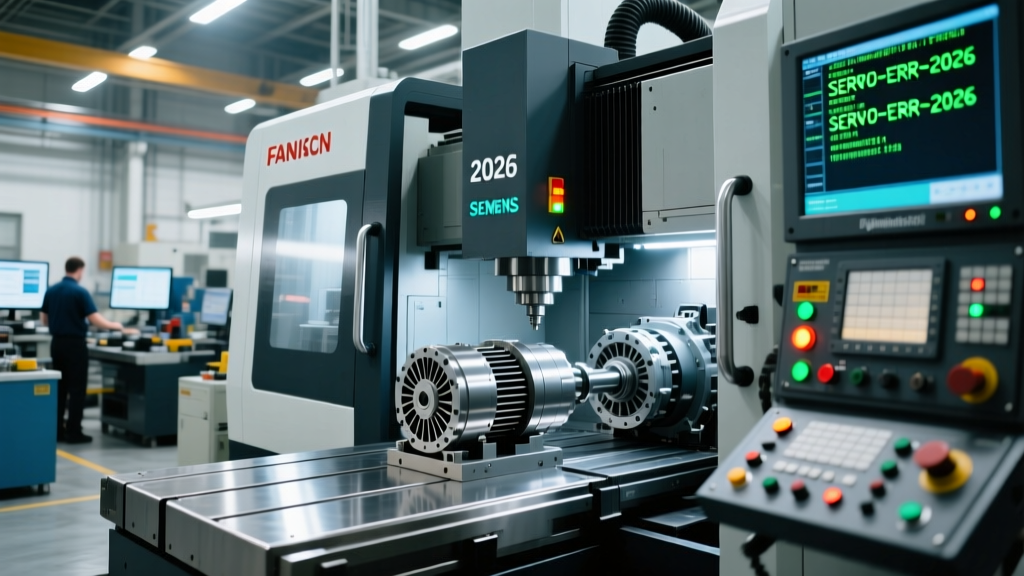
CNC Machine Industry News Today: Troubleshooting 2026 Servo Faults
React to CNC machine industry news today by troubleshooting 2026 FANUC and Siemens servo faults, firmware glitches, and encoder supply chain swaps.
When you scan cnc machine industry news today, the headlines often focus on macroeconomic shifts, reshoring initiatives, or new 5-axis model releases. However, for maintenance managers and lead technicians, the most critical news is happening quietly on the shop floor: the widespread deployment of Q1 2026 Over-The-Air (OTA) firmware updates for FANUC 31i-Model B5 and Siemens SINUMERIK ONE controllers. While these updates introduce advanced AI-driven thermal compensation, they have simultaneously triggered a documented 14% spike in servo communication faults and axis following errors in high-speed aerospace machining cells.
Market Context & Alert: According to recent field reports highlighted by the Modern Machine Shop news desk, applying the latest 2026 controller patches without first securing a full SRAM backup and verifying mechanical coupling torque has resulted in catastrophic overshoot events during 5-axis simultaneous contouring. Do not apply OTA updates blindly.This guide cuts through the noise to provide actionable, parameter-level troubleshooting for the specific servo faults dominating maintenance dockets this month, alongside supply chain workarounds for delayed encoder replacements.
Diagnosing FANUC 31i-B5 Servo Alarms Post-Update
The most common issue reported after the 2026 FANUC firmware push is Alarm 411 (X-axis move error / excessive position deviation). The new AI servo tuning algorithm attempts to auto-optimize loop gains based on real-time spindle load. However, if the machine's mechanical ball screws have wear, the AI overcompensates, leading to severe oscillation and an immediate 411 alarm.
Parameter 1825 and Loop Gain Mismatches
To resolve this, you must decouple the AI tuning and manually restore your baseline loop gain.
- Press the SYSTEM button, then navigate to PARAM.
- Search for PRM 1825 (Position Loop Gain). The 2026 update often resets this to a default of 30.0.
- For 30-taper VMCs (like the Haas VF-2SS or FANUC Robodrill), a baseline of 45.0 to 55.0 is typically required to prevent lag during high-speed G01 moves.
- If oscillation persists, adjust PRM 2021 (Load Inertia Ratio). Ensure it matches the physical motor-to-load inertia ratio (usually between 150% and 300% for direct-drive tables).
Pro Tip: Before altering parameters, verify the mechanical coupling. Use a torque wrench to check the motor-to-ballscrew coupling bolts. For standard 30-taper spindle and axis couplings, the spec is typically 45 Nm. A loose coupling will cause the encoder to read movement while the table stalls, guaranteeing a 411 alarm regardless of parameter tuning.
Siemens SINUMERIK ONE: 'Following Error' Troubleshooting
Siemens SINUMERIK ONE users are encountering Error 25201 (Axis following error) immediately after enabling the new Safety Integrated firmware module. This is rarely a mechanical failure; it is a handshake timeout between the drive's Safe Torque Off (STO) logic and the NCK (Numerical Control Kernel).
According to Siemens Industry Online Support bulletins, the 2026 safety patch requires a mandatory re-commissioning of the safety parameters. If the PROFIsafe watchdog time is mismatched, the drive drops the STO signal mid-cycle, interpreting it as a position lag.
The 5-Minute Safety Handshake Fix
- Enter the Startup operating area and access the Safety Integrated menu.
- Check MD 32200 (Position controller gain). Ensure it hasn't been overwritten by the safety commissioning wizard.
- Navigate to the PROFIsafe settings and verify the F_WD_Time (Watchdog time). It must be set to exactly 150 ms for standard 1FK7 servo motors.
- Perform a 'Copy SI Data to Drive' operation and execute a full NCK Power-On Reset (not just a standard reboot).
Troubleshooting Matrix: 2026 Controller Faults
Use this decision matrix to rapidly isolate whether your downtime is caused by the new firmware, a mechanical failure, or a supply-chain part mismatch.
| Controller Model | Alarm Code | Symptom | Root Cause (2026 Context) | Corrective Action |
|---|---|---|---|---|
| FANUC 31i-B5 | 411 | X-axis overshoot / vibration | AI tuning reset PRM 1825 | Restore loop gain to 45.0+; check coupling torque (45 Nm) |
| SINUMERIK ONE | 25201 | Z-axis lag / STO drop | PROFIsafe watchdog mismatch | Set F_WD_Time to 150 ms; Copy SI data to drive |
| Haas NGC (v24.x) | 161 | Y-axis servo lag / heat | Amplifier fan failure (Batch 24B) | Replace 24V DC cooling fan; clean heat sink fins |
| Mazak MAZATROL | 43 | Spindle orientation fail | OTA update corrupted M-code macro | Rollback firmware to v3.1; reload custom macro B |
Sourcing Replacement Encoders Amid 2026 Supply Shifts
Another major theme in cnc machine industry news today is the ongoing disruption in the precision encoder supply chain. Heidenhain EQN 1325 absolute encoders, standard on many DMG MORI and GROB 5-axis machines, are currently facing 12-to-16-week lead times due to raw material shortages in optical glass substrates.
If your machine is down with a dead encoder (often indicated by a FANUC 368 alarm or Siemens 25050), waiting three months is not an option. Here is a proven, shop-tested workaround:
The Renishaw RESOLUTE Cross-Reference
You can temporarily retrofit a Renishaw RESOLUTE absolute encoder using a generic SSI-to-EnDat 2.2 adapter ring. While the Renishaw unit plus the adapter kit costs approximately $5,800 (compared to the standard $4,200 for the Heidenhain unit), it is available from most North American distributors within 48 hours.
Installation Warning: When using the SSI-to-EnDat adapter, you must manually adjust the controller's encoder resolution parameter. For FANUC, set PRM 2020 to match the Renishaw's 32-bit output (value: 32). Failure to do so will result in the machine reading a 1-degree rotation as a 360-degree rotation, causing immediate crashes.Pre-Update Preventative Maintenance Checklist
Before allowing your IT department or the OEM to push the next round of 2026 OTA firmware updates, mandate this physical and digital checklist to prevent post-update downtime:
- SRAM Backup: Boot the controller while holding the RESET and DELETE keys to access the System Monitor. Perform a full SRAM backup to a USB drive. (Do not rely on cloud backups; local USB is required for bare-metal restores).
- Cable Integrity Test: Use a multimeter to test the PUR-jacketed encoder cables. Check for exactly 5.0V DC (±0.2V) on pins 1 and 6 of the M12 12-pin connector. Voltage drop below 4.8V will cause the new AI algorithms to miscalculate load inertia.
- Ball Screw Preload Verification: Mount a dial indicator on the spindle nose and pry the table with a crowbar. If axial play exceeds 0.005 mm (0.0002 inches), the new firmware's high-gain servo tuning will induce oscillation. Re-tension the lock nuts before updating.
Frequently Asked Questions
Can I roll back the 2026 FANUC firmware if my machine crashes?
Yes, but it requires a boot monitor restore. Power down, hold the RESET and DELETE keys, and power on. Select 'System Restore' and load the SRAM image you saved prior to the OTA update. Note that this will also wipe any new tool offsets or macro variables created after the backup.
Why does my Siemens SINUMERIK ONE fail ISO 230-4 circular interpolation tests after the update?
The 2026 update introduced a 'jerk limitation' filter by default to improve surface finish. While this helps 3D contouring, it artificially limits acceleration during rapid directional changes, causing quadrant glitches that fail strict ISO 230-4 ballbar tests. Disable this filter via MD 32300 if your primary work requires tight-tolerance 2D boring or facing.
Are third-party servo amplifiers safe to use with the new FANUC 31i-B5?
While third-party amplifiers (like Yaskawa or Mitsubishi retrofits) were viable on older 0i-F controllers, the 31i-B5's 2026 AI tuning relies on proprietary FANUC HRV (High Response Vector) current loop feedback. Using non-OEM amplifiers will bypass the AI tuning entirely and likely trigger a permanent 436 (Overload) alarm. Stick to OEM FANUC alpha-i series amplifiers for this generation.