VMC CNC Milling Machine Troubleshooting: Fixing Spindle Chatter
Diagnose and fix spindle chatter in your VMC CNC milling machine. Expert troubleshooting steps, tooling checks, drawbar specs, and bearing replacement costs.
The True Cost of Unchecked VMC Spindle Chatter
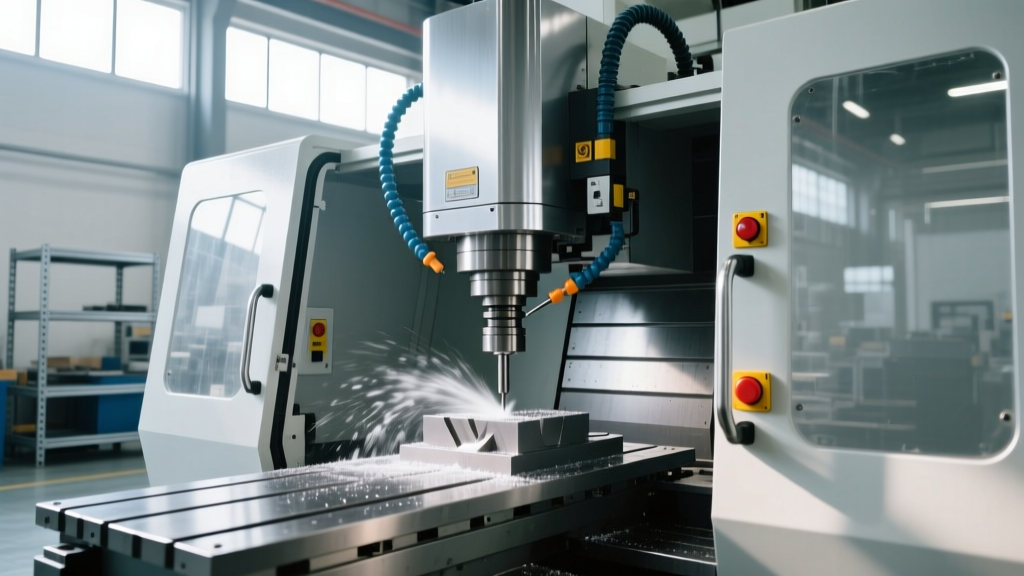
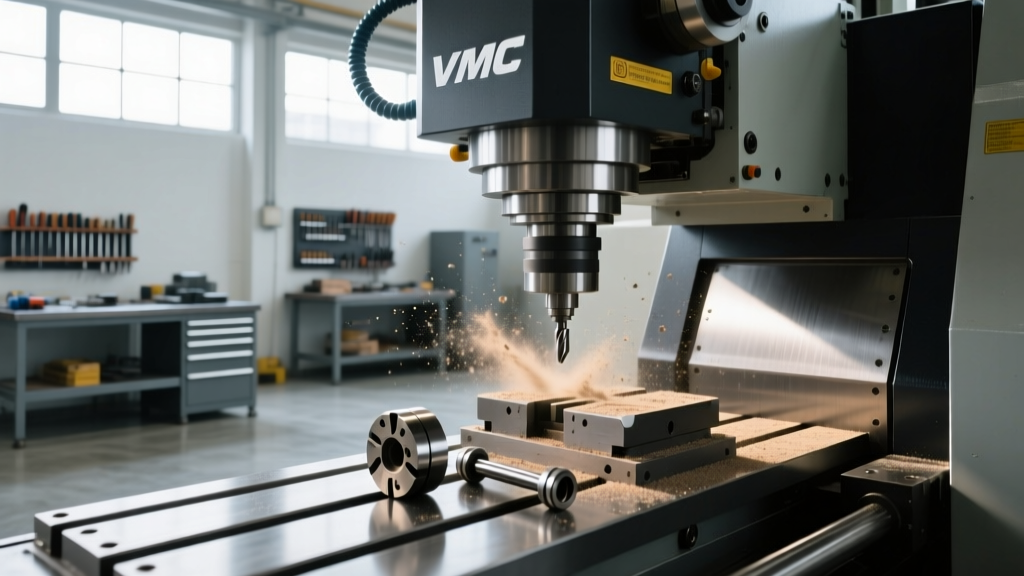
When a VMC CNC milling machine—such as a Haas VF-2SS, Fadal VMC-20, or Doosan DVM 2700—develops spindle chatter, the immediate symptom is a degraded surface finish and accelerated tool wear. However, the secondary mechanical damage is where machine shops lose significant capital. Unchecked high-frequency vibration degrades the spindle's ceramic hybrid bearings, frets the toolholder tapers, and accelerates Turcite way wear. A $300 carbide end mill shattered by chatter is a minor expense compared to the $8,500 to $14,000 required for a complete CAT40 or BT40 spindle rebuild in 2026.
Troubleshooting a VMC CNC milling machine requires a systematic isolation of the vibration source. Chatter is rarely a single-point failure; it is the result of a compromised dynamic stiffness loop involving the toolholder, spindle taper, drawbar retention, and machine geometry. Below is a definitive, step-by-step diagnostic framework to isolate and resolve spindle chatter.
Diagnostic Decision Tree: Isolating the Vibration Source
Before tearing down the spindle, run this rapid diagnostic sequence to categorize the chatter frequency and amplitude.
- Symptom: High-pitch squeal during light finishing passes.
- Probable Cause: Tool deflection, excessive overhang, or harmonic resonance.
- Immediate Check: Verify tool stick-out and switch to a variable helix/pitch end mill.
- Symptom: Low-frequency shudder during heavy roughing (X/Y axis movement).
- Probable Cause: Way lubrication failure, loose gib strips, or ball screw backlash.
- Immediate Check: Inspect Turcite ways for dry spots and check Bijur metering unit pressures.
- Symptom: Broadband vibration present even during air cutting (no load).
- Probable Cause: Spindle bearing degradation, unbalanced toolholder, or drawbar pull-force loss.
- Immediate Check: Run a dial indicator test on the toolholder taper and measure drawbar retention force.
Phase 1: Toolholder and Taper Inspection (The 80% Fix)
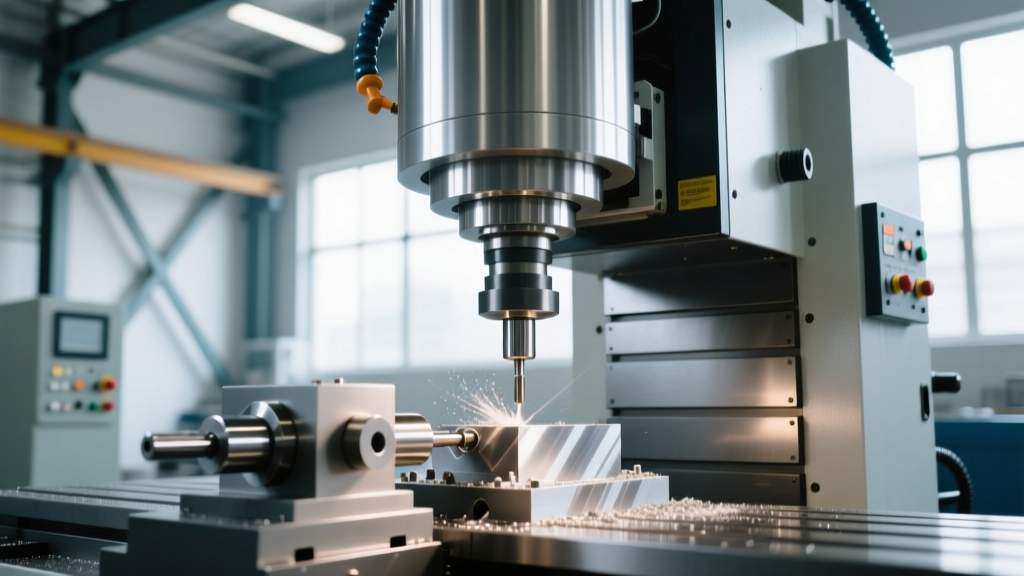
According to Harvey Tool's technical support database, over 80% of perceived machine spindle issues originate at the toolholder-spindle interface. In a VMC CNC milling machine, the CAT40 or BT40 taper relies on metal-to-metal contact to provide radial and axial rigidity. Even microscopic debris or fretting corrosion will cause the toolholder to seat improperly, resulting in Total Indicator Runout (TIR) that amplifies cutting forces.
Measuring TIR and Fretting
Insert a precision ground test arbor into the spindle. Mount a 0.0001-inch resolution dial indicator on the machine table. Measure the runout at the gage line and 4 inches below the gage line. Acceptable TIR for high-performance milling is less than 0.0002 inches. If TIR exceeds 0.0005 inches, inspect the spindle taper for fretting—visible as small, rust-colored pits or smearing on the taper surface.
Expert Tip: Never use a standard shop rag and WD-40 to clean a spindle taper. Use a dedicated, lint-free spindle cleaning tool with a high-flash solvent. Residual oil film alters the friction coefficient and promotes micro-movements at 10,000 RPM.Phase 2: Drawbar Pull-Force Degradation
The retention system in a VMC CNC milling machine utilizes a stack of Belleville spring washers to pull the toolholder into the taper. Over thousands of tool changes, these washers fatigue and lose their elastic memory. A standard CAT40 spindle requires a minimum of 2,500 lbs of pull force to maintain rigidity under heavy radial loads. If the force drops below 1,800 lbs, the toolholder will micro-lift during aggressive milling, causing severe chatter and galling the spindle taper.
Purchase or rent a spindle pull-stud force gauge (costing approximately $1,200 to $2,500). Test the drawbar retention force. If it is below 2,200 lbs, the Belleville spring stack must be replaced. This is a $400 to $800 repair that can be performed in-house by a trained maintenance technician in under two hours, preventing catastrophic spindle failure.
Phase 3: Way Lubrication and Gib Adjustment
If the chatter occurs primarily during axis interpolation rather than pure Z-axis plunging, the machine's linear guideways or box ways are the culprit. Box-way VMCs rely on a continuous film of way oil (typically ISO Grade 68 or equivalent) to prevent stick-slip friction. Stick-slip manifests as low-frequency chatter, ruining surface finishes and causing dimensional inaccuracies.
| Lube System Component | Target Specification | Failure Symptom | Corrective Action |
|---|---|---|---|
| Bijur Pump Pressure | 150 - 220 PSI | Pump runs but pressure drops immediately | Clean pump filter; replace pressure relief valve ($150 part) |
| Metering Units (Zerk) | 0.010" - 0.020" displacement | Dry Turcite surfaces; axis servo lag errors | Replace clogged metering units ($25 each); flush lines |
| Gib Strip Clearance | 0.0005" max play | Chatter during Y-axis contouring | Adjust gib set screws; re-lock with Loctite 243 |
Consulting Sandvik Coromant's milling knowledge hub emphasizes that machine tool stiffness directly dictates achievable metal removal rates (MRR). If the way lube system is compromised, the dynamic stiffness of the VMC drops exponentially, forcing machinists to reduce feed rates and spindle speeds to compensate for vibration.
Phase 4: Spindle Bearing Degradation (The Expensive Fix)
If tooling, drawbar force, and way lubrication have been verified, the vibration originates inside the spindle cartridge. Modern VMC CNC milling machines utilize precision angular contact bearings (often ABEC-9 class) with silicon nitride (Si3N4) ceramic balls to reduce centrifugal expansion at high RPMs.
Acoustic and Thermal Diagnostics
Bearing failure rarely happens instantly. It progresses through distinct phases. First, the grease breaks down or the oil-air mist system fails, leading to increased thermal growth. A healthy 10,000 RPM BT40 spindle should stabilize at a temperature 10°C to 15°C above ambient room temperature after a 30-minute warm-up cycle. If the spindle housing exceeds 45°C (113°F) or exhibits a 20°C differential from front to rear bearings, lubrication has failed.
Second, the bearing races develop spalling. This generates high-frequency acoustic emissions. While professional shops use $15,000 vibration analyzers, a practical shop-floor test involves using a mechanic's stethoscope with a metal probe placed against the spindle housing. A healthy bearing produces a smooth, high-pitched hiss. A failing bearing produces a distinct grinding, clicking, or rumbling sound that correlates with the rotational frequency.
Critical Warning: Do not attempt to "flush" a sealed, grease-packed ceramic spindle bearing with solvents to extend its life. This will wash out the remaining synthetic grease and guarantee catastrophic bearing seizure within hours of operation. If spalling is detected, the spindle cartridge must be removed and sent to a certified rebuild facility.Preventative Maintenance Protocol for VMC Fleets
Preventing chatter is vastly more cost-effective than repairing the damage it causes. Implement this strict maintenance schedule for all VMC CNC milling machines on the shop floor:
- Daily: Wipe the spindle taper with a lint-free cloth and inspect the pull studs for micro-cracks or galling before loading the tool magazine.
- Weekly: Verify the way lube reservoir level and manually cycle the lube pump to ensure oil is weeping from all axis metering units.
- Quarterly: Run a 30-minute spindle warm-up program (cycling from 1,000 RPM to max RPM in 2,000 RPM increments) and log the spindle housing temperature with an infrared pyrometer.
- Annually: Test drawbar pull-force with a calibrated gauge and check X/Y axis backlash using a dial indicator to detect early ball screw or thrust bearing wear.
By adhering to this diagnostic framework, maintenance teams can accurately isolate the root cause of VMC CNC milling machine chatter, avoiding unnecessary spindle teardowns and maximizing the uptime of their most critical production assets.