Troubleshooting CNC Machining Plastics: Melt, Burrs, and Tolerances
Fix melted edges, burrs, and tolerance loss when CNC machining plastics. Expert troubleshooting guide for PEEK, Delrin, and polycarbonate defect resolution.
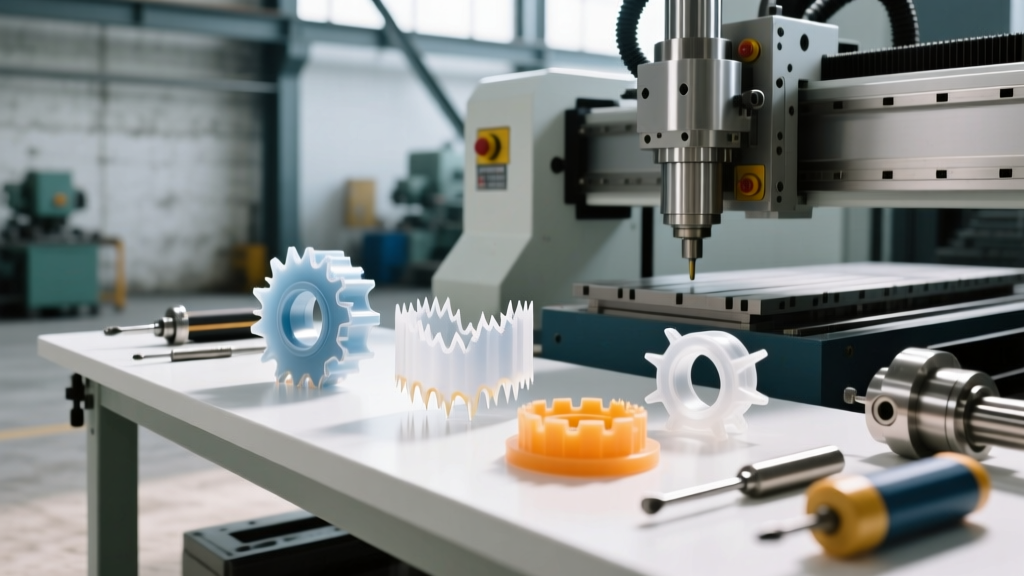
CNC machining plastics requires managing fundamentally different physics than milling metals. Polymers exhibit low thermal conductivity (typically 0.1–0.5 W/m·K) and high coefficients of linear thermal expansion (CLTE). When heat cannot dissipate into the chip, it transfers into the workpiece and the cutting tool, resulting in melted edges, dimensional instability, and surface tearing. This troubleshooting guide addresses the three most common failure modes encountered when CNC machining engineering plastics like PEEK, Acetal (Delrin), Polycarbonate, and UHMW-PE, providing exact tooling geometries, feeds/speeds, and thermal management protocols.
Critical Thermal Warning: Unreinforced plastics expand 6 to 10 times more than 6061 aluminum. A 10-inch Delrin part heated just 20°F above ambient during aggressive roughing will grow by approximately 0.012 inches. If you bore a hole to a tight +0.001/-0.000 tolerance while the part is hot, it will shrink below the minimum tolerance once it returns to room temperature.Symptom 1: Melted Edges, Chip Welding, and Stringing
In metal cutting, the chip carries away roughly 80% of the generated heat. In plastics, the chip is a poor thermal conductor. If the chip remains in the cut zone, friction reheats the material past its glass transition or melting point, causing stringing, burrs, and welded chips on the tool flutes.
Root Cause Analysis
- Incorrect Flute Geometry: Standard 35-degree helix endmills pack chips too tightly in the flute valley, creating friction.
- Insufficient Chip Load: Running high RPMs with low feed rates causes the tool to rub rather than shear, generating massive localized heat.
- Improper Coolant: Using water-soluble flood coolants on hygroscopic materials (like Nylon or UHMW) causes moisture absorption and swelling.
Actionable Fixes
Switch to an O-flute (single flute) or straight-flute endmill designed specifically for plastics. The O-flute geometry features a large gullet that aggressively evacuates chips before heat transfer occurs. For Cast Acrylic and Polycarbonate, use a 15-degree helix O-flute (such as the Onsrud 63-000 series). For harder engineering plastics like Delrin, a 2-flute straight-flute or low-helix (15-degree) carbide endmill is optimal.
Baseline Parameters for 1/4" O-Flute Carbide:
- Cast Acrylic: 18,000 RPM | 90 IPM | 0.125" Depth of Cut (DOC)
- Delrin (POM): 22,000 RPM | 120 IPM | 0.125" DOC
- Polycarbonate: 16,000 RPM | 80 IPM | 0.100" DOC
Coolant Strategy: Abandon flood coolant. Use a high-pressure air blast (minimum 80 PSI) combined with a micro-mist lubrication system (e.g., Accu-Lube) or pure compressed air to blow chips out of deep pockets. According to the Ensinger Plastics Machining Guide, compressed air is the preferred method for cooling to prevent thermal shock and chemical degradation in sensitive polymers like PEEK.
Symptom 2: Dimensional Springback and Post-Machining Warpage
Polymers possess a high modulus of elasticity compared to metals, meaning they exhibit significant elastic recovery (springback) immediately after the tool passes. Furthermore, extruded or molded plastic stock contains internal residual stresses that are released during material removal, causing parts to warp or twist days after machining.
Root Cause Analysis
- Tool Deflection: The cutting edge pushes the plastic away; the plastic rebounds into the tool, causing the final dimension to be undersized in profiles and oversized in pockets.
- Stress Imbalance: Removing material from one side of a thick billet disrupts the internal stress equilibrium.
Thermal and Toolpath Protocols
To combat springback, program a roughing pass that leaves 0.005" to 0.010" of radial stock on all walls. Follow this with a finishing pass at a very light depth of cut (0.002" to 0.003") and a high feed rate. This ensures the tool shears the material rather than plowing through it, minimizing the radial cutting forces that cause deflection.
For high-precision parts, annealing is mandatory to relieve internal stresses. Reference the Curbell Plastics Fabrication Guidelines for exact thermal profiles. Never quench plastics in water or oil; always allow them to cool slowly in the oven to prevent new thermal stresses from forming.
| Material | Elastic Recovery (per inch) | Annealing Temp | Hold Time |
|---|---|---|---|
| PEEK | 0.0015" - 0.0025" | 390°F (199°C) | 1 hr / 0.25" thick |
| Acetal (Delrin) | 0.0010" - 0.0015" | 290°F (143°C) | 1 hr / 0.5" thick |
| UHMW-PE | 0.0030" - 0.0050" | Not Recommended | N/A (Oversize toolpaths) |
| Nylon (PA 6/6) | 0.0020" - 0.0030" | 212°F (100°C) | 2 hrs / 0.5" thick |
Symptom 3: Surface Tearing, Chatter Marks, and Fuzzy Finishes
A fuzzy or torn surface finish indicates that the material is being ripped rather than cleanly sheared. This is highly prevalent in soft, low-durometer plastics like UHMW and LDPE, as well as in fiber-reinforced composites.
Root Cause Analysis
- Tool Coatings: Standard TiAlN or TiCN coatings possess microscopic surface roughness that increases friction and drags the polymer, causing tearing.
- Dull Cutting Edges: Plastics dull carbide tools differently than metals. Instead of edge chipping, the sharp cutting edge undergoes micro-abrasion, rounding off the rake angle until it rubs.
- Climb vs. Conventional Milling: Conventional milling pushes the chip ahead of the tool, often causing the thin plastic wall to flex and tear.
Actionable Fixes
Use strictly uncoated, mirror-polished carbide endmills for unreinforced plastics. The polished flute reduces the coefficient of friction, allowing the chip to slide cleanly out of the cut zone. Reserve CVD diamond-coated tooling exclusively for abrasive, carbon-fiber-reinforced polymers (CFRP); using diamond tools on pure UHMW will result in poor surface finishes due to the aggressive rake angles required for the coating.
Always utilize climb milling (down milling) for finishing passes. Climb milling cuts the chip thick-to-thin, directing the cutting forces downward into the table rather than lifting the workpiece. Set your radial stepover to 5% to 8% of the tool diameter on finishing passes to minimize radial engagement and eliminate chatter.
Advanced Troubleshooting: Workholding Without Deformation
Clamping forces that easily hold aluminum will permanently yield and crush soft plastics. UHMW-PE has a yield strength of roughly 3,000 PSI, while Nylon sits around 11,000 PSI. Standard manual vise clamping can easily generate localized jaw pressures exceeding 15,000 PSI, causing the part to bow in the middle and spring back to a warped state once unclamped.
Expert Workholding Rule: Never use standard hard vise jaws on engineering plastics. Machine custom soft jaws from 6061 aluminum or high-density polyurethane that match the exact profile of the roughed part. Use a torque wrench on your vise handle, limiting torque to 15-20 ft-lbs for standard 1/2"-13 pull studs to prevent over-clamping.
For thin-walled parts or sheets under 0.25" thick, abandon mechanical clamping entirely. Use a vacuum table with a porous fixture plate and a continuous neoprene gasket cord. Ensure your vacuum pump pulls a minimum of 25 inches of Mercury (inHg) to provide adequate holding force for aggressive profiling operations.
Tooling Selection Matrix for Engineering Polymers
| Material Type | Flute Count | Helix Angle | Tool Coating |
|---|---|---|---|
| Acrylic / Polycarbonate | 1 (O-Flute) | 15° - 20° | Uncoated Polished |
| Delrin (POM) / Nylon | 2 | 15° - 30° | Uncoated Polished |
| UHMW-PE / LDPE | 1 or 2 | Straight or 10° | Uncoated Polished |
| PEEK / PTFE | 2 or 3 | 30° - 35° | Uncoated or ZrN |
| CFRP / G10 (Garolite) | 2 | 35° - 45° | CVD Diamond |
Mastering CNC machining plastics requires shifting your mindset from managing cutting forces to managing thermal dynamics and elastic recovery. By implementing O-flute geometries, utilizing compressed air cooling, programming light finishing passes to counteract springback, and strictly controlling workholding pressures, you can reliably hold tolerances within ±0.001" on even the most challenging engineering polymers.