CNC Machine Stone Fabrication: Architectural & Monument Case Studies
Explore real-world case studies of CNC machine stone fabrication. Discover ROI, 5-axis tooling strategies, and architectural applications for granite.
The Shift to 5-Axis CNC Stone Routing
The transition from manual bridge saws and hand-carved templates to multi-axis CNC routing has fundamentally altered the economics of natural stone fabrication. When a shop integrates a high-torque CNC machine, stone transforms from a rigid, labor-intensive material into a highly programmable medium. Modern 5-axis stone CNCs, such as the Breton ShapeMill or Park Industries TITAN series, allow fabricators to execute complex 3D reliefs, undermount sink cutouts, and architectural moldings with sub-millimeter precision.
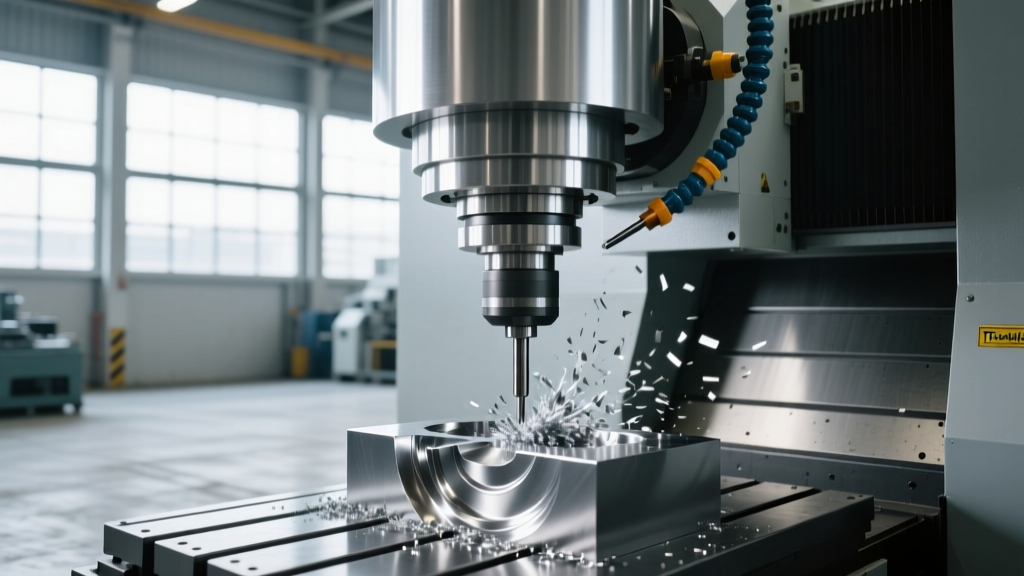
Unlike woodworking or aluminum milling, routing granite, marble, and quartzite demands specialized machine kinematics. Stone is intensely abrasive and lacks the tensile strength of metals, meaning it fractures rather than shears. Therefore, a CNC machine stone setup requires a liquid-cooled spindle delivering massive torque at relatively low RPMs (typically 3,000 to 10,000 RPM), paired with aggressive flood coolant systems to suppress hazardous silica dust and maintain the integrity of sintered diamond tooling.
CRITICAL COMPLIANCE: Silica Dust & OSHA MandatesDry routing engineered or natural stone generates respirable crystalline silica, a known carcinogen. Under OSHA's respirable crystalline silica standards, shops must utilize integrated water suppression systems. A standard 5-axis stone CNC requires a dedicated chiller and pump delivering 15 to 20 Gallons Per Minute (GPM) directly to the cutting zone to maintain compliance and prevent diamond matrix glazing.
Case Study 1: High-Volume Commercial Facades in Absolute Black Granite
A mid-sized architectural fabricator in the Midwest secured a contract to produce 4,500 linear feet of custom 3cm-thick Absolute Black granite window surrounds and louvers for a commercial high-rise. The design featured a complex 15-degree undercut on the interior drip edge—a geometry impossible to achieve consistently with a standard 3-axis bridge saw.
Machine & Tooling Configuration
The shop utilized a 5-axis CNC machine stone workstation equipped with a 24 HP liquid-cooled spindle. The CAM programming (via AlphaCAM Stone) divided the operation into three distinct passes:
- Roughing: A 1/2-inch shank Weha sintered diamond finger bit at 4,500 RPM and 40 Inches Per Minute (IPM), taking 10mm step-downs to remove bulk material.
- Semi-Finishing: A 3/8-inch electroplated diamond profile bit to clear the undercut corners, running at 6,000 RPM and 25 IPM.
- Finishing & Polishing: An automated CNC spindle attachment holding a sequence of resin-bonded diamond polishing pads (from 50 to 3000 grit) to achieve a mirror finish on the undercut face without manual intervention.
ROI and Time Savings
Manual templating and grinding the 15-degree undercut would have required approximately 14 minutes per linear foot. The 5-axis CNC reduced this to 3.5 minutes per linear foot. Despite the $420,000 capital expenditure of the CNC machine, stone fabrication labor costs for this specific contract dropped by 72%, yielding a net profit increase of $115,000 on the project alone and achieving full machine ROI in under 18 months.
Case Study 2: Bespoke Marble Staircases and Sculptural Elements
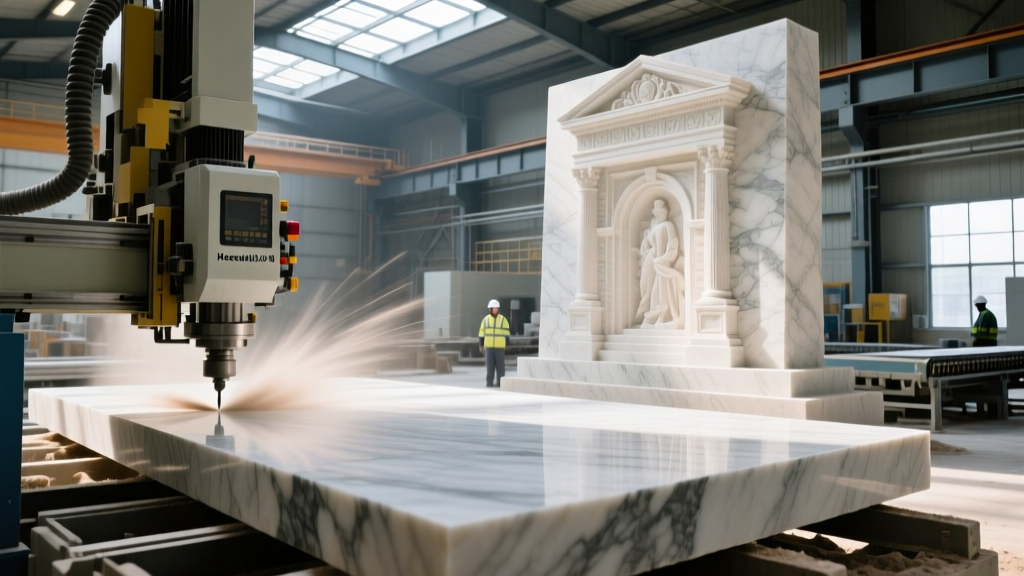
While granite demands abrasion resistance, marble demands delicacy. A luxury residential fabricator was tasked with milling a floating, spiral staircase from 4-inch thick Calacatta Gold marble slabs. The challenge with marble is its fissile nature; aggressive toolpaths can cause catastrophic blowout along the natural veining.
Adaptive Toolpath Strategies
To mitigate blowout, the programmers utilized a 'climb milling' strategy exclusively, ensuring the diamond bit rotated into the material in the same direction as the feed, which compresses the stone fibers rather than tearing them. The spindle speed was capped at 8,000 RPM to prevent thermal shock, which can cause micro-fractures in high-calcite stones.
Data Highlight: Manual vs. 5-Axis CNC for 3D Marble Carving| Metric | Manual Artisan Carving | 5-Axis CNC Routing |
|---|---|---|
| Time per Tread (Avg) | 18 Hours | 2.5 Hours |
| Dimensional Tolerance | ± 2.0 mm | ± 0.15 mm |
| Material Waste (Breakage) | 12% | < 2% |
| Vein Matching Continuity | Variable | Exact (via 3D scanning) |
By 3D-scanning the raw slabs prior to cutting, the CAM software mapped the natural veining, allowing the nesting algorithm to align the staircase treads so the gold veining flowed continuously from step to step—a level of aesthetic control documented frequently in Stone World industry case studies regarding luxury architectural millwork.
Tooling Economics: Diamond Bits and Coolant Flow
The operational cost of a CNC machine stone setup is heavily skewed toward consumable tooling and water filtration. Standard carbide endmills used in metalworking will dull in seconds when hitting quartzite. Fabricators must invest in specialized diamond tooling, which varies wildly in lifespan based on the stone's Mohs hardness and quartz content.
Tooling Lifespan & Cost Matrix
| Tool Type | Best Application | Avg. Cost | Lifespan (Linear Feet) |
|---|---|---|---|
| Electroplated Diamond Finger Bit | Marble, Limestone, Soft Granite | $85 - $120 | 150 - 250 ft |
| Sintered Diamond Router Bit | Hard Granite, Quartzite | $180 - $260 | 400 - 700 ft |
| Vacuum Brazed Diamond Profile Wheel | Edge Profiling, Ogee, Bullnose | $300 - $450 | 800 - 1,200 ft |
| CVD Diamond Coated Carbide (for Engineered Stone) | Quartz Composites (e.g., Caesarstone) | $150 - $200 | 200 - 300 ft |
Shops processing high-quartz engineered stones must factor in a 30% higher tooling budget, as the resin binders in engineered quartz create a gummy residue that clogs the pores of sintered diamond bits, requiring frequent dressing with an aluminum oxide brick.
Edge Cases: Managing Micro-Fractures in Quartzite
Quartzite is notoriously unforgiving on CNC machine stone setups. Because it is a metamorphic rock formed under extreme heat and pressure, it harbors internal tension. When a CNC router releases this tension by cutting a deep pocket or sink bowl, the slab can spontaneously crack or 'ping' hours after the cut is completed.
WARNING: Quartzite Tension ReleaseNever rough out a sink cutout in quartzite and leave the slab sitting on the CNC bed overnight. The internal stresses will warp the slab, potentially crashing the Z-axis upon the next tool change. Always complete the full cutout, remove the core, and apply structural epoxy backing mesh in the same operational shift.
To mitigate micro-fracturing, expert fabricators use a 'trochoidal' or adaptive clearing toolpath. Instead of plunging the diamond bit straight down and pushing laterally (which exerts massive lateral PSI on the stone walls), trochoidal milling moves the bit in continuous, overlapping circles. This maintains a constant chip load and reduces lateral cutting forces by up to 60%, preserving the structural integrity of fragile quartzite veins.
FAQ: CNC Machine Stone Operations
Q: Can I use my existing 3-axis wood CNC to route soft stone like soapstone or alabaster?
A: While you can physically cut soapstone on a wood CNC, the abrasive dust will destroy standard HSK or collet spindles not rated for IP65 dust/water ingress. Furthermore, wood CNCs lack the necessary flood coolant plumbing required to manage the slurry, which will quickly ruin linear guide rails and ball screws.
Q: What is the minimum spindle horsepower required for 3cm granite?
A: For reliable 3cm (1-1/4 inch) granite profiling and sink cutting, a minimum of 15 HP (11 kW) is required. For 5-axis 3D carving where the tool is engaged at multiple angles simultaneously, 20 HP to 25 HP is the industry standard to prevent spindle stalling.
Q: How do fabricators secure heavy stone slabs to the CNC bed without mechanical clamps?
A: The industry standard is a vacuum pod system. However, natural stone is porous. Fabricators must use a specialized porous vacuum chuck system paired with a high-volume dry vacuum pump (minimum 140 CFM) and seal the perimeter of the slab with a hot-melt glue or specialized foam gasket tape to maintain the vacuum seal during high-lateral-force profiling.
For further technical guidelines on stone anchoring and structural tolerances, fabricators should consult the dimensional stone design manuals published by the Natural Stone Institute, which provide the foundational engineering data required to program safe toolpaths for load-bearing architectural stone elements.