CNC Granite Machine Maintenance Schedule: Daily to Annual Guide
Maximize uptime and precision with our comprehensive CNC granite machine maintenance schedule. Covers daily, weekly, and annual service intervals.
The Abrasive Reality: Why Granite CNCs Degrade Faster
Machining natural stone is fundamentally different from milling aluminum or steel. Granite contains high concentrations of crystalline silica, registering between 6 and 7 on the Mohs hardness scale. By comparison, the hardened steel used in CNC ball screws and linear guideways typically sits around 4 to 5. This means the byproduct of your cutting process is inherently harder than the machine components it inevitably infiltrates. A standard CNC maintenance protocol will result in catastrophic axis failure within 18 months on a stone router. To protect your capital equipment, a specialized, aggressive preventative maintenance (PM) schedule is non-negotiable.
CRITICAL SAFETY WARNING: Silica Dust ComplianceRespirable crystalline silica (RCS) is a severe health hazard. The Occupational Safety and Health Administration (OSHA) enforces a strict Permissible Exposure Limit (PEL) of 50 micrograms per cubic meter of air. Failure to maintain your CNC granite machine's water containment and dust extraction systems not only degrades the machine but exposes your shop to severe regulatory fines and long-term liability. Always consult the OSHA Silica Standards and CDC NIOSH Silica Guidelines to ensure your shop floor remains compliant.
Daily Operator Checklist (Shift Start & End)
Daily maintenance on a CNC granite machine is less about lubrication and more about contamination removal. Operators must execute these steps to prevent slurry from curing into a concrete-like mass inside the machine's moving assemblies.
Shift Start Protocol
- Spindle Air Purge Verification: Before powering the spindle, verify the labyrinth seal air purge system is active. Air pressure must read between 4.0 and 6.0 bar. If air pressure drops below coolant pressure, water will infiltrate the spindle bearings, causing rust and catastrophic failure within hours.
- Way Cover & Bellows Inspection: Manually cycle the X and Y axes through their full travel. Visually inspect the Kevlar-reinforced or stainless steel telescopic way covers for tears, punctures, or heavy sludge buildup that could impede movement.
- Tooling & Collet Check: Inspect diamond sintered and electroplated tooling for segment wear. Clean the ER collet and nut with a brass wire brush to remove dried stone dust, which causes tool runout and premature spindle bearing wear.
Shift End Protocol
- High-Pressure Washdown: Use a low-pressure, high-volume water spray to flush the machine bed, way covers, and tool changer. Never use a high-pressure nozzle directly at the axis seals or spindle nose, as this forces abrasive slurry past the seals.
- Sludge Evacuation: Scrape settled granite sludge from the machine bed and primary drainage troughs. Allowing sludge to sit overnight causes it to harden, leading to way cover binding the following morning.
- Control Cabinet Filter Check: Inspect the intake filters on the CNC control cabinet. Stone dust is highly conductive when mixed with ambient humidity and can short-circuit PLC boards if it bypasses the cabinet seals.
Weekly & Monthly Preventative Service Intervals
Weekly and monthly intervals focus on fluid management and mechanical lubrication. Because water is the primary cutting fluid in stone machining, maintaining its chemical balance is critical to preventing flash rust on exposed machine surfaces.
| Component | Interval | Action Required | Est. Time |
|---|---|---|---|
| Coolant / Water pH | Weekly | Test pH levels. Maintain between 8.5 and 9.2 using synthetic stone coolant additives to prevent flash rust and bacterial growth. | 10 mins |
| Centralized Lube System | Weekly | Check reservoir levels. Purge air from lines. Verify metering valves are cycling and delivering oil to all axis blocks. | 15 mins |
| Way Wipers | Monthly | Inspect polyurethane wipers on linear guides. Replace if edges are frayed or if granite dust is visible on the polished rail. | 30 mins |
| Tool Changer Mechanism | Monthly | Degrease the carousel and fork mechanism. Apply a light, water-resistant lithium grease to the cam and pivot points. | 45 mins |
| Z-Axis Brake | Monthly | Test the Z-axis holding brake. Command a Z-drop in E-stop to verify the brake engages instantly without axis drift. | 15 mins |
Bi-Annual & Annual Deep Maintenance
Annual maintenance requires taking the CNC granite machine offline for precision measurement and deep component servicing. This is where you protect the geometric accuracy of the machine.
Ball Screw Backlash Mapping
Granite slurry acts as a lapping compound. Even with intact way covers, microscopic particles enter the ball nut, accelerating wear and introducing backlash. Every six months, utilize a wireless ballbar system (such as the Renishaw QC20-W) to map the volumetric accuracy of the machine. If backlash on the X or Y axis exceeds 0.0015 inches, the ball screw assembly must be removed, disassembled, and the ball bearings replaced. Neglecting this results in poor edge profiling and visible chattering on polished stone edges.
Spindle Bearing Regreasing
High-frequency stone routing spindles (typically 10,000 to 24,000 RPM) require precise lubrication. Annually, or every 2,000 spindle run-hours, the spindle must be sent to an authorized service center or carefully regreased in-house using a high-speed, water-resistant grease like Kluber Isoflex NBU 15. Over-greasing is a common failure mode; it causes excessive hydraulic pressure inside the bearing race, leading to overheating and seal blowout.
Geometric Alignment Verification
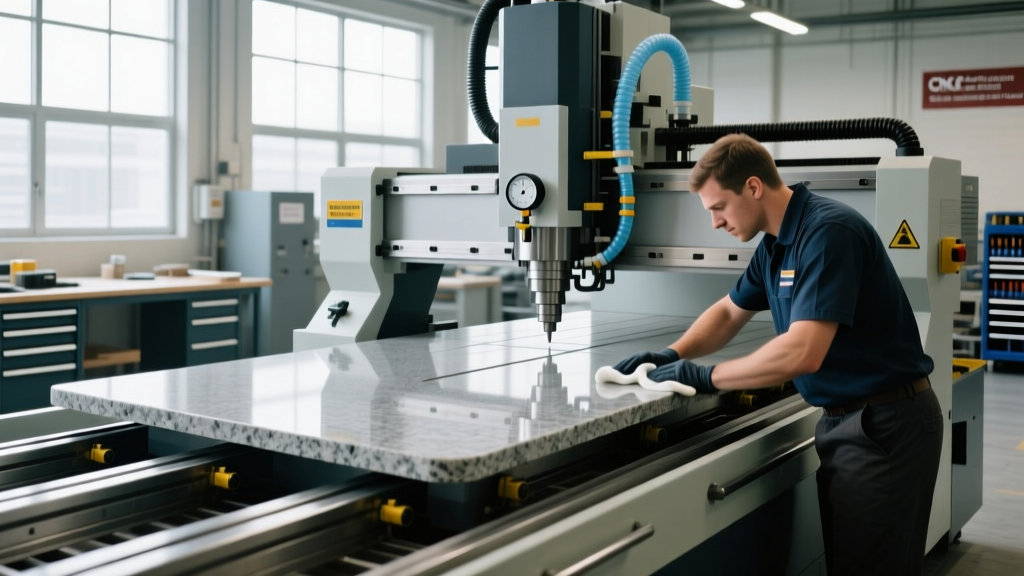
The immense weight of stone slabs (often exceeding 2,000 lbs) places continuous stress on the machine bed and gantry. Annually, use a precision machinist level and a granite straightedge to verify the bed flatness and gantry squareness. Shim the machine feet as necessary to correct any settling in the shop floor concrete.
Coolant & Water Filtration System Overhaul
The filtration system is the lifeblood of a CNC granite machine. Standard paper band filters are entirely inadequate for stone slurry, which quickly blinds the media. Professional stone shops utilize hydrocyclone separators paired with filter presses or settling pits.
According to fabrication guidelines published by the Natural Stone Institute, improper slurry management is the leading cause of premature pump failure and surface finish degradation in stone CNC operations. Recirculating dirty water essentially pumps liquid sandpaper through your spindle cooling jacket and nozzle lines.
Filter Press Maintenance: Every 90 days, inspect the filter press cloths for blinding. Wash them with a mild acid solution to dissolve embedded calcium and silica deposits. Check the hydraulic ram pressure; it should maintain at least 100 bar during the squeeze cycle to ensure dry cake discharge.
Hydrocyclone Inspection: Annually, measure the internal diameter of the hydrocyclone apex (underflow) and vortex finder (overflow). The abrasive slurry erodes the polyurethane lining. If the apex diameter has increased by more than 15% from its original specification, replace the insert to maintain proper separation efficiency.
Troubleshooting Common Granite CNC Failures
When maintenance is deferred, specific failure modes emerge. Use this diagnostic framework to identify and resolve common issues.
- Symptom: Spindle overheating and tripping thermal alarms.
Cause: Blockage in the spindle chiller unit or scale buildup in the spindle cooling jacket due to poor water chemistry.
Fix: Flush the chiller circuit with a descaling agent. Verify chiller flow rate meets the spindle manufacturer's minimum requirement (usually 4-6 liters per minute). - Symptom: Visible chatter marks on the milled stone edge.
Cause: Worn linear guide blocks or excessive ball screw backlash allowing harmonic vibration under heavy cutting loads.
Fix: Perform a ballbar test. Preload linear guides if adjustable, or replace worn carriage blocks. Remap axis backlash parameters in the CNC controller. - Symptom: Z-axis dropping slightly when power is removed.
Cause: Worn brake pads on the Z-axis servo motor or failing brake rectifier.
Fix: Replace the motor brake assembly immediately. Operating with a slipping Z-brake risks crashing the spindle into the stone bed during power fluctuations.
Cost of Neglect vs. Preventative Maintenance
Shop owners often view rigorous PM schedules as lost production time. However, the financial reality of reactive repairs on a CNC granite machine heavily favors preventative care. Below is a comparative cost analysis based on 2026 industrial service rates.
| Component Failure (Reactive) | Estimated Repair Cost | Downtime | Preventative Alternative |
|---|---|---|---|
| Spindle Rebuild (Water Intrusion) | $6,500 - $14,000 | 2 - 4 Weeks | Daily air purge checks ($0) |
| X-Axis Ball Screw Replacement | $3,200 - $5,500 | 3 - 5 Days | Way cover & wiper maintenance ($150/yr) |
| Coolant Pump Cavitation Failure | $1,800 - $2,500 | 1 - 2 Days | Filter press & hydrocyclone servicing ($400/yr) |
Implementing a strict, documented maintenance schedule for your CNC granite machine is not merely an operational best practice; it is a critical financial safeguard. By respecting the abrasive nature of stone and adhering to daily, weekly, and annual service intervals, fabrication shops can easily extend the precision lifespan of their equipment from five years to over fifteen years, ensuring consistent edge profiles and maximizing return on investment.