Best CNC Machine for Stone Fabrication: 2026 Buyer Guide
Compare top 5-axis and 3-axis CNC machines for stone fabrication. Explore 2026 pricing, spindle specs, water management, and top brands like Breton and CMS.
Machine Configurations: Matching the CNC to Your Shop Output
Selecting the right CNC machine for stone fabrication requires aligning hardware capabilities with your shop's specific material mix and production volume. In 2026, the market is heavily segmented between dedicated 3-axis edge profilers, fully integrated 5-axis machining centers, and hybrid CNC saw/router combinations. Understanding the mechanical limitations of each configuration prevents costly bottlenecks when processing high-quartzite or large-format porcelain slabs.
| Machine Type | Primary Application | 2026 Price Range (USD) | Operational Limitations |
|---|---|---|---|
| 3-Axis Stone Router | Edge profiling, bowl cutouts, basic engraving | $45,000 - $85,000 | Cannot perform miter cuts or complex 3D monument carving; requires pre-cutting. |
| 5-Axis CNC Center | Mitered edges, 3D architectural elements, full slab nesting | $130,000 - $220,000 | Higher floor space requirement; requires advanced CAD/CAM programming skills. |
| CNC Saw/Router Hybrid | High-volume countertop shops; combines straight cutting and edge routing | $180,000 - $320,000+ | Spindle RPM is often lower than dedicated routers, limiting fine-detail porcelain edging. |
Non-Negotiable Hardware Specifications
Stone is an unforgiving material that exposes weak machine dynamics immediately. When evaluating a CNC machine for stone, look past the marketing brochures and inspect these core mechanical specifications.
Spindle Power, Torque, and Cooling
For processing hard natural stones (like Blue Bahia quartzite or absolute black granite) and engineered quartz, a minimum 15 HP (11 kW) spindle is mandatory. However, for high-volume shops running 3cm porcelain and Dekton, a 24 HP (18 kW) liquid-cooled spindle is the 2026 industry standard. Air-cooled spindles fail prematurely in stone environments due to abrasive dust ingress. Ensure the spindle features a labyrinth seal and requires a dedicated chiller unit maintaining a constant 68°F (20°C) to prevent thermal expansion during 4-hour continuous milling cycles.
Bed Dimensions and Z-Axis Clearance
Standard jumbo slabs measure up to 126 inches by 63 inches. If your CNC bed is only 10 feet long, operators must pre-cut slabs on a bridge saw before loading them onto the router, doubling material handling time. Demand a bed size of at least 13 feet by 6.5 feet. Furthermore, Z-axis clearance dictates your edge profile capabilities. A minimum 12-inch Z-axis travel is required to accommodate large ogee or dupont profile diamond tooling without the spindle nose colliding with the stone surface.
⚠️ Drive System Warning: Avoid machines utilizing standard ball screws on the X and Y axes for stone applications. The abrasive slurry inevitably penetrates ball screw housings, causing catastrophic failure within 18 months. Insist on helical rack and pinion drives with automated way-cover bellows and continuous grease lubrication systems.Handling Porcelain and Ultra-Compact Sintered Stone
The explosive growth of sintered stone and large-format porcelain has fundamentally changed CNC requirements. Unlike granite, which can be aggressively milled, porcelain features a brittle, high-tension glaze that micro-chips if tooling geometry and feed rates are incorrect. To machine porcelain successfully, your CNC must be capable of sustaining 15,000 to 18,000 RPM while maintaining strict vibration dampening. Machines with lightweight, welded steel gantries will chatter at these speeds, ruining the finished edge. Look for gantries constructed from cast iron or heavy-walled tubular steel filled with epoxy granite for maximum harmonic dampening.
2026 Brand Landscape and Pricing Brackets
The stone CNC market is dominated by specialized European and North American manufacturers who engineer specifically for the harsh, wet environment of a fabrication shop.
- Park Industries (USA): The TITAN and COMMANDER series remain staples in North American shops. Known for exceptional local support and rigid 5-axis capabilities. Expect to invest between $160,000 and $240,000 for a fully loaded 5-axis TITAN.
- Breton (Italy): The SMARTCUT and SHAPEMILL lines offer unparalleled precision for complex architectural stonework and monument carving. Breton's proprietary software integration justifies their premium pricing, typically starting at $200,000 for mid-sized 5-axis models.
- CMS Stone (Italy/USA): The Brembana series offers an excellent balance of speed and footprint. Their enclosed cabin designs are among the best for containing silica-laden mist. Pricing generally ranges from $130,000 to $190,000.
- Donatoni (Italy): Highly regarded for their 5-axis bridge saw and router hybrids. Ideal for shops wanting to eliminate the standalone bridge saw footprint. Pricing for the K Series often exceeds $250,000.
Facility Preparation: Water, Power, and Silica Compliance
Installing a stone CNC is not a plug-and-play endeavor. Facility preparation often accounts for 15% to 20% of the total project cost.
Closed-Loop Water Filtration
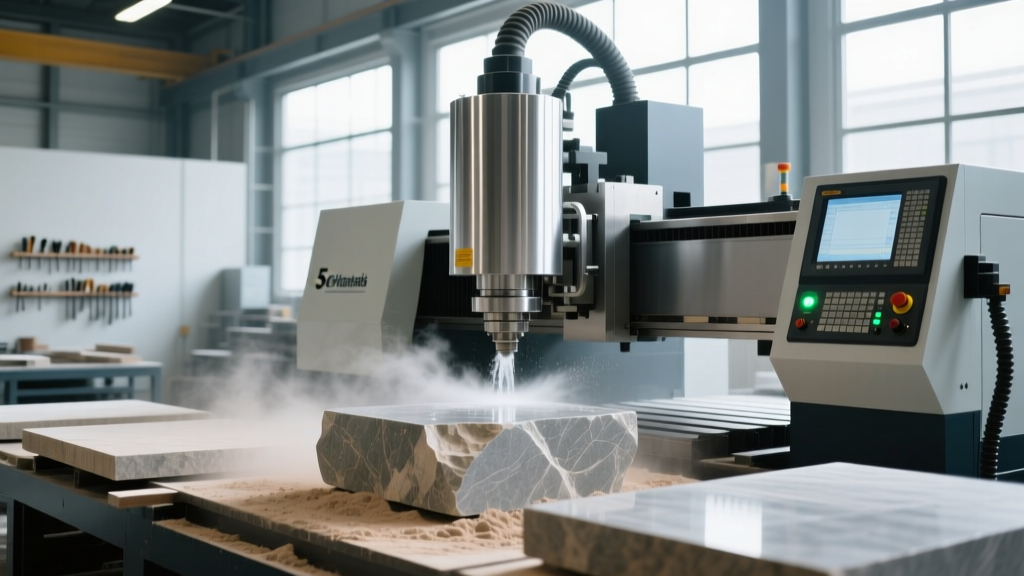
Stone CNCs consume 15 to 30 gallons of water per minute for tool cooling and dust suppression. Discharging this into municipal drains is illegal in most jurisdictions and environmentally disastrous. You must install a closed-loop water recycling system equipped with a 5-micron filtration bag and an automatic flocculant dosing pump. Without flocculants, microscopic stone particles remain suspended in the water, which will destroy the CNC's internal coolant pump seals within weeks.
Silica Dust and Air Quality
Even with water suppression, dry cutting operations (like engraving or certain polishing steps) generate respirable crystalline silica (RCS). Compliance with OSHA's respirable crystalline silica standard requires strict engineering controls. Shops must integrate localized exhaust ventilation (LEV) systems directly into the CNC enclosure. Refer to the NIOSH guidelines on silica exposure to ensure your shop's air monitoring and PPE protocols meet current federal limits. The Natural Stone Institute also provides critical, industry-specific safety bulletins for fabricators managing RCS hazards in enclosed CNC environments.
💡 Power Requirement Tip: Most industrial 5-axis stone CNCs require 480V, 3-phase power drawing up to 60 amps. Verify your facility's electrical panel capacity before signing a purchase order. Upgrading a commercial transformer can add $15,000 to your prep budget.CAD/CAM Software and Diamond Tooling Ecosystem
The hardware is only half the equation. A CNC machine for stone requires specialized CAM software that understands tool compensation for diamond profile wheels, which wear down over time. AlphaCAM Stone and Vectric Aspire (with stone modules) are the dominant platforms in 2026. These programs automatically adjust toolpaths based on the measured wear of the brazed diamond bits.
Budget an additional $8,000 to $12,000 for your initial tooling inventory. This should include:
- 1/2-inch shank sintered diamond router bits for roughing granite and quartz.
- Brazed diamond profile wheels (1/2-inch and 3/8-inch shanks) for standard eased, bullnose, and ogee edges.
- Continuous rim electroplated diamond blades specifically designed for zero-chip porcelain cutting.
- Diamond polishing pads mounted on CNC-specific pneumatic or spring-loaded holders for automated edge honing.
Ultimately, the decision hinges on your shop's trajectory. If you are strictly processing 2cm quartz countertops with standard eased edges, a high-quality 3-axis router provides a rapid ROI. However, if your 2026 business model targets high-end custom architecture, mitered waterfall islands, and large-format porcelain, a rigid 5-axis CNC machining center is an absolute operational necessity.