Safety Standards for 5 Axis CNC Machining Service Maintenance
Master OSHA and ISO safety compliance for 5-axis CNC maintenance. Learn LOTO protocols for trunnion tables and audit outsourced machining services.
The Regulatory Framework for 5-Axis Kinematics
Maintaining 5-axis CNC equipment introduces complex safety variables that standard 3-axis vertical machining centers do not possess. The simultaneous movement of rotary and linear axes creates compound momentum vectors, requiring maintenance teams to adhere to stringent safety protocols. Whether you manage an in-house facility or audit an outsourced 5 axis cnc machining service, compliance with ISO 16090-1:2017 (Machine tool safety for machining centres) and OSHA 29 CFR 1910.147 (Control of Hazardous Energy) is non-negotiable.
Modern 5-axis platforms, such as the Haas UMC-750SS or DMG MORI DMU 50 3rd Gen, utilize high-torque direct-drive motors and pneumatically released, spring-applied brakes on their trunnion tables. A failure to properly isolate these systems during spindle repair, way cover replacement, or ball screw lubrication can result in catastrophic gravity drops or uncontrolled rotary axis release.
⚠️ CRITICAL WARNING: Trunnion Gravity Drop Hazard
Never rely solely on hydraulic or pneumatic holding pressure to support a loaded 5-axis trunnion table during maintenance. If facility air pressure drops below the required 6-bar threshold, the spring-applied brakes on the A-axis may disengage or slip under heavy payloads. Always insert a mechanically rated physical block (e.g., a machined 6061-T6 aluminum or Delrin prop rated for minimum 2,000 lbs) beneath the table platen before placing hands near the kinematic chain.
Evaluating an Outsourced 5 Axis CNC Machining Service
When aerospace, medical, or defense contractors outsource complex geometries, they often evaluate a 5 axis cnc machining service based on cycle times and ISO 9001 certifications. However, safety and maintenance compliance directly impact part quality and supply chain liability. A shop with poor Lockout/Tagout (LOTO) practices or deferred maintenance on collision-avoidance systems is a high-risk partner.
During a supplier audit, request the following specific maintenance documentation:
- Rotary Axis Brake Test Logs: Verification that the A and C axis holding torque (often exceeding 400 Nm on the C-axis) is tested bi-annually using a calibrated torque multiplier.
- Probe Calibration Records: Documentation showing weekly calibration of tool-setting and part-probing systems (e.g., Renishaw OMP60 or Blum Novotest) which act as the primary software-based collision avoidance layer.
- Way Lube Flow Sensor Audits: Proof that positive-pressure flow sensors on the linear guideways are functional and wired to the machine's E-stop circuit, preventing dry-run catastrophic wear.
Maintenance Compliance Matrix for 5-Axis Systems
The following matrix outlines specific maintenance tasks, their associated hazards, and the governing compliance standards for 5-axis equipment.
| Maintenance Task | Primary Hazard | Governing Standard | Required Mitigation |
|---|---|---|---|
| Spindle Tear-Down | Stored kinetic energy in drawbar | OSHA 1910.147 | Use manufacturer-specific drawbar compression tooling |
| Trunnion Table Removal | Gravity drop / Crushing | ISO 16090-1 | Mechanical blocking + dual-chain LOTO |
| Coolant Nozzle Adjustment | High-pressure fluid injection | ANSI B11.23 | Bleed 1,000 PSI through-spindle lines before access |
| Control Cabinet Wiring | Arc flash / Electrocution | NFPA 79 / 70E | Verify zero voltage with CAT III rated multimeter |
| Way Cover Replacement | Pinch points in telescopic covers | OSHA 1910.212 | Lock Y and Z axes via servo-motor holding brakes |
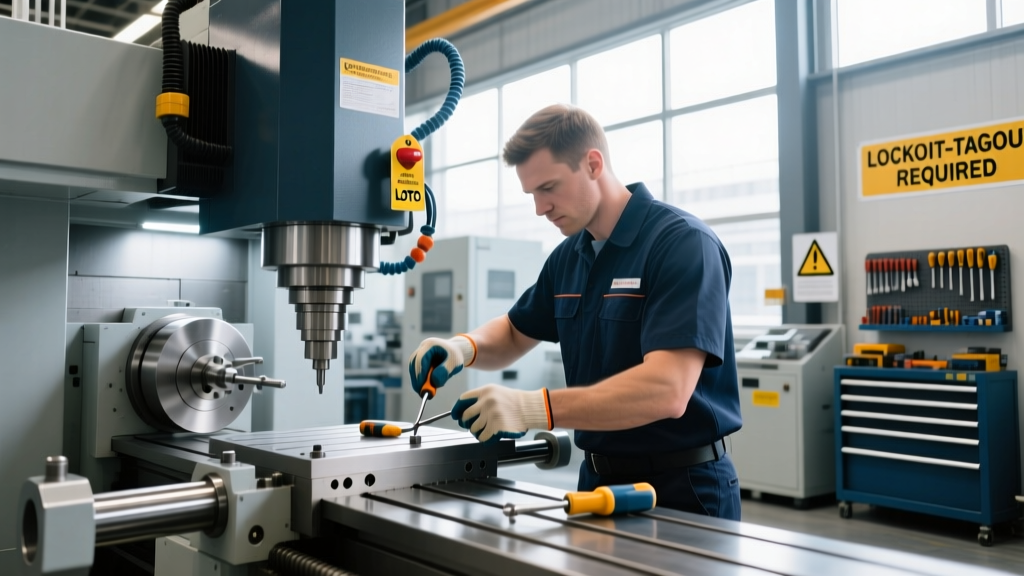
Step-by-Step LOTO Protocol for 5-Axis Trunnion Maintenance
Standard LOTO procedures for 3-axis mills are insufficient for 5-axis machines due to the stored energy in rotary axes and the counterbalance systems. Follow this exact sequence when performing maintenance on the A or C axes:
- Notification & Preparation: Notify all affected operators. Identify all energy sources on the machine's specific energy control placard (usually located inside the main electrical cabinet door).
- Electrical Isolation: Rotate the main 480V 3-phase disconnect to the OFF position and apply your personal safety padlock. Note: Turning off the control pendant does NOT remove power from the servo drives.
- Pneumatic Bleed-Down: Close the main air supply valve and actuate the manual bleed valve on the machine's pneumatic manifold. Watch the pressure gauge drop to 0 bar. This is critical to ensure the A/C axis brakes do not unexpectedly release or engage violently.
- Mechanical Blocking: Jog the trunnion table to a predetermined maintenance safe-zone (usually A=0, C=0). Insert the OEM-specified mechanical support block beneath the table platen.
- Hydraulic Counterbalance Isolation: If the machine utilizes a hydraulic counterbalance cylinder for the Y-axis or tilting head, close the isolation ball valve and verify pressure decay.
- Zero Energy Verification: Turn the main electrical disconnect back ON temporarily (without removing your LOTO lock from the hasp, if using a specialized verification setup) or use the battery-backed handheld pendant to attempt to jog the rotary axes. Confirm the drives fault out and no movement occurs. Return disconnect to OFF.
Mist Collection and Respiratory Compliance
5-axis machines frequently utilize high-pressure through-spindle coolant (TSC) systems operating between 300 and 1,000 PSI to clear chips from deep cavity milling and complex undercuts. This atomizes metalworking fluids (MWFs) into sub-micron aerosols. According to NIOSH guidelines on metalworking fluids, prolonged exposure to MWF aerosols can cause occupational asthma and hypersensitivity pneumonitis.
While OSHA's current Permissible Exposure Limit (PEL) for MWF mist is 5 mg/m³ as an 8-hour Time-Weighted Average (TWA), NIOSH recommends a much stricter REL of 0.4 mg/m³. To maintain compliance and protect maintenance technicians who must enter the machining envelope to clean or repair fixtures:
- Install HEPA-grade mist collectors (e.g., Filtermist or Losma) capable of capturing particles down to 0.3 microns.
- Ensure the machine enclosure maintains a negative pressure of at least -0.05 inches of water gauge (in. w.g.) relative to the shop floor.
- Mandate the use of N95 or P100 half-mask respirators for technicians performing extended internal cleanouts or way cover repairs where accumulated aerosol concentrations are highest.
"The transition to 5-axis machining often outpaces a facility's safety infrastructure. We frequently see shops invest $750,000 in a Mazak VARIAXIS but fail to upgrade their ambient air filtration or implement specific rotary-axis LOTO procedures. The kinetic energy stored in a direct-drive C-axis table is enough to cause fatal crushing injuries if the brake fails during a way cover adjustment."
— Industrial Safety Engineering Report, 2025 Manufacturing Compliance Review
Electrical Cabinet and NFPA 79 Standards
Modern 5-axis machines rely on complex regenerative spindle drives and dual-servo gantry systems. When maintaining the electrical cabinets of these machines, compliance with NFPA 79 (Electrical Standard for Industrial Machinery) is mandatory. Maintenance electricians must verify that all 24VDC control circuits are separated from 480VAC power lines by physical barriers or grounded metal dividers within the cabinet. Furthermore, any replacement of safety relays (such as Pilz PNOZ series) governing the door interlock switches must be validated using a multi-meter to ensure the redundant channels are functioning correctly before the machine is returned to production.
Frequently Asked Questions
How often should 5-axis rotary brakes be tested for safety compliance?
ISO 16090-1 recommends functional testing of holding brakes every 6 months, or immediately following any crash event exceeding 1G of deceleration, as the shock can degrade the friction material inside the brake assembly.
Can a standard 3-axis LOTO padlock station be used for 5-axis machines?
No. 5-axis machines require a comprehensive energy control placard that includes pneumatic bleed valves and hydraulic counterbalance isolation points, which are absent on standard 3-axis VMCs.