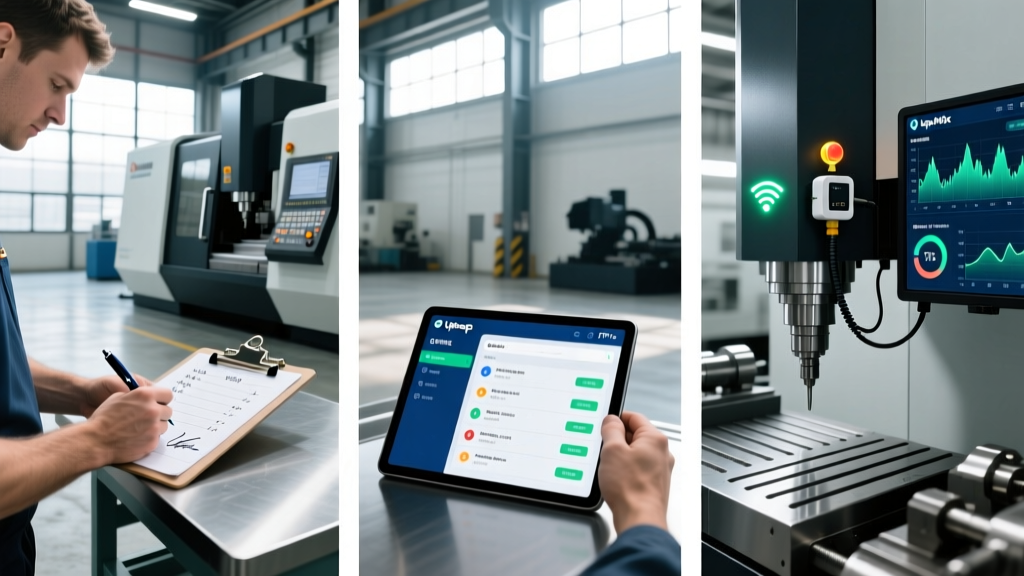
CNC Machine Daily Maintenance Checklist: Paper vs. CMMS vs. IoT
Compare CNC machine daily maintenance checklist methods: paper logs, CMMS platforms, and IoT automation. Find the best approach for your shop floor.
The True Cost of Skipping the CNC Machine Daily Maintenance Checklist
Unplanned downtime in a CNC machining environment costs an average of $1,500 to $2,500 per hour in lost production, scrapped parts, and delayed shipments. The most effective defense against catastrophic spindle failures, way cover degradation, and hydraulic leaks is a rigorously executed CNC machine daily maintenance checklist. However, the manufacturing industry is currently undergoing a massive shift in how these checklists are executed. Shop floor managers are actively replacing legacy paper logs with Computerized Maintenance Management Systems (CMMS) and direct IoT telemetry.
This analysis compares the three primary alternatives for executing daily CNC maintenance routines, evaluating compliance rates, hidden costs, and data visibility to help you select the optimal framework for your facility.
The Baseline: What Belongs on a Daily CNC Checklist?
Before evaluating execution software, the physical parameters of the checklist must be standardized. A robust daily protocol for a standard 3-axis Vertical Machining Center (VMC) requires verifying the following specific metrics:
- Way Lubrication: Verify reservoir levels of ISO 68 way oil (e.g., Mobil Vactra Oil No. 2). Check the cycle timer to ensure the lube pump is actuating every 15–30 minutes, not just running continuously or failing to trigger.
- Coolant Concentration & pH: Use a refractometer to check concentration (typically 8%–10% for synthetic coolants like TRIM E709) and test pH levels (ideal range: 8.8–9.2) to prevent bacterial growth and aluminum staining.
- Pneumatic Pressure: Confirm shop air supply at the machine regulator is stable between 90 and 110 PSI, and drain the inline moisture trap.
- Spindle Warm-Up: Execute the OEM macro warm-up program (usually 10 minutes at 2,000 RPM, stepping up to 5,000 RPM) to thermally stabilize the spindle bearings before cutting.
Execution Alternatives: Paper vs. CMMS vs. IoT Telemetry
The core friction point in maintenance is not knowing what to check, but ensuring the checks are actually performed accurately. Below is a comparison matrix of the three dominant execution alternatives.
| Feature | Paper / Whiteboard Logs | Mobile CMMS (UpKeep, MaintainX) | IoT / Native Telemetry (MTConnect) |
|---|---|---|---|
| Implementation Cost | $0 (Paper/Printers) | $12 – $20 / user / month | $800 – $1,500 / machine / year |
| Compliance Reliability | Low (High 'pencil-whipping' risk) | High (Requires photo/QR verification) | Absolute (Automated PLC polling) |
| Data Visibility | Siloed, physical archives | Cloud dashboard, trend analysis | Real-time alerts, MTConnect dashboards |
| Setup Time | 1–2 Hours | 1–2 Weeks (Digitizing SOPs) | 2–4 Weeks (Network & API integration) |
Alternative 1: Paper Logs and Whiteboards (The Legacy Approach)
Despite the proliferation of digital tools, an estimated 40% of small-to-mid-sized job shops still rely on laminated paper checklists hanging from the machine enclosure. Operators use dry-erase markers or clipboards to initial daily tasks.
The 'Pencil-Whipping' Vulnerability
The fatal flaw of paper checklists is 'pencil-whipping'—the practice of operators signing off on maintenance tasks without actually performing them, often to maximize spindle-on time and hit production quotas. A study by the Society of Manufacturing Engineers (SME) highlights that manual data entry in maintenance leads to a 15-20% error or omission rate. When a way lube reservoir runs dry because an operator initialed the box without looking at the sight glass, the resulting $12,000 ball-screw replacement dwarfs any time saved.
Alternative 2: Mobile CMMS Platforms (MaintainX, UpKeep, Fiix)
CMMS platforms digitize the CNC machine daily maintenance checklist, transforming it into an interactive mobile workflow. Operators use smartphones or shop-floor tablets to complete tasks.
CMMS Feature Spotlight: Forced Verification
Modern CMMS tools like UpKeep and MaintainX allow administrators to require specific proof of completion. For example, the checklist item 'Verify Coolant Concentration' can be configured to require the operator to input the exact refractometer Brix reading and snap a photo of the tool. If the reading falls outside the 8-10% parameter, the software automatically generates a corrective work order for the maintenance team to add Trimming fluid or water.
Cost Analysis: Equipping a 20-machine shop with a CMMS typically costs between $240 and $400 per month for operator and manager licenses. The ROI is usually realized within 90 days by eliminating a single prevented hydraulic pump failure caused by clogged suction filters that a paper checklist missed.
Alternative 3: IoT Telemetry and MTConnect Integration
The ultimate alternative to a manual checklist is removing the human element entirely where possible. By leveraging the MTConnect open-source standard, shops can pull data directly from the CNC machine's PLC (Programmable Logic Controller) to automate daily verification.
Automating the Checklist via PLC Registers
Instead of asking an operator to check if the spindle warm-up was performed, an IoT gateway reads the spindle load and RPM registers. If the machine transitions from 'Idle' to 'Cutting' without a preceding 10-minute warm-up cycle at the prescribed RPMs, the system flags a protocol violation. Similarly, native OEM solutions like Haas Connect or Mazak's iSMART Box monitor way lube pressure switches and coolant temperature sensors in real-time, pushing push-notifications to the floor manager's phone if parameters drift out of spec.
Limitation: IoT cannot check everything. Physical inspections—such as wiping down way covers to remove stringy chips, checking for hydraulic hose weeping, or visually inspecting tool magazine grippers for wear—still require human eyes and must be supplemented by a digital CMMS checklist.
Machine-Specific Nuances: 3-Axis VMC vs. 5-Axis Mill-Turn
When designing your checklist alternative, the complexity of the machine dictates the depth of the protocol. A standardized checklist fails when applied across a mixed fleet.
| Checklist Element | 3-Axis VMC (e.g., Haas VF-2) | 5-Axis Mill-Turn (e.g., Mazak Integrex i-200S) |
|---|---|---|
| Tool Magazine | Check for empty pockets, verify air blast. | Inspect chain-type magazine tension, clean gripper arms, verify tool ID chip readers. |
| Hydraulics | Check main clamp/unclamp pressure. | Check chuck clamping pressure, tailstock hydraulic thrust, and steady-rest lubrication lines. |
| Chip Management | Clear standard auger conveyor. | Clear complex hinge-belt conveyors, check coolant nozzle articulation joints for chip packing. |
Decision Framework: Selecting the Right Alternative
Choosing between paper, CMMS, and IoT depends on your shop's scale, machine age, and quality control requirements (e.g., AS9100 or ISO 13485 certifications).
If your shop has under 5 machines and low mix/high volume: Stick to laminated paper checklists, but implement a mandatory end-of-shift supervisor sign-off to combat pencil-whipping.
If your shop has 10–50 machines and requires audit trails for aerospace/medical compliance: Deploy a Mobile CMMS. The ability to attach photos, timestamp entries, and track historical coolant concentrations is mandatory for passing AS9100 audits.
If your shop runs 24/7 lights-out or high-value 5-axis milling: Invest in MTConnect/IoT telemetry. The cost of a crashed $80,000 5-axis spindle due to a missed thermal stabilization cycle justifies the $1,200 annual IoT licensing fee per machine.
Optimizing your CNC machine daily maintenance checklist is not just about preventing breakdowns; it is about establishing a verifiable, data-driven baseline for machine health. Transitioning from reactive paper logs to proactive CMMS or IoT alternatives transforms maintenance from a daily chore into a strategic advantage that protects margins and ensures on-time delivery.