Evaluating the Cost of a CNC Machine for Safe Portable Field Work
Analyze the true cost of a CNC machine for portable field work, including hidden safety compliance expenses, OSHA standards, and risk mitigation.
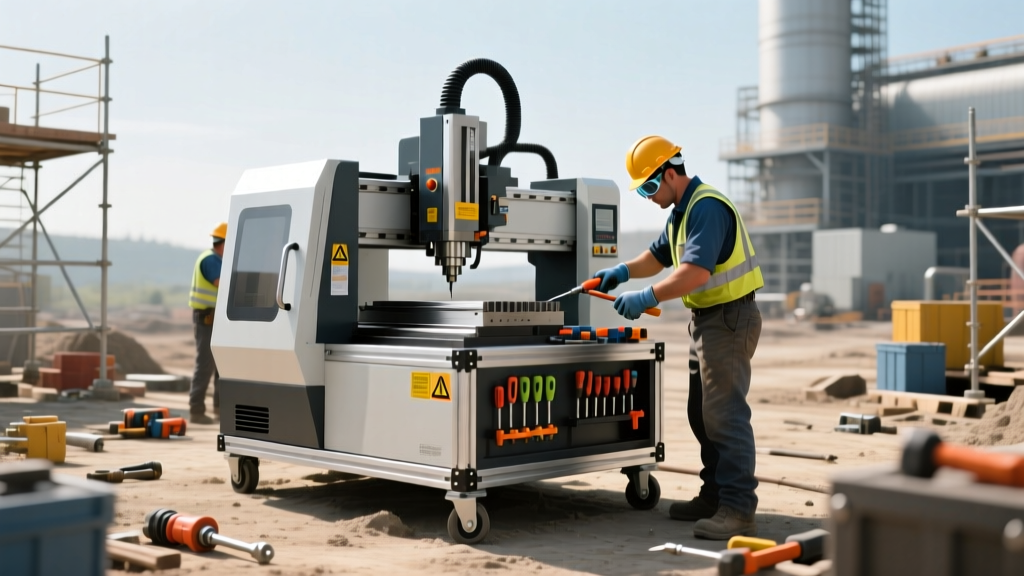
Field machining eliminates the massive downtime and logistical nightmare of disassembling, transporting, and reassembling heavy industrial components. However, when procurement teams calculate the initial cost of a CNC machine designed for portability, they typically look only at the base price of the spindle, control unit, and travel axes. This approach severely underestimates the total capital required. In 2026, operating portable CNC equipment in uncontrolled environments—such as wind turbine nacelles, shipyard valve vaults, or active mining sites—demands rigorous adherence to safety standards that drastically inflate the true operational cost.
⚠️ Compliance Warning: Operating an unguarded portable milling or boring machine in a general industry setting violates OSHA 1910.212 (General Requirements for All Machines). Fines for willful violations regarding rotating part exposure in field settings now routinely exceed $160,000 per instance, instantly eclipsing the hardware investment.Breaking Down the True Cost of a CNC Machine for Field Applications
The sticker price of portable CNC hardware is merely the entry fee. To achieve compliance with ANSI B11.8 (the standard governing drilling, milling, and boring machines) in a non-factory environment, you must invest in specialized rigging, localized containment, and emergency tethering systems. Below is a realistic 2026 cost breakdown for three common tiers of portable field CNC equipment.
| Equipment Tier & Model | Base Hardware Cost | Safety & Compliance Add-ons | Total Field-Ready Cost |
|---|---|---|---|
| Light-Duty Routing (e.g., Shaper Origin) |
$3,500 | $1,200 (HEPA dust extraction, custom polycarbonate shields) | $4,700 |
| Mid-Range Portable Milling (e.g., Mirage PBM-600 CNC) |
$38,000 - $45,000 | $8,500 (MQL system, magnetic base shear-keys, localized misting tent) | $46,500 - $53,500 |
| Heavy Industrial Boring/Facing (e.g., Climax BB5000) |
$55,000 - $72,000 | $14,000 (Hydraulic power pack guarding, remote E-stop tethers, swarf containment) | $69,000 - $86,000 |
Navigating Machine Guarding in Uncontrolled Environments
Factory CNC machines rely on heavy, interlocked polycarbonate enclosures to contain swarf and prevent operator contact with the spindle. Portable CNC machines, by definition, cannot use fixed enclosures because the machine is bolted directly to the workpiece. According to the OSHA Machine Guarding eTool, when primary guarding is impossible, secondary guarding and strict administrative controls must be implemented.
1. Flexible Containment and Swarf Management
For portable CNC mills like the Mirage PBM series, operators must deploy heavy-duty, flame-retardant vinyl welding tents modified with magnetic C-channel seals to wrap the machining zone. This prevents high-velocity titanium or steel chips from becoming ballistic hazards. Budget approximately $1,800 to $2,500 for custom-fitted, reusable magnetic containment tarps per machine setup.
2. Remote Emergency Stop (E-Stop) Tethering
When a portable CNC is mounted on a heat exchanger or inside a pressure vessel, the operator cannot stand adjacent to the control pendant due to spatial constraints and line-of-sight blockages. Safety compliance dictates the use of wireless or hardwired remote E-stop tethers. Industrial-grade wireless safety relays (such as those from Banner Engineering or Pilz) add $2,200 to the system cost but are mandatory for confined-space field work.
Fixturing Compliance: Magnetic vs. Mechanical Rigging Safety
The most catastrophic failure mode in portable CNC field work is fixturing detachment. If a 400 lb portable boring bar detaches from a vertical flange, it becomes a lethal dropped object. ANSI standards require a minimum 3:1 safety factor for static holding forces in overhead or vertical machining applications.
- Magnetic Bases: Electro-permanent magnetic bases are preferred over standard electromagnets because they do not drop the load if power is severed. However, magnetic holding force degrades exponentially on curved surfaces, painted steel, or surfaces with mill scale. Compliance Rule: Never rely solely on magnetic bases for vertical heavy-milling. They must be backed up by mechanical chain clamps or welded shear lugs.
- Mechanical Bolt-On: Requires welding mounting pads or using existing bolt patterns. While mechanically superior, the act of welding mounting pads in classified hazardous areas (e.g., oil and gas refineries) requires hot-work permits and fire-watch personnel, adding $1,500+ per day in indirect compliance costs.
Coolant Containment and Respiratory Compliance
Field machining often occurs in poorly ventilated areas. Traditional flood coolant used in portable CNC operations atomizes upon impact with the cutting tool, creating metalworking fluid (MWF) mist. The National Institute for Occupational Safety and Health (NIOSH) warns that prolonged inhalation of MWF mist causes severe respiratory illnesses, including occupational asthma and hypersensitivity pneumonitis.
To comply with NIOSH Recommended Exposure Limits (RELs) in confined field spaces, procurement must shift from flood coolant to Minimum Quantity Lubrication (MQL) systems paired with localized HEPA extraction.
MQL Integration Costs
Retrofitting a portable CNC with an MQL system (like those from Unist or Vogel) reduces coolant consumption from gallons per hour to mere milliliters, virtually eliminating airborne misting. Expect to pay $1,800 for the MQL delivery unit and an additional $3,500 for a portable, explosion-proof HEPA fume extractor (e.g., Tiger-Vac or Ruwac models) to capture the minimal aerosolized particulate. This $5,300 compliance package is non-negotiable for indoor or confined-space field work.
Compliance Cost Matrix: Field Scenario Decision Tree
Use this matrix to estimate the hidden safety overhead based on your specific field application.
| Field Scenario | Primary Safety Hazard | Required Compliance Gear | Est. Added Cost |
|---|---|---|---|
| Wind Turbine Flange Facing (Aloft) | Dropped objects; high-wind spindle drift | Secondary wire-rope tethers; wind-anemometer auto-stop interlocks | $3,200 |
| Submarine / Shipyard Valve Repair | Confined space MWF misting; electrical shock | MQL system; GFCI integrated power distribution; confined space blower | $6,800 |
| Mining Excavator Pin Boring | Heavy vibration loosening fixturing; coal dust ignition | Hydraulic torque tensioners; ATEX-rated control enclosure | $9,500+ |
The Bottom Line on Portable CNC Procurement
Evaluating the cost of a CNC machine for portable field work requires looking far beyond the manufacturer's base invoice. A $45,000 portable CNC mill easily transforms into a $60,000 fully compliant field-machining ecosystem once magnetic backups, MQL systems, wireless E-stops, and localized containment are integrated. Failing to budget for these safety standards not only exposes your workforce to severe mechanical and respiratory hazards but guarantees catastrophic financial penalties during an OSHA site inspection. Procurement teams must mandate that vendor quotes include a line-item breakdown for ANSI B11.8 and OSHA 1910.212 compliance accessories before signing any purchase order.