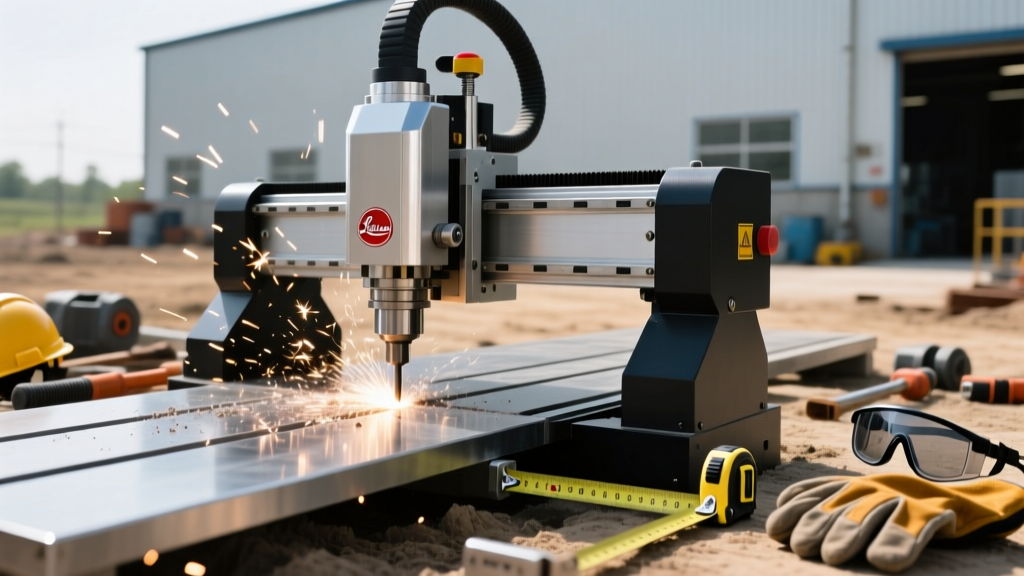
How a Portable CNC Machine Works: Field Safety Standards
Explore how a portable CNC machine works in field environments. Learn ANSI/OSHA safety standards, magnetic anchoring risks, and compliance setups.
The Mechanics: How a Portable CNC Machine Works On-Site
Taking heavy machining capabilities directly to massive, immovable workpieces—such as offshore wind turbine flanges, pressure vessels, or structural steel beams—requires a fundamental inversion of traditional manufacturing logic. When safety officers and site engineers evaluate how a portable CNC machine works on an active job site, the primary concern shifts from standard operator pinching hazards to catastrophic equipment detachment and environmental exposure.
Unlike a fixed-bed Vertical Machining Center (VMC) where the workpiece is bolted to a massive cast-iron table, a portable CNC (such as the York Portable CNC Track Mill or Mirage Machining portable mills) utilizes the workpiece itself as the machine bed. The system relies on a modular, flexible track system bolted or magnetically clamped to the target surface. A motorized gantry travels along this track, carrying a high-speed spindle or cutting torch.
Reference Frame Inversion and Kinematic Hazards
In a portable setup, the X, Y, and Z axes are relative to the track, not the earth. If the track shifts by even 0.005 inches during a heavy facing operation on an A516 Gr 70 steel pressure vessel, the cutting tool can snap, sending high-velocity carbide shrapnel into the work area. Understanding this kinematic vulnerability is the foundation of field CNC safety compliance.
⚠️ CRITICAL WARNING: Electromagnetic Base Failure ModesMany portable CNCs utilize electromagnetic bases for rapid setup on ferrous metals. These magnets require a continuous DC power supply (typically 24V or 110V DC). If a field generator experiences a voltage sag or trips offline, the magnetic holding force drops to zero in milliseconds. A 45-lb gantry traveling at 15 IPM will immediately detach and fall, posing a severe crush and strike hazard to ground personnel.
Anchoring Systems: Magnetic vs. Mechanical Compliance
To comply with OSHA 1910.212 general machine guarding and anchoring requirements, portable CNCs must be secured against all anticipated cutting forces, vibration, and gravity. Site supervisors must choose anchoring methods based on the workpiece material and geometry.
| Anchoring Method | Holding Force | Best Application | Safety Compliance Requirement |
|---|---|---|---|
| Electromagnetic Base | 2,500 - 4,000 lbs | Flat or large-radius ferrous metals | Must have mechanical backup (chain clamps) or UPS battery backup for the DC controller. |
| Mechanical Chain Clamps | Variable (Torque dependent) | Pipes, irregular shapes, non-magnetic metals | Requires calibrated torque wrenches and regular tension checks during multi-hour cuts. |
| Tack-Welded Rail Stops | Material Yield Strength | Heavy milling on thick carbon steel | Requires certified welder; post-removal NDE (Non-Destructive Examination) to check for heat-affected zone cracking. |
| Vacuum Chucks | 1,500 - 2,500 lbs | Non-porous surfaces (glass, polished aluminum) | Requires continuous vacuum monitoring with an automatic tool-retract interlock if pressure drops below 80%. |
Regulatory Compliance: ANSI and OSHA in the Field
Field machining operates in a regulatory gray area because it bridges construction safety (OSHA 1926) and general industry manufacturing (OSHA 1910). The ANSI B11 Council provides the baseline for machine safety, but applying B11.8 (Drilling, Milling, and Boring) to a machine hanging 200 feet in the air on a wind tower requires specialized interpretation.
Guarding the Unguardable
OSHA mandates that the point of operation be guarded to prevent the operator from entering the hazard zone. In a shop, this means polycarbonate sliding doors with safety interlocks. In the field, enclosing a portable CNC is often impossible due to the size of the workpiece.
- Local Tool Shielding: Attach 0.5-inch thick Lexan polycarbonate shields directly to the portable gantry. These move with the spindle, containing the immediate chip and coolant spray zone.
- Perimeter Exclusion Zones: Establish a hard-barricade exclusion zone based on the calculated projectile trajectory of a broken carbide end mill. For a 1-inch end mill spinning at 3,000 RPM, the exclusion radius must be a minimum of 15 feet.
- Remote Pendants: Operators must use wireless pendants or ruggedized tablets tethered via a 20-foot breakaway cable, allowing them to stand outside the immediate swarf ejection path while maintaining visual contact.
Step-by-Step Field Rigging and Hazard Mitigation
Improper rigging is the leading cause of portable CNC failure and subsequent safety incidents. Follow this strict sequence to ensure compliance and operational stability:
- Surface Preparation and NDE: Grind the workpiece surface where the track will mount. Remove all paint, rust, and mill scale. If using electromagnetic bases, verify that surface irregularities do not exceed 0.010 inches; larger air gaps exponentially reduce magnetic holding force.
- Track Alignment and Shimming: Use precision machinist levels and laser trackers to align the modular track sections. Use stainless steel shims (never brass or plastic, which can crush under dynamic cutting loads) to bridge gaps between the track and uneven weldments.
- Redundant Anchoring: Apply the primary anchoring method (e.g., electromagnets). Then, install secondary mechanical tethers. Wrap a 3/8-inch grade 80 alloy steel chain around the workpiece and the machine base, secured with a load-rated ratchet binder.
- Swarf and Coolant Containment: In outdoor environments, wind turns metal chips into hazardous projectiles. Deploy magnetic chip-collection shrouds around the spindle and use minimum quantity lubrication (MQL) or high-viscosity cutting pastes instead of flood coolant to prevent environmental contamination and slip hazards on scaffolding.
- Dynamic Load Testing: Before engaging the workpiece, run the gantry at maximum rapid traverse (G00) rates across the entire track length while monitoring for any micro-shifts in the track alignment using a dial indicator mounted to the workpiece.
2026 Equipment Costs and Compliance Budgeting
Budgeting for portable CNC field work must include the cost of safety and compliance infrastructure, not just the bare machine. Based on current 2026 industrial pricing, a fully compliant field-machining setup requires significant capital allocation beyond the base unit.
Typical Field Compliance Budget Breakdown
- Base Portable CNC Mill (3-Axis, 4ft travel): $24,000 - $38,000
- Modular Track Sections (4x 4ft carbon fiber/aluminum): $6,500
- Redundant Mechanical Chain Clamp Kits: $1,200
- Custom Polycarbonate Gantry Shields & Magnetic Shrouds: $2,800
- Wireless Safety Pendant with E-Stop Relay: $1,500
- Uninterruptible Power Supply (UPS) for DC Magnets: $950
Total Estimated Safe Setup Cost: $36,950 - $50,950
Troubleshooting Field Compliance Issues
Even with rigorous planning, field conditions introduce variables that can compromise safety. Site managers must be prepared to address these common edge cases:
Vibration-Induced Fastener Loosening
Heavy interrupted cuts (such as milling splines or keyways) generate high-frequency harmonic vibrations. Standard hex bolts securing the track to the workpiece can back out within minutes. Solution: Mandate the use of Nord-Lock washers or safety-wired flange nuts on all track mounting hardware. Apply medium-strength threadlocker (Loctite 243) to all threaded fasteners before rigging.
Thermal Expansion of the Track
When machining outdoors, direct sunlight can heat an aluminum or steel track significantly more than the massive steel workpiece it is mounted to. This differential thermal expansion causes the track to bow, leading to binding and potential motor stall. Solution: Erect temporary UV-blocking shade tents over the machining zone. If ambient temperatures exceed 90°F (32°C), pause operations during peak solar hours or switch to Invar (iron-nickel alloy) track sections, which exhibit near-zero thermal expansion, albeit at a 40% cost premium.
'The greatest mistake in field machining is treating a portable CNC like a shop tool that happens to be outside. The environment is actively trying to move your machine, contaminate your ways, and defeat your safety guards. Compliance isn't just about guarding the spindle; it is about defending the entire kinematic chain against the elements.' — Lead Field Applications Engineer, Heavy Industry Machining Division
By rigorously applying ANSI B11 frameworks to non-traditional environments and mandating redundant mechanical safeguards, operators can leverage the immense cost-saving power of portable CNCs without compromising job-site safety.